



 Chat with AI
Exam 18: International Macroeconomics

Exam 1: First Principles183 Questions
Exam 2: Economic Models: Trade-Offs and Trade341 Questions
Exam 3: Supply and Demand230 Questions
Exam 4: Price Controls and Quotas: Meddling With Markets187 Questions
Exam 5: International Trade224 Questions
Exam 6: Macroeconomics: the Big Picture128 Questions
Exam 7: GDP and the CPI: Tracking the Macroeconomy213 Questions
Exam 8: Unemployment and Inflation300 Questions
Exam 9: Long-Run Economic Growth268 Questions
Exam 10: Savings, Investment Spending, and the Financial Syst355 Questions
Exam 11: Income and Expenditure114 Questions
Exam 12: Aggregate Demand and Aggregate Supply308 Questions
Exam 13: Fiscal Policy120 Questions
Exam 14: Money, Banking, and the Federal Reserve System135 Questions
Exam 15: Monetary Policy316 Questions
Exam 16: Inflation, Disinflation, and Deflation194 Questions
Exam 17: Macroeconomics: Events and Ideas283 Questions
Exam 18: International Macroeconomics411 Questions
Select questions type


Contractionary monetary policy in the United States will cause the dollar to:
(Multiple Choice)
4.9/5  (90)
(90) Scenario: Gizmovia II The Republic of Gizmovia wants to maintain the exchange rate of its currency, the gizmo, at $0.50, but the current exchange rate for the gizmo is $0.75. If Gizmovia uses monetary policy to bring the exchange rate for the gizmo to $0.50, it should _____ interest rates, which will _____ capital inflows of gizmos.
(Multiple Choice)
4.8/5 (86)
(86) Use the following to answer questions:  -(Figure: Change in the Demand for U.S. Dollars) Refer to Figure: Change in the Demand for U.S. Dollars. A movement from E1 to E2 in this foreign exchange market would cause Americans to purchase _____ goods and services from Europe.
 (Multiple Choice)
4.8/5 (82)
(82) A country has a financial account surplus if the balance on the:
(Multiple Choice)
4.9/5 (89)
(89) Consider the demand for and the supply of the U.S. dollar. The exchange rate is measured in terms of yen per dollar. If the demand for the U.S. dollar decreases, which statement would NOT be true?
(Multiple Choice)
4.9/5 (91)
(91) When the dollar appreciates relative to the Canadian dollar:
(Multiple Choice)
5.0/5 (65)
(65) A Peruvian financial investor purchases a sporting goods store in Colorado Springs. In the accounting for U.S. international transactions, this transaction would appear in the _____, and it would be entered as a payment _____ foreigners.
(Multiple Choice)
4.9/5 (74)
(74) Use the following to answer questions: 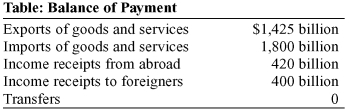 -(Table: Balance of Payments) Refer to Table: Balance of Payments. The country's balance of payments on current account is:
 (Multiple Choice)
4.9/5 (91)
(91) A system in which exchange rates are set by government policy is a(n) _____ system.
(Multiple Choice)
4.8/5 (86)
(86) Which argument was made against Britain's adopting the euro? I. Using the same currency as many other European countries would discourage trade and decrease productivity.
II) Using the euro would decrease the effectiveness of monetary policy.
(Multiple Choice)
4.7/5 (87)
(87) Scenario: Exchange Rates The value of a euro goes from US$1.25 to US$1.50. The dollar has:
(Multiple Choice)
4.8/5 (67)
(67) A floating exchange rate: I. leaves monetary policy available for domestic stabilization.
II) reduces the uncertainty of international trade.
(Multiple Choice)
4.9/5 (78)
(78) Economists usually use GDP rather than GNP because they are tracking:
(Multiple Choice)
4.8/5 (63)
(63) An increase in the value of a fixed rate currency is called an appreciation.
(True/False)
5.0/5 (69)
(69) All other things equal, an expansionary monetary policy will cause the domestic currency to appreciate.
(True/False)
4.8/5 (84)
(84) Which country did NOT adopt the euro? I. Britain
II) Switzerland
III) Sweden
(Multiple Choice)
4.7/5 (88)
(88) Some countries have exchange rate policies that lie somewhere between fixed and floating exchange rates, such as rates that are managed by the government to avoid wide swings.
(True/False)
5.0/5 (73)
(73) 
Filters
- Essay(0)
- Multiple Choice(0)
- Short Answer(0)
- True False(0)
- Matching(0)