



 Chat with AI
Exam 18: International Macroeconomics

Exam 1: First Principles183 Questions
Exam 2: Economic Models: Trade-Offs and Trade341 Questions
Exam 3: Supply and Demand230 Questions
Exam 4: Price Controls and Quotas: Meddling With Markets187 Questions
Exam 5: International Trade224 Questions
Exam 6: Macroeconomics: the Big Picture128 Questions
Exam 7: GDP and the CPI: Tracking the Macroeconomy213 Questions
Exam 8: Unemployment and Inflation300 Questions
Exam 9: Long-Run Economic Growth268 Questions
Exam 10: Savings, Investment Spending, and the Financial Syst355 Questions
Exam 11: Income and Expenditure114 Questions
Exam 12: Aggregate Demand and Aggregate Supply308 Questions
Exam 13: Fiscal Policy120 Questions
Exam 14: Money, Banking, and the Federal Reserve System135 Questions
Exam 15: Monetary Policy316 Questions
Exam 16: Inflation, Disinflation, and Deflation194 Questions
Exam 17: Macroeconomics: Events and Ideas283 Questions
Exam 18: International Macroeconomics411 Questions
Select questions type


If the exchange rate for the U.S. dollar changes from $1.25 per euro to $1.50 per euro, then the dollar depreciates.
(True/False)
4.9/5  (83)
(83) All other things equal, a contractionary monetary policy will cause the domestic currency to appreciate.
(True/False)
4.9/5 (96)
(96) If the U.S. dollar depreciates relative to currencies in other countries, then U.S. imports will _____ and exports will _____.
(Multiple Choice)
4.9/5 (80)
(80) When a Japanese investor buys stock in General Motors, the _____ account is affected.
(Multiple Choice)
4.9/5 (88)
(88) Suppose that the United States and European Union are the only trading partners in the world. If interest rates in the United States are significantly lower than those in the European Union, we would expect the:
(Multiple Choice)
4.9/5 (68)
(68) A revaluation will make exports less expensive and imports more expensive.
(True/False)
4.8/5 (66)
(66) If a country with floating exchange rates uses an expansionary monetary policy, the domestic interest rate _____, demand for the domestic currency _____, supply of the domestic currency _____, and the effect on the exchange rate is _____.
(Multiple Choice)
4.8/5 (78)
(78) A person from the U.S. deposits $10,000 in an account in a London bank. In the U.S. balance of payments, this transaction causes the balance on the _____ account to _____.
(Multiple Choice)
4.9/5 (71)
(71) If a government wants to increase the value of its currency in foreign exchange markets, it can:
(Multiple Choice)
4.9/5 (82)
(82) When there is a deficit in the U.S. balance of payments on the current account, we pay for the difference by:
(Multiple Choice)
4.9/5 (81)
(81) Use the following to answer questions: 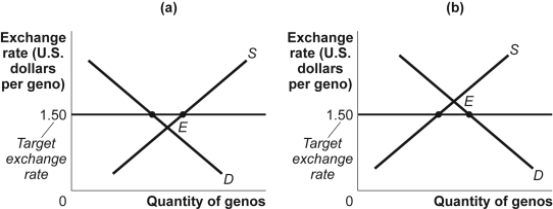 -(Figure: Exchange Market Intervention) Refer to panel (a) in Figure: Exchange Market Intervention. Which approach could the Genovian government use to raise the value of the geno above its present equilibrium exchange rate and into the target range?
 (Multiple Choice)
4.9/5 (76)
(76) A reduction in the value of a currency that is set under a fixed exchange rate regime is a(n):
(Multiple Choice)
4.9/5 (71)
(71) Suppose that the value of the euro fell from $1.32 on April 30, 2012, to $1.24 on July 5, 2012. This implies that during this period the euro _____ and the dollar _____.
(Multiple Choice)
4.8/5 (81)
(81) The real exchange rate between the U.S. dollar and the Indian rupee is the:
(Multiple Choice)
4.9/5 (65)
(65) Foreign exchange controls decrease the costs of red tape and corruption surrounding international trade.
(True/False)
4.8/5 (88)
(88) Under a floating exchange rate regime, raising the interest rate does NOT:
(Multiple Choice)
4.9/5 (68)
(68) 
Filters
- Essay(0)
- Multiple Choice(0)
- Short Answer(0)
- True False(0)
- Matching(0)