



 Chat with AI
Exam 18: International Macroeconomics

Exam 1: First Principles183 Questions
Exam 2: Economic Models: Trade-Offs and Trade341 Questions
Exam 3: Supply and Demand230 Questions
Exam 4: Price Controls and Quotas: Meddling With Markets187 Questions
Exam 5: International Trade224 Questions
Exam 6: Macroeconomics: the Big Picture128 Questions
Exam 7: GDP and the CPI: Tracking the Macroeconomy213 Questions
Exam 8: Unemployment and Inflation300 Questions
Exam 9: Long-Run Economic Growth268 Questions
Exam 10: Savings, Investment Spending, and the Financial Syst355 Questions
Exam 11: Income and Expenditure114 Questions
Exam 12: Aggregate Demand and Aggregate Supply308 Questions
Exam 13: Fiscal Policy120 Questions
Exam 14: Money, Banking, and the Federal Reserve System135 Questions
Exam 15: Monetary Policy316 Questions
Exam 16: Inflation, Disinflation, and Deflation194 Questions
Exam 17: Macroeconomics: Events and Ideas283 Questions
Exam 18: International Macroeconomics411 Questions
Select questions type


An exchange rate regime is a rule governing policy for the exchange rate.
(True/False)
4.7/5  (81)
(81) If the government wants to increase the value of its currency in foreign exchange markets, it can use expansionary monetary policy.
(True/False)
4.8/5 (84)
(84) In the 1970s most European countries were unhappy with floating exchange rates because they made each country's domestic monetary policy ineffective.
(True/False)
4.7/5 (87)
(87) A family from New York City eats in a restaurant in Mexico City. In the accounting for U.S. international transactions, this transaction would appear in the _____, and it would be entered as a payment _____ foreigners.
(Multiple Choice)
4.8/5 (84)
(84) Use the following to answer questions: 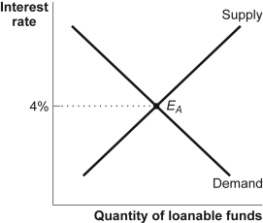 -(Figure: The Loanable Funds Model in the U.S. Market) Refer to Figure: The Loanable Funds Model in the U.S. Market. If the actual interest rate is equal to 4% in the U.S. market, then the quantity supplied of loanable funds will be _____ the quantity of loanable funds demanded.
 (Multiple Choice)
4.8/5 (77)
(77) Since they reduce uncertainty, fixed exchange rates are good for business.
(True/False)
4.8/5 (80)
(80) Countries with government budget surpluses are likely to have capital inflows, all other things equal.
(True/False)
4.8/5 (78)
(78) The benefits of fixed exchange rates served as one of the motivations for the international system of fixed rates established after World War II.
(True/False)
4.9/5 (81)
(81) After a revaluation, all other things equal, exports will likely _____ and imports will likely _____.
(Multiple Choice)
4.9/5 (67)
(67) The Chinese yuan is on a fixed rate. If the government of China uses monetary policy to change the exchange rate of the yuan from $0.16 to $0.10, the Chinese yuan has appreciated.
(True/False)
4.8/5 (80)
(80) Which statement is NOT true of a fixed exchange rate system?
(Multiple Choice)
4.8/5 (79)
(79) In countries with rapidly growing economies, like China and India, the demand for loanable funds is _____ and interest rates are _____ than in countries with slowly growing economies.
(Multiple Choice)
4.7/5 (75)
(75) After a revaluation, all other things equal, a country's balance of payments on the current account will likely:
(Multiple Choice)
4.9/5 (84)
(84) If the United States exports $100 billion of goods and services and imports $150 billion of goods and services and there is no other factor income or transfers, the balance on the current account is:
(Multiple Choice)
4.8/5 (74)
(74) Money flows into the United States from other countries as a direct result of:
(Multiple Choice)
4.7/5 (73)
(73) The pound sterling floats. If the exchange rate for the pound changes from $1.68 to $1.60, the pound has:
(Multiple Choice)
5.0/5 (89)
(89) The value of accounting services purchased by clients in China is included in the merchandise trade balance.
(True/False)
4.9/5 (78)
(78) 
Filters
- Essay(0)
- Multiple Choice(0)
- Short Answer(0)
- True False(0)
- Matching(0)