



 Chat with AI
Exam 18: International Macroeconomics

Exam 1: First Principles183 Questions
Exam 2: Economic Models: Trade-Offs and Trade341 Questions
Exam 3: Supply and Demand230 Questions
Exam 4: Price Controls and Quotas: Meddling With Markets187 Questions
Exam 5: International Trade224 Questions
Exam 6: Macroeconomics: the Big Picture128 Questions
Exam 7: GDP and the CPI: Tracking the Macroeconomy213 Questions
Exam 8: Unemployment and Inflation300 Questions
Exam 9: Long-Run Economic Growth268 Questions
Exam 10: Savings, Investment Spending, and the Financial Syst355 Questions
Exam 11: Income and Expenditure114 Questions
Exam 12: Aggregate Demand and Aggregate Supply308 Questions
Exam 13: Fiscal Policy120 Questions
Exam 14: Money, Banking, and the Federal Reserve System135 Questions
Exam 15: Monetary Policy316 Questions
Exam 16: Inflation, Disinflation, and Deflation194 Questions
Exam 17: Macroeconomics: Events and Ideas283 Questions
Exam 18: International Macroeconomics411 Questions
Select questions type


A floating exchange rate: I. leaves monetary policy available for domestic stabilization.
II) is less expensive to maintain than a fixed exchange rate.
III) adds uncertainty to international trade.
(Multiple Choice)
4.8/5  (87)
(87) A revaluation will make exports _____expensive and imports _____ expensive.
(Multiple Choice)
4.7/5 (76)
(76) U.S. retailers import toys from China. In the U.S. balance of payments account, this transaction is entered as a payment _____ foreigners in the _____ account.
(Multiple Choice)
4.9/5 (69)
(69) According to the principle of purchasing power parity, the 2001 devaluation of the Argentine peso:
(Multiple Choice)
4.7/5 (75)
(75) A revaluation can help reduce _____ of domestic currency. I. shortages
II) surpluses
(Multiple Choice)
4.8/5 (65)
(65) Use the following to answer questions: 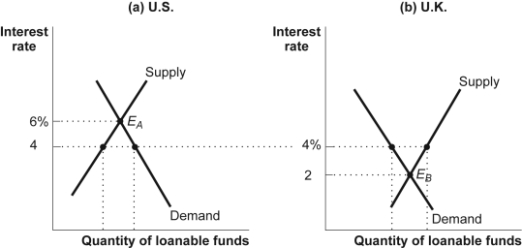 -(Figure: International Capital Flows) Refer to Figure: International Capital Flows. At an interest rate of 4%, the excess of loanable funds supplied by _____ lenders will be exported to _____ borrowers.
 (Multiple Choice)
4.8/5 (76)
(76) If the U.S. dollar appreciates relative to currencies in other countries, then U.S. imports will _____ and exports will _____.
(Multiple Choice)
4.8/5 (83)
(83) An increase in the value of a floating currency is called a revaluation.
(True/False)
4.8/5 (81)
(81) Suppose that a country has floated its currency and the central bank sets an expansionary monetary policy. Which outcome is likely to occur?
(Multiple Choice)
4.9/5 (86)
(86) A devaluation can help reduce a(n) _____ gap. I. inflationary
II) deflationary
(Multiple Choice)
4.8/5 (88)
(88) As a result of contractionary monetary policy, higher U.S. interest rates will result in a(n) _____ in the demand for dollars and a(n) _____ in the supply of dollars.
(Multiple Choice)
4.8/5 (80)
(80) Suppose that the U.S. dollar depreciates nominally against the Mexican peso by 5%. The price level in the United States increases by 7%, but Mexico's price level does not change. From this we can conclude that:
(Multiple Choice)
4.9/5 (82)
(82) Suppose that the United States and European Union are the only trading partners in the world. If the United States lowers import restrictions from the European Union, we would expect the:
(Multiple Choice)
4.8/5 (91)
(91) Toyota's factory in San Antonio is an example of direct foreign investment.
(True/False)
4.8/5 (100)
(100) If the Chinese government wants to keep the real and nominal exchange rates between the yuan and the U.S. dollar fixed at 8 yuan per dollar without government intervention in the foreign exchange market, the _____ rate in China must be _____ that in the United States.
(Multiple Choice)
4.7/5 (82)
(82) A fixed exchange rate means that the government keeps the exchange rate against some other currency at or near a particular target.
(True/False)
5.0/5 (93)
(93) If the exchange rate is $1 = 12.95 Mexican pesos, then the price of a $10,000 Harley Davidson motorcycle is _____ pesos in Mexico.
(Multiple Choice)
4.8/5 (83)
(83) 
Filters
- Essay(0)
- Multiple Choice(0)
- Short Answer(0)
- True False(0)
- Matching(0)