



 Chat with AI
Exam 18: International Macroeconomics

Exam 1: First Principles183 Questions
Exam 2: Economic Models: Trade-Offs and Trade341 Questions
Exam 3: Supply and Demand230 Questions
Exam 4: Price Controls and Quotas: Meddling With Markets187 Questions
Exam 5: International Trade224 Questions
Exam 6: Macroeconomics: the Big Picture128 Questions
Exam 7: GDP and the CPI: Tracking the Macroeconomy213 Questions
Exam 8: Unemployment and Inflation300 Questions
Exam 9: Long-Run Economic Growth268 Questions
Exam 10: Savings, Investment Spending, and the Financial Syst355 Questions
Exam 11: Income and Expenditure114 Questions
Exam 12: Aggregate Demand and Aggregate Supply308 Questions
Exam 13: Fiscal Policy120 Questions
Exam 14: Money, Banking, and the Federal Reserve System135 Questions
Exam 15: Monetary Policy316 Questions
Exam 16: Inflation, Disinflation, and Deflation194 Questions
Exam 17: Macroeconomics: Events and Ideas283 Questions
Exam 18: International Macroeconomics411 Questions
Select questions type


The nominal exchange rate is: I. the evaluation and ranking of different global stock exchanges.
II) the price of a country's money in terms of another country's money.
(Multiple Choice)
4.9/5  (82)
(82) If the euro depreciates, then a Chevrolet will be cheaper for Italians.
(True/False)
4.9/5 (89)
(89) Floating exchange rates help insulate countries from recessions in other countries.
(True/False)
4.7/5 (81)
(81) Foreign exchange reserves are stocks of foreign currencies that a government maintains to buy its currency in foreign exchange markets.
(True/False)
5.0/5 (81)
(81) If a government fixes the exchange rate _____ the market equilibrium, there will be a shortage of the domestic currency and a tendency for the exchange rate (U.S. dollars per unit of the other currency) to _____.
(Multiple Choice)
4.9/5 (78)
(78) If a country has a current account deficit, it must have a:
(Multiple Choice)
4.9/5 (82)
(82) The Exchange Rate Mechanism established a target zone for European exchange rates during the late 1980s and 1990s.
(True/False)
4.8/5 (87)
(87) Use the following to answer questions: 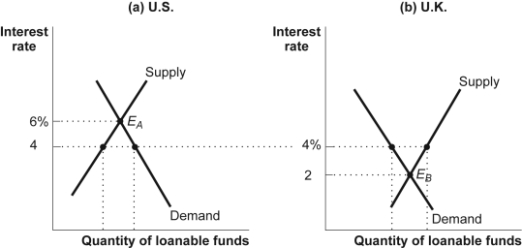 -(Figure: International Capital Flows) Refer to Figure: International Capital Flows. At an interest rate of 4%, the shortage of loanable funds available to _____ borrowers will be satisfied by _____ lenders.
 (Multiple Choice)
4.8/5 (79)
(79) Scenario: Japan and the United States Suppose that the interest rate in the United States is 4%, in Japan it is 7%, and financial assets in the two countries are equal in risk. The implication is that:
(Multiple Choice)
4.8/5 (72)
(72) Use the following to answer questions:
-(Figure: International Capital Flows) Refer to Figure: International Capital Flows. At an interest rate of 4%, the quantity of loanable funds demanded by U.S. borrowers is _____ the quantity of loanable funds supplied by U.S. lenders.
-(Figure: International Capital Flows) Refer to Figure: International Capital Flows. At an interest rate of 4%, the quantity of loanable funds demanded by U.S. borrowers is _____ the quantity of loanable funds supplied by U.S. lenders. (Multiple Choice)
4.7/5 (79)
(79) If a country fixes its exchange rate, it loses its ability to use monetary policy for macroeconomic stabilization.
(True/False)
4.9/5 (85)
(85) All other things equal, a contractionary monetary policy in Canada will decrease Canadian interest rates and increase the demand for and decrease the supply of the Canadian dollar.
(True/False)
4.8/5 (70)
(70) A devaluation of a currency tends to decrease the current account deficit.
(True/False)
5.0/5 (100)
(100) An argument against Britain's adopting the euro was that using the euro would make monetary policy less effective.
(True/False)
4.7/5 (92)
(92) If the price levels in two countries are equal, then the real exchange rate between their currencies equals the nominal exchange rate.
(True/False)
4.9/5 (74)
(74) Use the following to answer questions:
-(Figure: International Capital Flows) Refer to Figure: International Capital Flows. At an interest rate of 4%, the quantity of loanable funds supplied by British lenders is _____ the quantity of loanable funds demanded by British borrowers.
-(Figure: International Capital Flows) Refer to Figure: International Capital Flows. At an interest rate of 4%, the quantity of loanable funds supplied by British lenders is _____ the quantity of loanable funds demanded by British borrowers. (Multiple Choice)
5.0/5 (76)
(76) If the United States is in an inflationary gap, the appropriate policy is to _____ the money supply to _____ interest rates.
(Multiple Choice)
4.8/5 (82)
(82) If Japanese buyers demand more U.S. dollars, then the dollar will _____, the yen will _____, the U.S. balance of payments on current account will _____, and the U.S. balance of payments on financial account will _____.
(Multiple Choice)
4.9/5 (84)
(84) If a country's currency appreciates, all other things equal, its exports and imports will increase.
(True/False)
4.7/5 (72)
(72) When the dollar appreciates, exports will _____ and imports will _____ .
(Multiple Choice)
4.8/5 (82)
(82) 
Filters
- Essay(0)
- Multiple Choice(0)
- Short Answer(0)
- True False(0)
- Matching(0)