



 Chat with AI
Exam 18: International Macroeconomics

Exam 1: First Principles183 Questions
Exam 2: Economic Models: Trade-Offs and Trade341 Questions
Exam 3: Supply and Demand230 Questions
Exam 4: Price Controls and Quotas: Meddling With Markets187 Questions
Exam 5: International Trade224 Questions
Exam 6: Macroeconomics: the Big Picture128 Questions
Exam 7: GDP and the CPI: Tracking the Macroeconomy213 Questions
Exam 8: Unemployment and Inflation300 Questions
Exam 9: Long-Run Economic Growth268 Questions
Exam 10: Savings, Investment Spending, and the Financial Syst355 Questions
Exam 11: Income and Expenditure114 Questions
Exam 12: Aggregate Demand and Aggregate Supply308 Questions
Exam 13: Fiscal Policy120 Questions
Exam 14: Money, Banking, and the Federal Reserve System135 Questions
Exam 15: Monetary Policy316 Questions
Exam 16: Inflation, Disinflation, and Deflation194 Questions
Exam 17: Macroeconomics: Events and Ideas283 Questions
Exam 18: International Macroeconomics411 Questions
Select questions type


A country wants to maintain a fixed exchange rate with the dollar, but at the current exchange rate its currency is in excess. Which policy can the country NOT adopt to maintain its exchange rate?
(Multiple Choice)
4.7/5  (70)
(70) A floating rate system eliminates uncertainty about the future value of a currency.
(True/False)
4.8/5 (80)
(80) Since the adoption of the euro in 2001, monetary policy has become much more effective in individual European countries.
(True/False)
4.9/5 (92)
(92) If the exchange rate for the euro is $1.38, $1 exchanges for €0.7246.
(True/False)
4.8/5 (73)
(73) If a country adopts a fixed rate, it is committing not to engage in inflationary policies because inflationary policies would destabilize the exchange rate.
(True/False)
4.9/5 (81)
(81) When the value of the euro changes from $1.30 to $1.20, it follows that:
(Multiple Choice)
4.8/5 (94)
(94) From 2014 to 2015, many U.S. companies that sell a lot overseas experienced declining profits due to the:
(Multiple Choice)
4.9/5 (70)
(70) Assume the nominal exchange rate is £0.593 per dollar, the price level in the United States is 250, and the price level in Britain is 225. The real exchange rate is £0.659 per dollar.
(True/False)
4.8/5 (66)
(66) Use the following to answer questions:  -(Figure: Change in the Demand for U.S. Dollars) Refer to Figure: Change in the Demand for U.S. Dollars. The change from D1 to D2 will occur, all other things being equal, if the:
 (Multiple Choice)
4.7/5 (66)
(66) If a government fixes the exchange rate so as to generate a surplus of the domestic currency, the exchange rate (U.S. dollars per unit of the other currency) will tend to _____. To maintain the fixed exchange rate, the government must _____ the domestic currency.
(Multiple Choice)
4.8/5 (92)
(92) Use the following to answer questions: 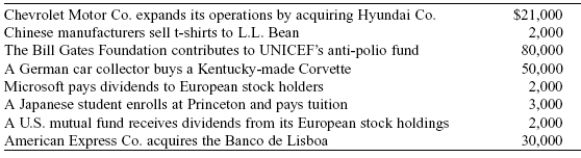 -(Table: International Transactions) Refer to Table: International Transactions. The balance of payments on goods and services is:
 (Multiple Choice)
4.7/5 (80)
(80) The Danish krone is a fixed exchange rate currency. If Denmark intervenes in the foreign exchange market to change the krone from $0.18 to $0.15, the krone has:
(Multiple Choice)
4.9/5 (69)
(69) A Brazilian bank buys shares of stock in Intel, a U.S. high-tech company. In the U.S. balance of payments, this transaction causes the balance on the _____ account to _____.
(Multiple Choice)
4.8/5 (77)
(77) Suppose that the equilibrium interest rate in the U.S. market for loanable funds is 3% prior to any international capital flows in the United States. The equilibrium interest rate in the Japanese market for loanable funds is 7%. If lenders in both nations believe that loans to foreigners are just as good as loans to their own citizens, capital will flow from _____, making interest rates _____ in Japan and _____ in the United States.
(Multiple Choice)
4.8/5 (85)
(85) Scenario: Gizmovia The Republic of Gizmovia wants to maintain the exchange rate of its currency, the gizmo, at $0.50, but the current exchange rate for the gizmo is $0.40. If Gizmovia uses exchange market intervention to increase the value of its currency to $0.50, it should _____ gizmos and _____ dollars in the foreign exchange market.
(Multiple Choice)
4.9/5 (79)
(79) Assume that the foreign exchange market is trading the domestic currency at a rate (U.S. dollars per unit of the domestic currency) above the rate fixed by the government. To maintain the fixed exchange rate, the government must:
(Multiple Choice)
4.8/5 (81)
(81) A devaluation will make exports _____expensive and imports _____ expensive.
(Multiple Choice)
4.9/5 (77)
(77) An argument against Britain's adopting the euro was that using the euro would make trade more difficult and decrease British productivity.
(True/False)
4.8/5 (68)
(68) The purchasing power parity between two currencies is the exchange rate at which a given basket of goods and services would cost the same amount in each country.
(True/False)
4.9/5 (76)
(76) 
Filters
- Essay(0)
- Multiple Choice(0)
- Short Answer(0)
- True False(0)
- Matching(0)