



 Chat with AI
Exam 15: Monetary Policy

Exam 1: First Principles183 Questions
Exam 2: Economic Models: Trade-Offs and Trade341 Questions
Exam 3: Supply and Demand230 Questions
Exam 4: Price Controls and Quotas: Meddling With Markets187 Questions
Exam 5: International Trade224 Questions
Exam 6: Macroeconomics: the Big Picture128 Questions
Exam 7: GDP and the CPI: Tracking the Macroeconomy213 Questions
Exam 8: Unemployment and Inflation300 Questions
Exam 9: Long-Run Economic Growth268 Questions
Exam 10: Savings, Investment Spending, and the Financial Syst355 Questions
Exam 11: Income and Expenditure114 Questions
Exam 12: Aggregate Demand and Aggregate Supply308 Questions
Exam 13: Fiscal Policy120 Questions
Exam 14: Money, Banking, and the Federal Reserve System135 Questions
Exam 15: Monetary Policy316 Questions
Exam 16: Inflation, Disinflation, and Deflation194 Questions
Exam 17: Macroeconomics: Events and Ideas283 Questions
Exam 18: International Macroeconomics411 Questions
Select questions type


Use the following to answer questions:
Figure: Monetary Policy I  -(Figure: Monetary Policy I) Refer to Figure: Monetary Policy I. If the economy is initially in equilibrium at E1 and the central bank chooses to buy Treasury bills, _____ shift to _____ a(n) _____ gap.
Free
(Multiple Choice)
4.9/5  (83)
(83) Correct Answer: Verified
A
The theory of monetary neutrality implies that monetary policy is effective in the short run but not in the long run.
Free
(True/False)
4.8/5 (87)
(87) Correct Answer:Verified
VerifiedTrue
Use the following to answer questions:
Figure: Short-Run Determination of the Interest Rate  -(Figure: Short-Run Determination of the Interest Rate) Refer to Figure: Short-Run Determination of the Interest Rate. If the money supply is at MS1 and the Fed conducts expansionary monetary policy, in the short run the interest rate drops to r2. In the long run prices will _____ thereby ___________the demand for money.
Free
(Multiple Choice)
4.8/5 (70)
(70) Correct Answer:Verified
VerifiedD
Use the following to answer questions:
Figure: Output Gap 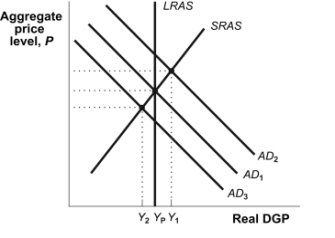 -(Figure: Output Gap) Refer to Figure: Output Gap. If the economy is at Y1 as a result of expansionary monetary policy and no further policy is implemented, in the long run nominal wages will _____ and shift the short-run aggregate supply curve to the _____, which will _____ real output.
 (Multiple Choice)
4.8/5 (94)
(94) Use the following to answer questions:
Figure: Short-Run Determination of the Interest Rate
-(Figure: Short-Run Determination of the Interest Rate) Refer to Figure: Short-Run Determination of the Interest Rate. If the money supply is at MS2 and the central bank sells Treasury bills, then the resulting short-run shift in the supply of savings (loanable funds) may be represented by a shift of the:
-(Figure: Short-Run Determination of the Interest Rate) Refer to Figure: Short-Run Determination of the Interest Rate. If the money supply is at MS2 and the central bank sells Treasury bills, then the resulting short-run shift in the supply of savings (loanable funds) may be represented by a shift of the: (Multiple Choice)
4.9/5 (86)
(86) If inflation increases from 2% to 5%, the money demand curve will:
(Multiple Choice)
4.8/5 (73)
(73) According to the liquidity preference model, a(n) _____ in the money supply shifts the money supply curve to the _____ and increases the equilibrium interest rate.
(Multiple Choice)
4.9/5 (87)
(87) If a checking account has an interest rate of 1% and a Treasury bill has an interest rate of 3%, the opportunity cost of holding cash in a checking account is:
(Multiple Choice)
4.8/5 (87)
(87) In September 2007, reversing its course, the Federal Reserve began a series of:
(Multiple Choice)
4.9/5 (84)
(84) Contractionary monetary policy causes a short-run _____ in interest rates in the short run and _____ in interest rates in the long run.
(Multiple Choice)
4.8/5 (83)
(83) If the economy is at potential output and the Fed decreases the money supply, in the short run the likely result will be a(n) _____ in investment and a(n) _____ in consumption.
(Multiple Choice)
4.7/5 (77)
(77) If long-term interest rates are 8% and short-term rates are 3%, the market expects:
(Multiple Choice)
4.9/5 (78)
(78) The loanable funds model focuses on interest rates in the short run.
(True/False)
4.8/5 (64)
(64) Suppose that the Federal Reserve is conducting an expansionary monetary policy. It will _____ Treasury bills on the open market, so that the money supply will _____, interest rates will _____, planned investment spending will _____, and the AD curve will shift to the _____.
(Multiple Choice)
4.9/5 (68)
(68) Use the following to answer questions:
Figure: The Money Supply and Aggregate Demand  -(Figure: The Money Supply and Aggregate Demand) Refer to Figure: The Money Supply and Aggregate Demand. If the economy is in an inflationary gap, the Federal Reserve will _____ Treasury bills, which will _____ the money supply and _____ interest rates. This is shown in panel _____.
 (Multiple Choice)
4.8/5 (83)
(83) When nominal wages decrease, the short-run aggregate supply curve shifts to the left.
(True/False)
4.9/5 (83)
(83) If the economy is at potential output and the Fed decreases the money supply, run the price level will likely decrease in the short run.
(True/False)
4.9/5 (71)
(71) If the Federal Reserve uses expansionary monetary policy there is a _____ short-run effect on _____, but_____.
(Multiple Choice)
4.8/5 (77)
(77) In a graph of a money demand curve, the _____ is plotted on the vertical axis.
(Multiple Choice)
4.8/5 (61)
(61) 
Filters
- Essay(0)
- Multiple Choice(0)
- Short Answer(0)
- True False(0)
- Matching(0)