



 Chat with AI
Exam 15: Monetary Policy

Exam 1: First Principles183 Questions
Exam 2: Economic Models: Trade-Offs and Trade341 Questions
Exam 3: Supply and Demand230 Questions
Exam 4: Price Controls and Quotas: Meddling With Markets187 Questions
Exam 5: International Trade224 Questions
Exam 6: Macroeconomics: the Big Picture128 Questions
Exam 7: GDP and the CPI: Tracking the Macroeconomy213 Questions
Exam 8: Unemployment and Inflation300 Questions
Exam 9: Long-Run Economic Growth268 Questions
Exam 10: Savings, Investment Spending, and the Financial Syst355 Questions
Exam 11: Income and Expenditure114 Questions
Exam 12: Aggregate Demand and Aggregate Supply308 Questions
Exam 13: Fiscal Policy120 Questions
Exam 14: Money, Banking, and the Federal Reserve System135 Questions
Exam 15: Monetary Policy316 Questions
Exam 16: Inflation, Disinflation, and Deflation194 Questions
Exam 17: Macroeconomics: Events and Ideas283 Questions
Exam 18: International Macroeconomics411 Questions
Select questions type


In the long run, a change in monetary policy will affect only the aggregate price level.
(True/False)
4.9/5  (77)
(77) If the economy is in a recessionary gap, the Federal Reserve should conduct _____ monetary policy by _____ the money supply.
(Multiple Choice)
4.9/5 (77)
(77) If the equilibrium interest rate in the money market is 5%, then at an interest rate of 2%, the quantity of money demanded is _____ than quantity of money supplied.
(Multiple Choice)
4.9/5 (66)
(66) Suppose that the economy enters a recession and real GDP falls. All else equal, we would expect:
(Multiple Choice)
4.8/5 (76)
(76) People incur a cost for holding money instead of nonmonetary assets such as Treasury bills.
(True/False)
5.0/5 (82)
(82) Use the following to answer questions:
Figure: Monetary Policy II 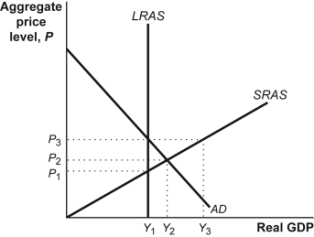 -(Figure: Monetary Policy II) Refer to Figure: Monetary Policy II. To eliminate the inflationary gap from the short-run equilibrium at Y2, monetary policy should be:
 (Multiple Choice)
4.8/5 (74)
(74) Consider an economy that is facing a recessionary gap. The Federal Reserve decides to use expansionary monetary policy to close that gap. As a result of this policy, in the short run the money supply will _____, the interest rate will _____, investment and consumption spending will _____, and real GDP will _____.
(Multiple Choice)
4.8/5 (90)
(90) Use the following to answer questions:
Figure: Equilibrium in the Money Market  -(Figure: Equilibrium in the Money Market) Refer to Figure: Equilibrium in the Money Market. If the rate of interest is below equilibrium, there will be an excess _____ money and the interest rate will _____.
 (Multiple Choice)
4.8/5 (83)
(83) If the economy is at potential output and the Fed decreases the money supply, in the short run the aggregate demand will likely:
(Multiple Choice)
4.7/5 (84)
(84) Use the following to answer questions:
Figure: A Money Market  -(Figure: A Money Market) Refer to Figure: A Money Market. The equilibrium interest rate is:
 (Multiple Choice)
4.9/5 (92)
(92) Short-term interest rates apply to financial assets due within:
(Multiple Choice)
4.8/5 (88)
(88) To lower the short-term interest rate, the Federal Reserve can:
(Multiple Choice)
4.8/5 (78)
(78) Use the following to answer questions:
Figure: Equilibrium in the Money Market
-(Figure: Equilibrium in the Money Market) Refer to Figure: Equilibrium in the Money Market. If the interest rate is above equilibrium, there will be an excess _____ money and the interest rate will _____.
-(Figure: Equilibrium in the Money Market) Refer to Figure: Equilibrium in the Money Market. If the interest rate is above equilibrium, there will be an excess _____ money and the interest rate will _____. (Multiple Choice)
4.9/5 (85)
(85) Use the following to answer questions:
Figure: Money Market I 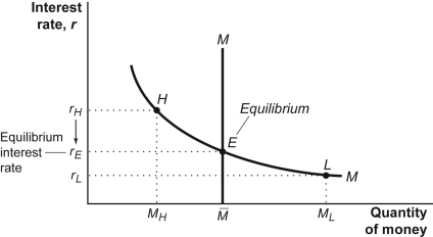 -(Figure: Money Market I) Refer to Figure: Money Market I. If the money market is initially in equilibrium at point E and the central bank buys Treasury bills, then the interest rate will:
 (Multiple Choice)
4.9/5 (79)
(79) If the economy is at potential output and the Fed increases the money supply, in the long run the price level will likely increase.
(True/False)
4.8/5 (90)
(90) Suppose that a typical basket of goods is now more expensive than it used to be. All else equal, we would expect:
(Multiple Choice)
4.8/5 (87)
(87) Suppose that the Federal Reserve has set a target for the federal funds rate. If initially the equilibrium interest rate happens to be higher than the target interest rate, then the Federal Reserve should _____ Treasury bills in the open market, _____ the money supply, shift the supply of money curve to the _____, and _____ the interest rate to the target rate.
(Multiple Choice)
4.9/5 (87)
(87) 
Filters
- Essay(0)
- Multiple Choice(0)
- Short Answer(0)
- True False(0)
- Matching(0)