



 Chat with AI
Exam 15: Monetary Policy

Exam 1: First Principles183 Questions
Exam 2: Economic Models: Trade-Offs and Trade341 Questions
Exam 3: Supply and Demand230 Questions
Exam 4: Price Controls and Quotas: Meddling With Markets187 Questions
Exam 5: International Trade224 Questions
Exam 6: Macroeconomics: the Big Picture128 Questions
Exam 7: GDP and the CPI: Tracking the Macroeconomy213 Questions
Exam 8: Unemployment and Inflation300 Questions
Exam 9: Long-Run Economic Growth268 Questions
Exam 10: Savings, Investment Spending, and the Financial Syst355 Questions
Exam 11: Income and Expenditure114 Questions
Exam 12: Aggregate Demand and Aggregate Supply308 Questions
Exam 13: Fiscal Policy120 Questions
Exam 14: Money, Banking, and the Federal Reserve System135 Questions
Exam 15: Monetary Policy316 Questions
Exam 16: Inflation, Disinflation, and Deflation194 Questions
Exam 17: Macroeconomics: Events and Ideas283 Questions
Exam 18: International Macroeconomics411 Questions
Select questions type


Use the following to answer questions:
Figure: Monetary Policy I  -(Figure: Monetary Policy I) Refer to Figure: Monetary Policy I. If the economy is initially in equilibrium at E2 and the central bank chooses to sell Treasury bills, _____ shift to _____ a(n) _____ gap.
 (Multiple Choice)
4.7/5  (95)
(95) Expansionary monetary policy will _____ interest rates and _____ savings in the short run.
(Multiple Choice)
4.8/5 (89)
(89) A decrease in the supply of money with no change in demand for money will lead to a(n) _____ in the equilibrium quantity of money and a _____ in the equilibrium interest rate.
(Multiple Choice)
4.9/5 (72)
(72) Use the following to answer questions:
Figure: Monetary Policy and the AD-SRAS Model  -(Figure: Monetary Policy and the AD-SRAS Model) Refer to Figure: Monetary Policy and the AD-SRAS Model. If the economy is in an inflationary gap at point h, it can move to point i as a result of:
 (Multiple Choice)
4.9/5 (80)
(80) If the opportunity cost of holding money rises, then the money demand curve shifts to the left.
(True/False)
4.7/5 (95)
(95) The Federal Reserve can influence financial crises because it:
(Multiple Choice)
4.9/5 (80)
(80) The demand for money in Japan is much lower than the demand for money in the United States.
(True/False)
4.8/5 (78)
(78) Use the following to answer questions:
Figure: Short-Run Determination of the Interest Rate  -(Figure: Short-Run Determination of the Interest Rate) Refer to Figure: Short-Run Determination of the Interest Rate. If the money supply is at MS1 and the Fed conducts expansionary monetary policy, in the short run the interest rate drops to r2. In the long run the demand for money will _____, and the interest rate will_____.
 (Multiple Choice)
4.9/5 (53)
(53) In 2014, Ben Bernanke was succeeded as chair of the Board of Governors of the Federal Reserve by:
(Multiple Choice)
4.8/5 (77)
(77) If a checking account has an interest rate of 1% and a Treasury bill has an interest rate of 2%, the opportunity cost of holding the checking account as money is:
(Multiple Choice)
4.7/5 (90)
(90) Use the following to answer questions:
Figure: Output Gap 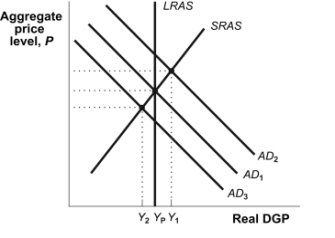 -(Figure: Output Gap) Refer to Figure: Output Gap. If the economy is producing at Y1, then it has a(n) _____ gap, as _____ real GDP exceeds _____ real GDP, and the Federal Reserve should use _____ monetary policy.
 (Multiple Choice)
4.9/5 (82)
(82) The quantity demanded of money is negatively related to _____, and the demand for money is positively related to _____.
(Multiple Choice)
4.7/5 (92)
(92) To decrease interest rates, the Fed should increase the money supply.
(True/False)
4.7/5 (85)
(85) In the income-expenditure model, expansionary monetary policy leads to _____ interest rates, a(n) _____ in planned investment spending, and a(n) _____ in equilibrium GDP.
(Multiple Choice)
4.7/5 (79)
(79) Between 2015 and 2017, the Fed raised its target federal funds rate by a large amount to prevent inflation.
(True/False)
4.9/5 (66)
(66) The money demand curve is _____ because the opportunity cost of holding money is _____ related to the interest rate.
(Multiple Choice)
4.9/5 (77)
(77) Use the following to answer questions:
Figure: Monetary Policy I
-(Figure: Monetary Policy I) Refer to Figure: Monetary Policy I. If the economy is initially in equilibrium at E2 and the central bank chooses to sell Treasury bills_____ shift to _____ a(n) _____ gap.
-(Figure: Monetary Policy I) Refer to Figure: Monetary Policy I. If the economy is initially in equilibrium at E2 and the central bank chooses to sell Treasury bills_____ shift to _____ a(n) _____ gap. (Multiple Choice)
4.8/5 (81)
(81) 
Filters
- Essay(0)
- Multiple Choice(0)
- Short Answer(0)
- True False(0)
- Matching(0)