



 Chat with AI
Exam 15: Monetary Policy

Exam 1: First Principles183 Questions
Exam 2: Economic Models: Trade-Offs and Trade341 Questions
Exam 3: Supply and Demand230 Questions
Exam 4: Price Controls and Quotas: Meddling With Markets187 Questions
Exam 5: International Trade224 Questions
Exam 6: Macroeconomics: the Big Picture128 Questions
Exam 7: GDP and the CPI: Tracking the Macroeconomy213 Questions
Exam 8: Unemployment and Inflation300 Questions
Exam 9: Long-Run Economic Growth268 Questions
Exam 10: Savings, Investment Spending, and the Financial Syst355 Questions
Exam 11: Income and Expenditure114 Questions
Exam 12: Aggregate Demand and Aggregate Supply308 Questions
Exam 13: Fiscal Policy120 Questions
Exam 14: Money, Banking, and the Federal Reserve System135 Questions
Exam 15: Monetary Policy316 Questions
Exam 16: Inflation, Disinflation, and Deflation194 Questions
Exam 17: Macroeconomics: Events and Ideas283 Questions
Exam 18: International Macroeconomics411 Questions
Select questions type


An increase in real aggregate spending will shift the money:
(Multiple Choice)
4.8/5  (74)
(74) The Fed prints money only when it is conducting monetary policy.
(True/False)
4.8/5 (80)
(80) Suppose that the economy is operating at potential output and the money supply increases. Aggregate output will _____ potential output, nominal wages will _____, and the SRAS will shift _____.
(Multiple Choice)
4.8/5 (71)
(71) If the economy is at potential output and the Fed increases the money supply, in the short run the price level will likely:
(Multiple Choice)
4.8/5 (75)
(75) The higher the short-term interest rate, the lower the opportunity cost of holding money.
(True/False)
4.9/5 (69)
(69) Available international evidence for the period 1970-2015 shows that the:
(Multiple Choice)
5.0/5 (78)
(78) Use the following to answer questions:
Figure: Money Market I 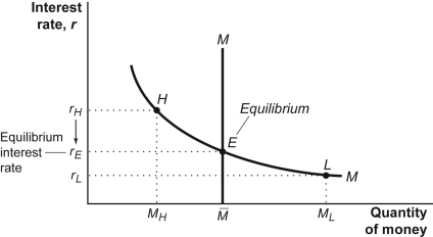 -(Figure: Money Market I) Refer to Figure: Money Market I. If the money market is initially in equilibrium at point E and the central bank sells Treasury bills, then the interest rate will:
 (Multiple Choice)
4.9/5 (77)
(77) If the equilibrium interest rate in the money market is 5%, at an interest rate of 2% the quantity of nonmonetary interest-bearing financial assets demanded is _____ the quantity supplied.
(Multiple Choice)
4.8/5 (79)
(79) If the equilibrium interest rate in the money market is 5%, then at an interest rate of 2% sellers of interest-bearing financial assets _____ interest rates to find willing buyers.
(Multiple Choice)
4.8/5 (60)
(60) A 20% increase in the aggregate price level will increase the quantity of money demanded by:
(Multiple Choice)
5.0/5 (84)
(84) The concept of monetary neutrality means that changes in the money supply have no real effects on real output in the long run.
(True/False)
4.9/5 (62)
(62) Use the following to answer questions:
Figure: Changes in the Money Supply  -(Figure: Changes in the Money Supply) Refer to Figure: Changes in the Money Supply. Federal Reserve policy to increase the supply of money, hence to lower the interest rate from 6% to 4%, is accomplished by action that ________ Treasury bills.
 (Multiple Choice)
4.9/5 (81)
(81) If the target rate of interest is higher than the equilibrium interest rate, the Federal Reserve will _____ Treasury bills in the open market, _____ the supply of money, and _____ the interest rate to the target rate.
(Multiple Choice)
4.8/5 (93)
(93) An increase in the money supply that will decrease interest rates causes a shift of the:
(Multiple Choice)
4.8/5 (90)
(90) A decrease in the supply of money will lead to a(n) _____ in equilibrium real GDP and a _____ equilibrium interest rate.
(Multiple Choice)
4.8/5 (84)
(84) Suppose that the economy is in long-run equilibrium at full employment levels of real GDP. In the long run, if the money supply increases, we would expect _____ in the price level and _____ in real GDP.
(Multiple Choice)
4.8/5 (78)
(78) 
Filters
- Essay(0)
- Multiple Choice(0)
- Short Answer(0)
- True False(0)
- Matching(0)