



 Chat with AI
Exam 15: Monetary Policy

Exam 1: First Principles183 Questions
Exam 2: Economic Models: Trade-Offs and Trade341 Questions
Exam 3: Supply and Demand230 Questions
Exam 4: Price Controls and Quotas: Meddling With Markets187 Questions
Exam 5: International Trade224 Questions
Exam 6: Macroeconomics: the Big Picture128 Questions
Exam 7: GDP and the CPI: Tracking the Macroeconomy213 Questions
Exam 8: Unemployment and Inflation300 Questions
Exam 9: Long-Run Economic Growth268 Questions
Exam 10: Savings, Investment Spending, and the Financial Syst355 Questions
Exam 11: Income and Expenditure114 Questions
Exam 12: Aggregate Demand and Aggregate Supply308 Questions
Exam 13: Fiscal Policy120 Questions
Exam 14: Money, Banking, and the Federal Reserve System135 Questions
Exam 15: Monetary Policy316 Questions
Exam 16: Inflation, Disinflation, and Deflation194 Questions
Exam 17: Macroeconomics: Events and Ideas283 Questions
Exam 18: International Macroeconomics411 Questions
Select questions type


Scenario: Taylor Rule Suppose that the Federal Reserve is following the Taylor rule, which takes both inflation and business cycles into account when setting the federal funds rate. Also suppose that the inflation rate in the economy is 3% and the unemployment gap is -2%. The economy has a(n):
(Multiple Choice)
4.7/5  (71)
(71) If the actual interest rate is below the target rate, the Fed should sell Treasury bills.
(True/False)
4.9/5 (85)
(85) One advantage of inflation targeting over the Taylor rule is that with inflation targeting, because the public knows the target in advance, uncertainty is reduced.
(True/False)
4.9/5 (79)
(79) Use the following to answer questions:
Figure: The Money Supply and Aggregate Demand  -(Figure: The Money Supply and Aggregate Demand) Refer to Figure: The Money Supply and Aggregate Demand. If the economy is in a recessionary gap, the Federal Reserve will _____ Treasury bills, which will _____ the money supply and _____ interest rates. This is shown in panel _____.
 (Multiple Choice)
4.9/5 (84)
(84) Figure: Short-Run and Long-Run Effects of Monetary Policy 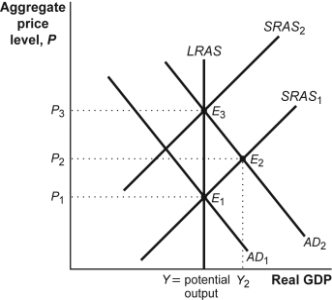 Refer to Figure: Short-Run and Long-Run Effects of Monetary Policy. If the economy is initially at E2 and the central bank makes no change in its monetary policy:
 (Multiple Choice)
4.7/5 (78)
(78) When nominal wages increase, the short-run aggregate supply curve:
(Multiple Choice)
4.9/5 (82)
(82) If the economy is at potential output and the Fed decreases the money supply so that actual output is less than potential output, eventually nominal wages will_____ and short-run aggregate supply will _____.
(Multiple Choice)
4.9/5 (86)
(86) Use the following to answer questions:
Figure: Equilibrium in the Money Market  -(Figure: Equilibrium in the Money Market) Refer to Figure: Equilibrium in the Money Market. Equilibrium will occur at interest rate _____ and quantity of money _____.
 (Multiple Choice)
4.8/5 (71)
(71) If the economy is at potential output and the Fed decreases the money supply, in the long run the price level will likely:
(Multiple Choice)
4.8/5 (91)
(91) If the interest rate is below equilibrium, then the quantity of money demanded is more than the quantity of money supplied, and the quantity of interest-bearing financial assets demanded is also more than the quantity supplied.
(True/False)
4.8/5 (72)
(72) Expansionary monetary policy _____ the money supply, _____ interest rates, and _____ consumption and investment spending.
(Multiple Choice)
4.8/5 (82)
(82) If the interest rate on CDs rises from 5% to 10%, the opportunity cost of holding money will _____ and the quantity demanded of money will _____.
(Multiple Choice)
4.8/5 (83)
(83) Monetary policy affects aggregate demand through changes in:
(Multiple Choice)
4.8/5 (76)
(76) Use the following to answer questions:
Figure: A Money Market  -(Figure: A Money Market) Refer to Figure: A Money Market. If the interest rate is r3, the interest rate will _____ because there is a _____ of money in the market.
 (Multiple Choice)
4.8/5 (96)
(96) Scenario: Money and Interest Rates Banks decide to do away with fees charged when other banks' customers use the bank's own ATM. If the Federal Reserve wants to maintain the same federal funds rate, it should:
(Multiple Choice)
4.8/5 (77)
(77) Use the following to answer questions:
Figure: Monetary Policy I  -(Figure: Monetary Policy I) Refer to Figure: Monetary Policy I. If the economy is initially in equilibrium at E1 and the central bank chooses to buy Treasury bills, _____ shift to _____ a(n) _____ gap.
 (Multiple Choice)
5.0/5 (80)
(80) According to the concept of monetary neutrality, _____ in the money supply _____ real GDP _____ the price level.
(Multiple Choice)
4.9/5 (75)
(75) If the actual interest rate is 6% and the target rate is 4%, the Fed should decrease the money supply.
(True/False)
4.8/5 (76)
(76) 
Filters
- Essay(0)
- Multiple Choice(0)
- Short Answer(0)
- True False(0)
- Matching(0)