



 Chat with AI
Exam 15: Monetary Policy

Exam 1: First Principles183 Questions
Exam 2: Economic Models: Trade-Offs and Trade341 Questions
Exam 3: Supply and Demand230 Questions
Exam 4: Price Controls and Quotas: Meddling With Markets187 Questions
Exam 5: International Trade224 Questions
Exam 6: Macroeconomics: the Big Picture128 Questions
Exam 7: GDP and the CPI: Tracking the Macroeconomy213 Questions
Exam 8: Unemployment and Inflation300 Questions
Exam 9: Long-Run Economic Growth268 Questions
Exam 10: Savings, Investment Spending, and the Financial Syst355 Questions
Exam 11: Income and Expenditure114 Questions
Exam 12: Aggregate Demand and Aggregate Supply308 Questions
Exam 13: Fiscal Policy120 Questions
Exam 14: Money, Banking, and the Federal Reserve System135 Questions
Exam 15: Monetary Policy316 Questions
Exam 16: Inflation, Disinflation, and Deflation194 Questions
Exam 17: Macroeconomics: Events and Ideas283 Questions
Exam 18: International Macroeconomics411 Questions
Select questions type


Use the following to answer questions:
Figure: Monetary Policy III 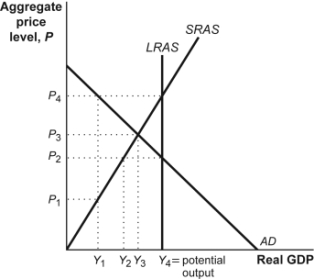 -(Figure: Monetary Policy III) Refer to Figure: Monetary Policy III. Expansionary economic policy will lead to an equilibrium GDP of:
 (Multiple Choice)
4.8/5  (77)
(77) The Federal Open Market Committee has decided that the federal funds rate should be 2% rather than the current rate of 1.5%. The appropriate open market action is to _____ Treasury bills to _____ money _____.
(Multiple Choice)
5.0/5 (86)
(86) If the economy is in a recession and real GDP decreases, the demand for money will shift to the left.
(True/False)
4.9/5 (78)
(78) The short-run aggregate supply curve is _____, and the long-run aggregate supply curve is _____.
(Multiple Choice)
4.9/5 (87)
(87) Use the following to answer questions:
Figure: Monetary Policy I  -(Figure: Monetary Policy I) Refer to Figure: Monetary Policy I. If the economy is initially in equilibrium at E2 and the central bank chooses to sell Treasury bills:
 (Multiple Choice)
4.8/5 (66)
(66) To expand the money supply, the Federal Reserve would have to:
(Multiple Choice)
5.0/5 (68)
(68) In the long run, changes in the money supply _____ the aggregate price level and _____ aggregate output.
(Multiple Choice)
5.0/5 (70)
(70) The federal funds rate is the interest rate on _____, and it is influenced by the _____.
(Multiple Choice)
4.8/5 (82)
(82) Use the following to answer questions:
Figure: Output Gap 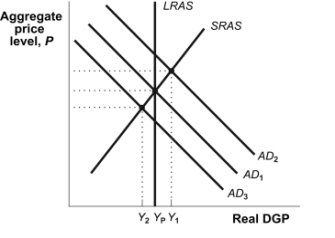 -(Figure: Output Gap) Refer to Figure: Output Gap. If the economy is at Y2 because of contractionary monetary policy and no further policy is implemented, in the long run nominal wages will _____ and shift the short-run aggregate supply curve to the _____, which will _____ real output.
 (Multiple Choice)
4.8/5 (75)
(75) The idea that the interest rate is determined by the supply and demand for money is known as:
(Multiple Choice)
4.9/5 (80)
(80) Other things equal, if there is an excess demand for money, the interest rate may rise.
(True/False)
4.9/5 (74)
(74) If the economy is at potential output and the Fed increases the money supply, the aggregate demand will likely decrease in the short run.
(True/False)
4.9/5 (66)
(66) According to the liquidity preference model, if the Federal Reserve increases the money supply, the equilibrium interest rate _____, and this leads to a(n) _____ in the quantity demanded of nonmonetary interest-bearing financial assets.
(Multiple Choice)
4.8/5 (99)
(99) An increase in the money supply _____ the interest rate in the short run but _____ the interest rate in the long run.
(Multiple Choice)
4.9/5 (72)
(72) Use the following to answer questions:
Figure: A Money Market  -(Figure: A Money Market) Refer to Figure: A Money Market. If the current interest rate is r1, the interest rate will _____ because there is a _____ of money in the market.
 (Multiple Choice)
4.8/5 (76)
(76) Scenario: Taylor Rule Suppose that the Federal Reserve is following the Taylor rule, which takes both inflation and business cycles into account when setting the federal funds rate. Also suppose that the inflation rate in the economy is 3% and the unemployment gap is -2%. In this case, the Federal Reserve will set the federal funds rate at _____%.
(Multiple Choice)
4.9/5 (84)
(84) If the economy is at potential output and the Fed increases the money supply, in the short run the likely result will be a(n) _____ in investment and a(n) _____ in consumption.
(Multiple Choice)
4.8/5 (81)
(81) 
Filters
- Essay(0)
- Multiple Choice(0)
- Short Answer(0)
- True False(0)
- Matching(0)