



 Chat with AI
Exam 15: Monetary Policy

Exam 1: First Principles183 Questions
Exam 2: Economic Models: Trade-Offs and Trade341 Questions
Exam 3: Supply and Demand230 Questions
Exam 4: Price Controls and Quotas: Meddling With Markets187 Questions
Exam 5: International Trade224 Questions
Exam 6: Macroeconomics: the Big Picture128 Questions
Exam 7: GDP and the CPI: Tracking the Macroeconomy213 Questions
Exam 8: Unemployment and Inflation300 Questions
Exam 9: Long-Run Economic Growth268 Questions
Exam 10: Savings, Investment Spending, and the Financial Syst355 Questions
Exam 11: Income and Expenditure114 Questions
Exam 12: Aggregate Demand and Aggregate Supply308 Questions
Exam 13: Fiscal Policy120 Questions
Exam 14: Money, Banking, and the Federal Reserve System135 Questions
Exam 15: Monetary Policy316 Questions
Exam 16: Inflation, Disinflation, and Deflation194 Questions
Exam 17: Macroeconomics: Events and Ideas283 Questions
Exam 18: International Macroeconomics411 Questions
Select questions type


Use the following to answer questions:
Figure: Changes in the Money Supply  -(Figure: Changes in the Money Supply) Refer to Figure: Changes in the Money Supply. If the supply of money shifts from S1 to S2, the Federal Reserve must have _____ Treasury bills in the open market.
 (Multiple Choice)
4.8/5  (78)
(78) The main objective of contractionary monetary policy is to:
(Multiple Choice)
4.8/5 (82)
(82) Quantitative easing occurs when instead of purchasing only short-term government debt, the Fed buys long-term government debt as well.
(True/False)
4.8/5 (83)
(83) One advantage of inflation targeting over the Taylor rule is that the central bank's policy can be evaluated by seeing how close to the target actual inflation rates are.
(True/False)
4.9/5 (73)
(73) When the Federal Reserve buys Treasury bills, this leads to a(n):
(Multiple Choice)
4.8/5 (91)
(91) Use the following to answer questions:
Figure: Short-Run Determination of the Interest Rate  -(Figure: Short-Run Determination of the Interest Rate) Refer to Figure: Short-Run Determination of the Interest Rate. If the money supply is at MS2 and the central bank sells Treasury bills, then in the short run the interest rate will:
 (Multiple Choice)
5.0/5 (87)
(87) If the Federal Reserve sets the federal funds rate on the basis of inflation and the output gap, then the Federal Reserve is following:
(Multiple Choice)
4.9/5 (75)
(75) Use the following to answer questions:
Figure: Economic Adjustments 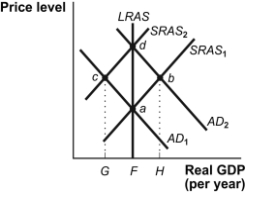 -(Figure: Economic Adjustments) Refer to Figure: Economic Adjustments. Assume that the economy is at point b. The effect of a decrease in the money supply is represented by a shift of the _____ curve to _____.
 (Multiple Choice)
4.7/5 (83)
(83) If the economy is at potential output and the Fed increases the money supply, in the long run the price level will likely:
(Multiple Choice)
4.8/5 (77)
(77) Use the following to answer questions:
Figure: Economic Adjustments
-(Figure: Economic Adjustments) Refer to Figure: Economic Adjustments. Assume that the economy is at point c. The effect of an increase in the money supply is represented by a shift of the _____ curve to _____.
-(Figure: Economic Adjustments) Refer to Figure: Economic Adjustments. Assume that the economy is at point c. The effect of an increase in the money supply is represented by a shift of the _____ curve to _____. (Multiple Choice)
4.7/5 (90)
(90) An increase in the money supply causes _____ in output in the short run and _____ in output in the long run.
(Multiple Choice)
4.8/5 (81)
(81) Monetary policy that lowers the interest rate is called _____ because it _____.
(Multiple Choice)
5.0/5 (92)
(92) If during 2016 the interest rate on one-month Treasury bills was 2.5% and during 2017 it was 2%, the opportunity cost of holding money, assuming the inflation rate remained constant,:
(Multiple Choice)
4.8/5 (66)
(66) When long-term rates are lower than short-term rates, the market is signaling that it expects short-term rates to fall.
(True/False)
4.7/5 (75)
(75) Which reason is NOT one for which the Japanese tend to keep large amounts of cash?
(Multiple Choice)
4.8/5 (81)
(81) If the quantity of money demanded is $100 billion and the quantity of money supplied is $200 billion, then the interest rate will:
(Multiple Choice)
4.8/5 (75)
(75) U.S. banks did not offer interest on checking accounts until the beginning of the 1980s. Then banking regulations changed, allowing banks to pay interest on checking account funds. As a result, the _____ money _____ and shifted the money demand curve to the _____.
(Multiple Choice)
4.9/5 (68)
(68) 
Filters
- Essay(0)
- Multiple Choice(0)
- Short Answer(0)
- True False(0)
- Matching(0)