



 Chat with AI
Exam 14: Oligopoly: Firms in Less Competitive Markets

Exam 1: Economics: Foundations and Models459 Questions
Exam 2: Trade-Offs, Comparative Advantage, and the Market System492 Questions
Exam 3: Where Prices Come From: the Interaction of Demand and Supply476 Questions
Exam 4: Economic Efficiency, Government Price Setting, and Taxes420 Questions
Exam 5: Externalities, Environmental Policy, and Public Goods262 Questions
Exam 6: Elasticity: the Responsiveness of Demand and Supply293 Questions
Exam 7: The Economics of Health Care337 Questions
Exam 8: Firms, the Stock Market, and Corporate Governance512 Questions
Exam 9: Comparative Advantage and the Gains From International Trade377 Questions
Exam 10: Consumer Choice and Behavioral Economics304 Questions
Exam 11: Technology, Production, and Costs326 Questions
Exam 12: Firms in Perfectly Competitive Markets296 Questions
Exam 13: Monopolistic Competition: the Competitive Model in a More Realistic Setting272 Questions
Exam 14: Oligopoly: Firms in Less Competitive Markets256 Questions
Exam 15: Monopoly and Antitrust Policy279 Questions
Exam 16: Pricing Strategy258 Questions
Exam 17: The Markets for Labor and Other Factors of Production279 Questions
Exam 18: Public Choice, Taxes, and the Distribution of Income258 Questions
Exam 19: Gdp: Measuring Total Production and Income260 Questions
Exam 20: Unemployment and Inflation290 Questions
Exam 21: Economic Growth, the Financial System, and Business Cycles251 Questions
Exam 22: Long-Run Economic Growth: Sources and Policies261 Questions
Exam 23: Aggregate Expenditure and Output in the Short Run305 Questions
Exam 24: Aggregate Demand and Aggregate Supply Analysis286 Questions
Exam 25: Money, Banks, and the Federal Reserve System278 Questions
Exam 26: Monetary Policy280 Questions
Exam 27: Fiscal Policy313 Questions
Exam 28: Inflation, Unemployment, and Federal Reserve Policy257 Questions
Exam 29: Macroeconomics in an Open Economy277 Questions
Exam 30: The International Financial System258 Questions
Select questions type


Table 14-2  Table 14-2 shows the payoff matrix for Walmart and Target from every combination of pricing strategies for the popular PlayStation 4. At the start of the game each firm charges a low price and each earns a profit of $7,000.
-Refer to Table 14-2. Suppose Walmart and Target both advertise that they will match the lowest price offered by any competitor. What is the purpose of such a strategy?
Table 14-2 shows the payoff matrix for Walmart and Target from every combination of pricing strategies for the popular PlayStation 4. At the start of the game each firm charges a low price and each earns a profit of $7,000.
-Refer to Table 14-2. Suppose Walmart and Target both advertise that they will match the lowest price offered by any competitor. What is the purpose of such a strategy? (Multiple Choice)
4.7/5  (71)
(71) Consider two craft bourbons distilled in Brooklyn, New York: Kings County and Stillhouse. If the distilleries advertise, they can both sell more bourbon and increase their revenue. However, the cost of advertising more than offsets the increased revenue so that each distillery ends up with a lower profit than if they do not advertise. On the other hand, if only one advertises, that distillery increases its market share and also its profit.
a. Construct a payoff matrix using the following hypothetical information: If neither distillery advertises, each earns a profit of $500,000 per month. If both advertise, each earns a profit of $250,000 per month. If one advertises and the other does not, the distillery that advertises earns a profit of $750,000 and the distillery that does not advertise earns a profit of $125,000.
b. If Kings County wants to maximize profit, will it advertise? Briefly explain.
c. If Stillhouse wants to maximize profit, will it advertise? Briefly explain.
d. Is there a dominant strategy for each distiller? Briefly explain.
(Essay)
4.8/5 (85)
(85) Table 14-10 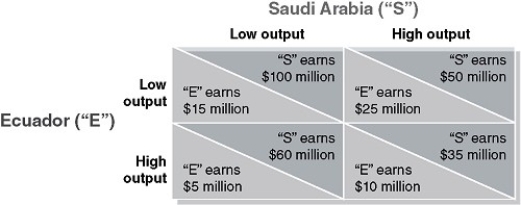 -Refer to Table 14-10. Suppose the payoff matrix in the above figure represents the payoffs to Saudi Arabia and Ecuador for the production of oil. Saudi Arabia and Ecuador must decide how much oil to produce. Since the demand for oil is inelastic, relatively low production rates drive up prices and profits. Saudi Arabia, the world's largest and lowest-cost producer, is able to influence market price; it has an incentive to keep output low. Ecuador, on the other hand, is a relatively high-cost producer with much smaller reserves. Assume Saudi Arabia now decides to try to further influence the oil market by offering to pay Ecuador $15 million to produce a low output.
a. Create a new payoff matrix that reflects Saudi Arabia's willingness to pay Ecuador $15 million to produce a low output.
b. What is the dominant strategy for each country in this new game?
c. What is the new Nash equilibrium?
-Refer to Table 14-10. Suppose the payoff matrix in the above figure represents the payoffs to Saudi Arabia and Ecuador for the production of oil. Saudi Arabia and Ecuador must decide how much oil to produce. Since the demand for oil is inelastic, relatively low production rates drive up prices and profits. Saudi Arabia, the world's largest and lowest-cost producer, is able to influence market price; it has an incentive to keep output low. Ecuador, on the other hand, is a relatively high-cost producer with much smaller reserves. Assume Saudi Arabia now decides to try to further influence the oil market by offering to pay Ecuador $15 million to produce a low output.
a. Create a new payoff matrix that reflects Saudi Arabia's willingness to pay Ecuador $15 million to produce a low output.
b. What is the dominant strategy for each country in this new game?
c. What is the new Nash equilibrium? (Essay)
4.7/5 (86)
(86) Because many business situations are repeated games, firms may be able to avoid the prisoner's dilemma and implicitly collude to keep prices high.
(True/False)
4.8/5 (92)
(92) Which of the following is not part of an oligopolist's business strategy?
(Multiple Choice)
4.9/5 (71)
(71) All games share three characteristics. Two of these characteristics are rule and strategies. What is the third characteristic called?
(Multiple Choice)
4.9/5 (73)
(73) For years, economists believed that market structure explained the ability of some firms to earn economic profits. For example, firms in industries with little competition and high barriers to entry would earn higher profits than firms in competitive industries with low entry barriers. Which of the following has caused economists to question this explanation and seek other explanations for why firms are profitable?
(Multiple Choice)
4.9/5 (73)
(73) Economies of scale will create a barrier to entry in an oligopoly when
(Multiple Choice)
4.7/5 (77)
(77) Natural resource cartels such as OPEC are inherently unstable because their members operate with excess capacity and have an incentive to cheat on their output quotas.
(True/False)
4.8/5 (92)
(92) The equilibrium in the prisoner's dilemma is a Nash equilibrium.
(True/False)
4.9/5 (76)
(76) For many years the Aluminum Company of America (Alcoa) controlled most of the world's supply of high quality bauxite, the ore needed to produce aluminum. What type of entry barrier was responsible for Alcoa's position in the aluminum industry?
(Multiple Choice)
4.9/5 (83)
(83) Consider two craft bourbons distilled in Brooklyn, New York: Kings County and Stillhouse. If the distilleries advertise, they can both sell more bourbon and increase their revenue. However, the cost of advertising more than offsets the increased revenue so that each distillery ends up with a lower profit than if they do not advertise. On the other hand, if only one advertises, that distillery increases its market share and also its profit.
a. Construct a payoff matrix using the following hypothetical information: If neither distillery advertises: each earns a profit of $500,000 per year. If both advertise: each earns a profit of $250,000 per year. If one advertises and the other does not: the distillery that advertises earns a profit of $750.000 and the distillery that does not advertise earns a profit of $125,000.
b. If the two distilleries agree to coordinate their strategies, what is the outcome?
(Essay)
4.8/5 (79)
(79) Suppose we want to use game theory to analyze how an oligopolist selects its optimal price. The payoff matrix shows
(Multiple Choice)
4.9/5 (72)
(72) Table 14-4  Alpha and Beta are the only firms selling gyros in the upscale town of Delphi. Each firm must decide on whether to offer a discount to students to compete for customers. If one firm offers a discount but the other does not, then the firm that offers the discount will increase its profit. Table 14-4 shows the payoff matrix for this game.
-Refer to Table 14-4. Does Beta have a dominant strategy and if so, what is it?
Alpha and Beta are the only firms selling gyros in the upscale town of Delphi. Each firm must decide on whether to offer a discount to students to compete for customers. If one firm offers a discount but the other does not, then the firm that offers the discount will increase its profit. Table 14-4 shows the payoff matrix for this game.
-Refer to Table 14-4. Does Beta have a dominant strategy and if so, what is it? (Multiple Choice)
4.8/5 (76)
(76) Consider two oligopolistic industries selling the same product in different locations. In the first industry, firms always match price changes by any other firm in the industry. In the second industry, firms always ignore price changes by any other firm. Which of the following statements is true about these two industries, holding everything else constant?
(Multiple Choice)
4.9/5 (92)
(92) Figure 14-1  Assume that Lexus (L) is the first automobile company to produce a luxury class hybrid automobile and is the only such company for the past four years. BMW is now considering producing its own luxury hybrid automobile and Lexus must decide whether or not to lower the price of its luxury hybrid to counter BMW's entry into the luxury hybrid niche.
-Refer to Figure 14-1. Should Lexus lower its price in order to deter BMW's entry into the luxury hybrid automobile market?
Assume that Lexus (L) is the first automobile company to produce a luxury class hybrid automobile and is the only such company for the past four years. BMW is now considering producing its own luxury hybrid automobile and Lexus must decide whether or not to lower the price of its luxury hybrid to counter BMW's entry into the luxury hybrid niche.
-Refer to Figure 14-1. Should Lexus lower its price in order to deter BMW's entry into the luxury hybrid automobile market? (Multiple Choice)
4.9/5 (89)
(89) Table 14-2 Table 14-2 shows the payoff matrix for Walmart and Target from every combination of pricing strategies for the popular PlayStation 4. At the start of the game each firm charges a low price and each earns a profit of $7,000.
-Refer to Table 14-2. For each firm, is there a better outcome than the current situation in which each firm charges the low price and earns a profit of $7,000?
Table 14-2 shows the payoff matrix for Walmart and Target from every combination of pricing strategies for the popular PlayStation 4. At the start of the game each firm charges a low price and each earns a profit of $7,000.
-Refer to Table 14-2. For each firm, is there a better outcome than the current situation in which each firm charges the low price and earns a profit of $7,000? (Multiple Choice)
4.7/5 (73)
(73) 
Filters
- Essay(0)
- Multiple Choice(0)
- Short Answer(0)
- True False(0)
- Matching(0)