



 Chat with AI
Exam 14: Oligopoly: Firms in Less Competitive Markets

Exam 1: Economics: Foundations and Models459 Questions
Exam 2: Trade-Offs, Comparative Advantage, and the Market System492 Questions
Exam 3: Where Prices Come From: the Interaction of Demand and Supply476 Questions
Exam 4: Economic Efficiency, Government Price Setting, and Taxes420 Questions
Exam 5: Externalities, Environmental Policy, and Public Goods262 Questions
Exam 6: Elasticity: the Responsiveness of Demand and Supply293 Questions
Exam 7: The Economics of Health Care337 Questions
Exam 8: Firms, the Stock Market, and Corporate Governance512 Questions
Exam 9: Comparative Advantage and the Gains From International Trade377 Questions
Exam 10: Consumer Choice and Behavioral Economics304 Questions
Exam 11: Technology, Production, and Costs326 Questions
Exam 12: Firms in Perfectly Competitive Markets296 Questions
Exam 13: Monopolistic Competition: the Competitive Model in a More Realistic Setting272 Questions
Exam 14: Oligopoly: Firms in Less Competitive Markets256 Questions
Exam 15: Monopoly and Antitrust Policy279 Questions
Exam 16: Pricing Strategy258 Questions
Exam 17: The Markets for Labor and Other Factors of Production279 Questions
Exam 18: Public Choice, Taxes, and the Distribution of Income258 Questions
Exam 19: Gdp: Measuring Total Production and Income260 Questions
Exam 20: Unemployment and Inflation290 Questions
Exam 21: Economic Growth, the Financial System, and Business Cycles251 Questions
Exam 22: Long-Run Economic Growth: Sources and Policies261 Questions
Exam 23: Aggregate Expenditure and Output in the Short Run305 Questions
Exam 24: Aggregate Demand and Aggregate Supply Analysis286 Questions
Exam 25: Money, Banks, and the Federal Reserve System278 Questions
Exam 26: Monetary Policy280 Questions
Exam 27: Fiscal Policy313 Questions
Exam 28: Inflation, Unemployment, and Federal Reserve Policy257 Questions
Exam 29: Macroeconomics in an Open Economy277 Questions
Exam 30: The International Financial System258 Questions
Select questions type


Figure 14-7 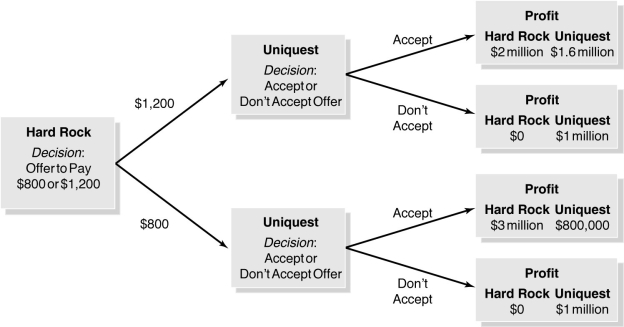 -Refer to Figure 14-7. Uniquest, Inc. is a company that provides PCs with internet access and touch-sensitive screens to hotels. Suppose the Hard Rock Hotel and Casino in Las Vegas informs Uniquest that it is considering installing these systems in its hotel rooms. The Hard Rock expects to be able to charge higher prices for these rooms if it installs Uniquest's systems in its rooms. The two companies begin bargaining over what price the Hard Rock will pay Uniquest for its systems, and the decision tree shown above illustrates this bargaining game. Note that the profit figures listed in the decision tree are additional profits for the Hard Rock and total profits for Uniquest.
a. Suppose the Hard Rock offers Uniquest $1,200 per system. Will Uniquest accept or reject this offer? Why?
b. Suppose the Hard Rock offers Uniquest $800 per system. Will Uniquest accept or reject this offer? Why?
c. Suppose Uniquest attempts to obtain a favorable outcome from the bargaining by telling the Hard Rock it will reject an $800-per-system offer. If the Hard Rock does not believe the threat is credible, what will it do? Why? What will Uniquest do? Why?
d. Is there a subgame-perfect equilibrium in this situation? Explain.
-Refer to Figure 14-7. Uniquest, Inc. is a company that provides PCs with internet access and touch-sensitive screens to hotels. Suppose the Hard Rock Hotel and Casino in Las Vegas informs Uniquest that it is considering installing these systems in its hotel rooms. The Hard Rock expects to be able to charge higher prices for these rooms if it installs Uniquest's systems in its rooms. The two companies begin bargaining over what price the Hard Rock will pay Uniquest for its systems, and the decision tree shown above illustrates this bargaining game. Note that the profit figures listed in the decision tree are additional profits for the Hard Rock and total profits for Uniquest.
a. Suppose the Hard Rock offers Uniquest $1,200 per system. Will Uniquest accept or reject this offer? Why?
b. Suppose the Hard Rock offers Uniquest $800 per system. Will Uniquest accept or reject this offer? Why?
c. Suppose Uniquest attempts to obtain a favorable outcome from the bargaining by telling the Hard Rock it will reject an $800-per-system offer. If the Hard Rock does not believe the threat is credible, what will it do? Why? What will Uniquest do? Why?
d. Is there a subgame-perfect equilibrium in this situation? Explain. (Essay)
4.9/5  (78)
(78) Which of the following is not an example of a government-imposed entry barrier?
(Multiple Choice)
4.9/5 (75)
(75) The study of how people make decisions in situations where attaining their goals depends on their interactions with others is called
(Multiple Choice)
4.8/5 (96)
(96) Which of the following is an example of implicit collusion?
(Multiple Choice)
4.8/5 (86)
(86) In the 1930s and 1940s, the Technicolor company was able to leverage its bargaining power over the movie industry because Technicolor was the sole producer of cameras and films needed to produce color films.
(True/False)
4.9/5 (64)
(64) Figure 14-1  Assume that Lexus (L) is the first automobile company to produce a luxury class hybrid automobile and is the only such company for the past four years. BMW is now considering producing its own luxury hybrid automobile and Lexus must decide whether or not to lower the price of its luxury hybrid to counter BMW's entry into the luxury hybrid niche.
-Refer to Figure 14-1. If Lexus lowers its price, will this deter BMW from entering the market?
Assume that Lexus (L) is the first automobile company to produce a luxury class hybrid automobile and is the only such company for the past four years. BMW is now considering producing its own luxury hybrid automobile and Lexus must decide whether or not to lower the price of its luxury hybrid to counter BMW's entry into the luxury hybrid niche.
-Refer to Figure 14-1. If Lexus lowers its price, will this deter BMW from entering the market? (Multiple Choice)
4.9/5 (93)
(93) Suppose two firms in a duopoly implicitly collude and charge a high price. How might each firm benefit from advertising that it will match the lowest price offered by its competitor?
(Multiple Choice)
4.8/5 (73)
(73) Price leadership is a form of explicit collusion where one firm in an oligopoly announces a price change and expects all other firms to follow suit.
(True/False)
4.9/5 (81)
(81) Figure 14-4  Rainbow Writer (RW) is a small online company selling a highly rated software package for engraving words onto objects produced by 3D printers. The firm currently earns a profit of $2 million per year selling its package exclusively on its Website. Odeon, the producer of the most popular 3D printers has expressed interest in bundling Rainbow Writer's product with its printers. Odeon expects that bundling would further boost its sales and allow it to sell its printers at a higher price, thus raising its profits beyond its current profit of $12 million. Figure 14.4 shows the decision tree for the Rainbow Writer-Odeon bargaining game.
-Refer to Figure 14-4. In a real world situation involving Rainbow Writer and Odeon, what scenario below might permit Rainbow Writer to rationally refuse an offer from Odeon of $40 per copy of the software package?
Rainbow Writer (RW) is a small online company selling a highly rated software package for engraving words onto objects produced by 3D printers. The firm currently earns a profit of $2 million per year selling its package exclusively on its Website. Odeon, the producer of the most popular 3D printers has expressed interest in bundling Rainbow Writer's product with its printers. Odeon expects that bundling would further boost its sales and allow it to sell its printers at a higher price, thus raising its profits beyond its current profit of $12 million. Figure 14.4 shows the decision tree for the Rainbow Writer-Odeon bargaining game.
-Refer to Figure 14-4. In a real world situation involving Rainbow Writer and Odeon, what scenario below might permit Rainbow Writer to rationally refuse an offer from Odeon of $40 per copy of the software package? (Multiple Choice)
4.8/5 (78)
(78) In most business situations where firms compete, often they can escape the prisoner's dilemma and reach the most profitable outcome. Which of the following is a reason for this?
(Multiple Choice)
5.0/5 (76)
(76) Firms are more likely to find themselves in a prisoner's dilemma in sequential games as opposed to simultaneous games.
(True/False)
4.7/5 (85)
(85) As a measure of competition in an industry, concentration ratios have several flaws. One of these flaws is that concentration ratios
(Multiple Choice)
4.9/5 (88)
(88) Airlines often engage in last-minute price cutting to fill remaining empty seats on a flight because this practice will generally
(Multiple Choice)
4.7/5 (73)
(73) In recent years, Amazon has lowered its profits by offering some of its customers free shipping on books and building more warehouses to hold its book inventories. Which of the following explains Amazons actions?
(Multiple Choice)
4.9/5 (83)
(83) According to Porter's Five Competitive Forces Model, which kinds of products are most likely to limit the ability of firms in an industry to raise prices?
(Multiple Choice)
4.7/5 (91)
(91) Figure 14-2  The government of a developing country plans to award two firms, Gigacom and Xenophone, the exclusive rights to share the market for high speed internet service. Gigacom and Xenophone can both provide the service either via television cable lines or via direct subscriber line (DSL). Suppose the government is considering a proposal to delay one firm's entry into the market on the grounds that it wants to prevent "harmful" competition. Figure 14-2 shows the decision tree for this game.
-Refer to Figure 14-2. If the government delays Gigacom's entry and Xenophone moves first, is a threat by Gigacom that it will provide DSL service if Xenophone provides cable service a credible threat?
The government of a developing country plans to award two firms, Gigacom and Xenophone, the exclusive rights to share the market for high speed internet service. Gigacom and Xenophone can both provide the service either via television cable lines or via direct subscriber line (DSL). Suppose the government is considering a proposal to delay one firm's entry into the market on the grounds that it wants to prevent "harmful" competition. Figure 14-2 shows the decision tree for this game.
-Refer to Figure 14-2. If the government delays Gigacom's entry and Xenophone moves first, is a threat by Gigacom that it will provide DSL service if Xenophone provides cable service a credible threat? (Multiple Choice)
4.9/5 (83)
(83) Table 14-3  Suppose OPEC has only two producers, Saudi Arabia and Ecuador. Saudi Arabia has far more oil reserves and is the lower-cost producer compared to Ecuador. The payoff matrix in Table 14-3 shows the profits earned per day by each country. "Low output" corresponds to producing the OPEC assigned quota and "high output" corresponds to producing the maximum capacity beyond the assigned quota.
-Refer to Table 14-3. What is the Nash equilibrium in this game?
Suppose OPEC has only two producers, Saudi Arabia and Ecuador. Saudi Arabia has far more oil reserves and is the lower-cost producer compared to Ecuador. The payoff matrix in Table 14-3 shows the profits earned per day by each country. "Low output" corresponds to producing the OPEC assigned quota and "high output" corresponds to producing the maximum capacity beyond the assigned quota.
-Refer to Table 14-3. What is the Nash equilibrium in this game? (Multiple Choice)
4.9/5 (79)
(79) 
Filters
- Essay(0)
- Multiple Choice(0)
- Short Answer(0)
- True False(0)
- Matching(0)