



 Chat with AI
Exam 2: Trade-Offs, Comparative Advantage, and the Market System

Exam 1: Economics: Foundations and Models459 Questions
Exam 2: Trade-Offs, Comparative Advantage, and the Market System492 Questions
Exam 3: Where Prices Come From: the Interaction of Demand and Supply476 Questions
Exam 4: Economic Efficiency, Government Price Setting, and Taxes420 Questions
Exam 5: Externalities, Environmental Policy, and Public Goods262 Questions
Exam 6: Elasticity: the Responsiveness of Demand and Supply293 Questions
Exam 7: The Economics of Health Care337 Questions
Exam 8: Firms, the Stock Market, and Corporate Governance512 Questions
Exam 9: Comparative Advantage and the Gains From International Trade377 Questions
Exam 10: Consumer Choice and Behavioral Economics304 Questions
Exam 11: Technology, Production, and Costs326 Questions
Exam 12: Firms in Perfectly Competitive Markets296 Questions
Exam 13: Monopolistic Competition: the Competitive Model in a More Realistic Setting272 Questions
Exam 14: Oligopoly: Firms in Less Competitive Markets256 Questions
Exam 15: Monopoly and Antitrust Policy279 Questions
Exam 16: Pricing Strategy258 Questions
Exam 17: The Markets for Labor and Other Factors of Production279 Questions
Exam 18: Public Choice, Taxes, and the Distribution of Income258 Questions
Exam 19: Gdp: Measuring Total Production and Income260 Questions
Exam 20: Unemployment and Inflation290 Questions
Exam 21: Economic Growth, the Financial System, and Business Cycles251 Questions
Exam 22: Long-Run Economic Growth: Sources and Policies261 Questions
Exam 23: Aggregate Expenditure and Output in the Short Run305 Questions
Exam 24: Aggregate Demand and Aggregate Supply Analysis286 Questions
Exam 25: Money, Banks, and the Federal Reserve System278 Questions
Exam 26: Monetary Policy280 Questions
Exam 27: Fiscal Policy313 Questions
Exam 28: Inflation, Unemployment, and Federal Reserve Policy257 Questions
Exam 29: Macroeconomics in an Open Economy277 Questions
Exam 30: The International Financial System258 Questions
Select questions type


In 18th century Europe, governments gave guilds legal authority to limit production of goods. This authority obstructed the market mechanism because the guild's actions prevented the forces of ________ from coordinating the self-interested decisions of producers and consumers.

Free
(Multiple Choice)
4.9/5  (74)
(74) Correct Answer: Verified
B
Figure 2-17 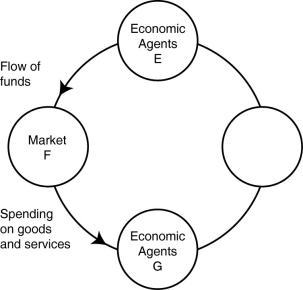 -Refer to Figure 2-17. One segment of the circular flow diagram in the figure shows the flow of funds from economic agents E to market F. Who are economic agents E and what is market F?
Free
(Multiple Choice)
4.7/5 (71)
(71) Correct Answer:Verified
VerifiedA
Figure 2-15  -Refer to Figure 2-15. In the circular flow diagram, market K represents
Free
(Multiple Choice)
4.8/5 (86)
(86) Correct Answer:Verified
VerifiedD
Table 2-13
 Table 2-13 shows the output per day of two pet groomers, Tammi and Horace. They can either devote their time to grooming dogs or bathing cats.
-Refer to Table 2-13. Which of the following statements is true?
Table 2-13 shows the output per day of two pet groomers, Tammi and Horace. They can either devote their time to grooming dogs or bathing cats.
-Refer to Table 2-13. Which of the following statements is true? (Multiple Choice)
4.8/5 (89)
(89) Article Summary
Two U.S. Senators have introduced a bipartisan bill to strengthen patent protection in the United States. The STRONGER Patents Act, designed to improve the patent system, includes provisions which would permit injunctions to protect patent owners against infringement both during and after court cases and guarantee fairness in administrative proceedings by limiting repetitive and harassing challenges against inventors. Changes over the last decade have lessened some U.S. patent rights, while countries such as China and Germany have moved to strengthen their own patent protections. In 2016, the United States fell to 10th place in the U.S. Chamber of Commerce's international ranking of patent system strength.
Source: Brian Pomper, "Senators Coons and Cotton Introduce STRONGER Patents Act of 2017," ipwatchdog.com, June 21, 2017.
-Refer to the Article Summary. If the STRONGER patents Act of 2017 becomes law, all of the following would most likely occur except
(Multiple Choice)
4.9/5 (88)
(88) Table 2-14
 Table 2-14 shows the number of labor hours required to produce a motorcycle and a guitar in Ireland and Scotland.
-Refer to Table 2-14. Ireland has a comparative advantage in the production of
Table 2-14 shows the number of labor hours required to produce a motorcycle and a guitar in Ireland and Scotland.
-Refer to Table 2-14. Ireland has a comparative advantage in the production of (Multiple Choice)
4.8/5 (85)
(85) Figure 2-11  Figure 2-11 shows the production possibilities frontiers for Pakistan and Indonesia. Each country produces two goods, cotton and cashews.
-Refer to Figure 2-11. What is the opportunity cost of producing 1 pound of cashews in Indonesia?
Figure 2-11 shows the production possibilities frontiers for Pakistan and Indonesia. Each country produces two goods, cotton and cashews.
-Refer to Figure 2-11. What is the opportunity cost of producing 1 pound of cashews in Indonesia? (Multiple Choice)
4.9/5 (73)
(73) If additional units of a good could be produced at an increasing opportunity cost, the production possibilities frontier would be linear.
(True/False)
5.0/5 (73)
(73) It is possible to have a comparative advantage in producing a good or service without having an absolute advantage.
(True/False)
5.0/5 (83)
(83) Consider the following items:
a. the novel "A Gentleman in Moscow" by Amor Towles
b. the "The Spirited Shipper," an innovative wine shipping box
c. a Swiss chef's award-winning recipe
d. an original fabric design, for example, the fabric used for "Coach" bags and luggage
Which of the items listed is an example of intellectual property?
(Multiple Choice)
4.8/5 (77)
(77) Figure 2-4  Figure 2-4 shows various points on three different production possibilities frontiers for a nation.
-Refer to Figure 2-4. Consider the following events:
a. an increase in the unemployment rate
b. a decrease in a nation's money supply
c. a war that kills a significant portion of a nation's population
Which of the events listed above could cause a movement from Z to X?
Figure 2-4 shows various points on three different production possibilities frontiers for a nation.
-Refer to Figure 2-4. Consider the following events:
a. an increase in the unemployment rate
b. a decrease in a nation's money supply
c. a war that kills a significant portion of a nation's population
Which of the events listed above could cause a movement from Z to X? (Multiple Choice)
4.9/5 (84)
(84) To compete in the automobile market, Tesla must make many strategic decisions such as whether to introduce a new car model, how to sell and service its cars, and where to advertise. At Tesla's Fremont, California plant, managers must decide on the monthly production quantities of their S and X models. In making this decision, the managers
(Multiple Choice)
4.9/5 (82)
(82) Table 2-20
 Table 2-20 shows the number of labor hours required to produce a wristwatch and a pound of rice in Japan and Thailand.
-Refer to Table 2-20. What is Thailand's opportunity cost of producing one wristwatch?
Table 2-20 shows the number of labor hours required to produce a wristwatch and a pound of rice in Japan and Thailand.
-Refer to Table 2-20. What is Thailand's opportunity cost of producing one wristwatch? (Multiple Choice)
4.9/5 (79)
(79) To increase gas mileage, automobile manufacturers make cars small and light. Large cars absorb more of the impact of an accident than small cars but yield lower gas mileage. These facts suggest that a negative relationship exists between safety and gas mileage.
(True/False)
4.7/5 (89)
(89) Figure 2-4 Figure 2-4 shows various points on three different production possibilities frontiers for a nation.
-Refer to Figure 2-4. A movement from ________ is the result of negative technological change in plastic production.
Figure 2-4 shows various points on three different production possibilities frontiers for a nation.
-Refer to Figure 2-4. A movement from ________ is the result of negative technological change in plastic production. (Multiple Choice)
4.8/5 (78)
(78) Table 2-18
 Table 2-18 shows the output per week of two people, Minnie and Mickey. They can either devote their time to making hats or making umbrellas.
-Refer to Table 2-18. Which of the following statements is true?
Table 2-18 shows the output per week of two people, Minnie and Mickey. They can either devote their time to making hats or making umbrellas.
-Refer to Table 2-18. Which of the following statements is true? (Multiple Choice)
4.7/5 (66)
(66) Table 2-20
Table 2-20 shows the number of labor hours required to produce a wristwatch and a pound of rice in Japan and Thailand.
-Refer to Table 2-20. Japan has a comparative advantage in the production of
Table 2-20 shows the number of labor hours required to produce a wristwatch and a pound of rice in Japan and Thailand.
-Refer to Table 2-20. Japan has a comparative advantage in the production of (Multiple Choice)
4.8/5 (67)
(67) Figure 2-15
-Refer to Figure 2-15. One segment of the circular flow diagram in the figure shows the flow of labor services from market K to economic agents J. What is market K and who are economic agents J?
-Refer to Figure 2-15. One segment of the circular flow diagram in the figure shows the flow of labor services from market K to economic agents J. What is market K and who are economic agents J? (Multiple Choice)
4.9/5 (86)
(86) If the opportunity cost of producing more of one good remains the same as more of that good is produced, then the production method is inefficient.
(True/False)
4.8/5 (81)
(81) 
Filters
- Essay(0)
- Multiple Choice(0)
- Short Answer(0)
- True False(0)
- Matching(0)