



 Chat with AI
Exam 27: Fiscal Policy

Exam 1: Economics: Foundations and Models459 Questions
Exam 2: Trade-Offs, Comparative Advantage, and the Market System492 Questions
Exam 3: Where Prices Come From: the Interaction of Demand and Supply476 Questions
Exam 4: Economic Efficiency, Government Price Setting, and Taxes420 Questions
Exam 5: Externalities, Environmental Policy, and Public Goods262 Questions
Exam 6: Elasticity: the Responsiveness of Demand and Supply293 Questions
Exam 7: The Economics of Health Care337 Questions
Exam 8: Firms, the Stock Market, and Corporate Governance512 Questions
Exam 9: Comparative Advantage and the Gains From International Trade377 Questions
Exam 10: Consumer Choice and Behavioral Economics304 Questions
Exam 11: Technology, Production, and Costs326 Questions
Exam 12: Firms in Perfectly Competitive Markets296 Questions
Exam 13: Monopolistic Competition: the Competitive Model in a More Realistic Setting272 Questions
Exam 14: Oligopoly: Firms in Less Competitive Markets256 Questions
Exam 15: Monopoly and Antitrust Policy279 Questions
Exam 16: Pricing Strategy258 Questions
Exam 17: The Markets for Labor and Other Factors of Production279 Questions
Exam 18: Public Choice, Taxes, and the Distribution of Income258 Questions
Exam 19: Gdp: Measuring Total Production and Income260 Questions
Exam 20: Unemployment and Inflation290 Questions
Exam 21: Economic Growth, the Financial System, and Business Cycles251 Questions
Exam 22: Long-Run Economic Growth: Sources and Policies261 Questions
Exam 23: Aggregate Expenditure and Output in the Short Run305 Questions
Exam 24: Aggregate Demand and Aggregate Supply Analysis286 Questions
Exam 25: Money, Banks, and the Federal Reserve System278 Questions
Exam 26: Monetary Policy280 Questions
Exam 27: Fiscal Policy313 Questions
Exam 28: Inflation, Unemployment, and Federal Reserve Policy257 Questions
Exam 29: Macroeconomics in an Open Economy277 Questions
Exam 30: The International Financial System258 Questions
Select questions type


Expansionary fiscal policy involves

Free
(Multiple Choice)
5.0/5  (73)
(73) Correct Answer: Verified
A
________ and ________ are the largest sources of revenue collected by the federal government.
Free
(Multiple Choice)
4.7/5 (76)
(76) Correct Answer:Verified
VerifiedB
When President Obama took office in January 2009, he pledged to pursue an expansionary fiscal policy to try to pull the economy out of the recession. The next month, Congress passed the American Recovery and Reinvestment Act of 2009, a $840 billion package of ________ that was the largest fiscal policy action in U.S. history.
Free
(Multiple Choice)
4.8/5 (74)
(74) Correct Answer:Verified
VerifiedA
The Social Security and Medicare programs have been a failure in terms of reducing poverty among elderly U.S. citizens.
(True/False)
4.9/5 (73)
(73) The Trump administration's policies to increase labor productivity growth include all of the following except
(Multiple Choice)
5.0/5 (78)
(78) An increase in government spending will force an appreciation of the dollar, which causes net exports to fall.
(True/False)
4.7/5 (97)
(97) Table 27-5
 -Refer to Table 27-5. The economy is in the state described by the table above. Draw the dynamic aggregate demand and aggregate supply diagram to illustrate the state of the economy in year 1 and year 2, assuming that no policy is pursued. Then illustrate and explain the appropriate fiscal policy to use in this situation. Assume that the policy results in the economy producing potential GDP.
 (Essay)
4.9/5 (86)
(86) What is meant by crowding out? Explain the difference between crowding out in the short run and in the long run.
(Essay)
4.8/5 (76)
(76) Assuming a fixed amount of taxes and a closed economy, calculate the value of the government purchases multiplier, the tax multiplier, and the balanced budget multiplier if the marginal propensity to consume equals 0.5.
(Essay)
4.7/5 (94)
(94) A decrease in individual income taxes ________ disposable income, which ________ consumption spending.
(Multiple Choice)
4.7/5 (76)
(76) Figure 27-12 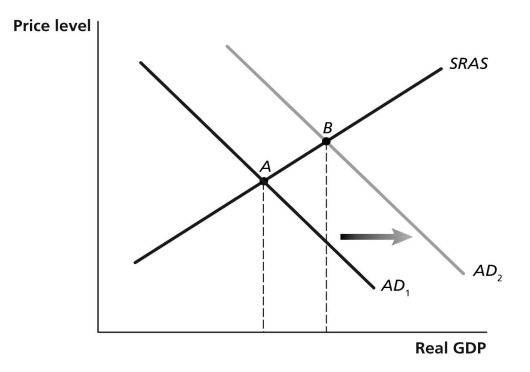 -Refer to Figure 27-12. An increase in government purchases causes aggregate demand to shift ultimately from AD1 to AD2. In the new equilibrium at point B, both real GDP and the price level have increased. The increase in real GDP is ________ than that indicated by the multiplier effect with a constant price level.
 (Multiple Choice)
4.9/5 (85)
(85) Crowding out refers to a decline in ________ as a result of an increase in ________.
(Multiple Choice)
4.7/5 (77)
(77) Borrowing to pay for long-lived capital expenditures makes sense as
(Multiple Choice)
4.8/5 (81)
(81) Table 27-3
 -Refer to Table 27-3. Consider the hypothetical information in the table above for potential real GDP, real GDP, and the price level in 2018 and in 2019 if Congress and the president do not use fiscal policy. If Congress and the president use fiscal policy successfully to keep real GDP at its potential level in 2019, which of the following will be higher than if Congress and the president had taken no action?
 (Multiple Choice)
4.7/5 (67)
(67) Figure 27-3  -Refer to Figure 27-3. In the graph above, suppose the economy is initially at point A. The movement of the economy to point B as shown in the graph illustrates the effect of which of the following policy actions by Congress and the president?
 (Multiple Choice)
4.8/5 (80)
(80) Figure 27-5  -Refer to Figure 27-5. In the dynamic model of AD-AS in the figure above, if the economy is at point A in year 1 and is expected to go to point B in year 2, Congress and the president would most likely pursue
 (Multiple Choice)
4.9/5 (88)
(88) The three categories of federal government expenditures, in addition to government purchases, are
(Multiple Choice)
4.8/5 (80)
(80) As spending on government purchases increases, income rises and money demand falls.
(True/False)
4.8/5 (77)
(77) In preparing their estimates of the stimulus package's effect on GDP, Obama administration economists estimated a government purchases multiplier of 1.57. Economist Robert Barro argues that during wartime, the military expenditures multiplier would be ________ the administration's estimate of the government purchases multiplier, and economists Lawrence Christiano, Martin Eichenbaum, and Sergio Rebelo argued that when short-term interest rates are zero, the government purchases multiplier would be ________ the administration's estimate.
(Multiple Choice)
4.8/5 (89)
(89) 
Filters
- Essay(0)
- Multiple Choice(0)
- Short Answer(0)
- True False(0)
- Matching(0)