



 Chat with AI
Exam 11: Technology, Production, and Costs

Exam 1: Economics: Foundations and Models459 Questions
Exam 2: Trade-Offs, Comparative Advantage, and the Market System492 Questions
Exam 3: Where Prices Come From: the Interaction of Demand and Supply476 Questions
Exam 4: Economic Efficiency, Government Price Setting, and Taxes420 Questions
Exam 5: Externalities, Environmental Policy, and Public Goods262 Questions
Exam 6: Elasticity: the Responsiveness of Demand and Supply293 Questions
Exam 7: The Economics of Health Care337 Questions
Exam 8: Firms, the Stock Market, and Corporate Governance512 Questions
Exam 9: Comparative Advantage and the Gains From International Trade377 Questions
Exam 10: Consumer Choice and Behavioral Economics304 Questions
Exam 11: Technology, Production, and Costs326 Questions
Exam 12: Firms in Perfectly Competitive Markets296 Questions
Exam 13: Monopolistic Competition: the Competitive Model in a More Realistic Setting272 Questions
Exam 14: Oligopoly: Firms in Less Competitive Markets256 Questions
Exam 15: Monopoly and Antitrust Policy279 Questions
Exam 16: Pricing Strategy258 Questions
Exam 17: The Markets for Labor and Other Factors of Production279 Questions
Exam 18: Public Choice, Taxes, and the Distribution of Income258 Questions
Exam 19: Gdp: Measuring Total Production and Income260 Questions
Exam 20: Unemployment and Inflation290 Questions
Exam 21: Economic Growth, the Financial System, and Business Cycles251 Questions
Exam 22: Long-Run Economic Growth: Sources and Policies261 Questions
Exam 23: Aggregate Expenditure and Output in the Short Run305 Questions
Exam 24: Aggregate Demand and Aggregate Supply Analysis286 Questions
Exam 25: Money, Banks, and the Federal Reserve System278 Questions
Exam 26: Monetary Policy280 Questions
Exam 27: Fiscal Policy313 Questions
Exam 28: Inflation, Unemployment, and Federal Reserve Policy257 Questions
Exam 29: Macroeconomics in an Open Economy277 Questions
Exam 30: The International Financial System258 Questions
Select questions type


Vipsana's Gyros House sells gyros. The cost of ingredients (pita, meat, spices, etc.) to make a gyro is $2.00. Vipsana pays her employees $60 per day. She also incurs a fixed cost of $120 per day. Calculate Vipsana's total cost per day when she produces 50 gyros using two workers?

Free
(Multiple Choice)
5.0/5  (77)
(77) Correct Answer: Verified
D
Figure 11-10 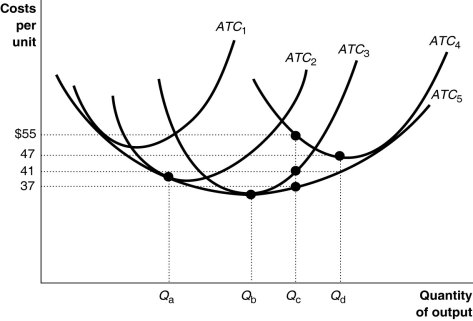 -Refer to Figure 11-10. Suppose for the past 8 years the firm has been producing Qd units per period using plant size ATC4. Now, following a permanent change in demand, it plans to cut production to Qc units. What will happen to its average cost of production?
Free
(Multiple Choice)
5.0/5 (74)
(74) Correct Answer:Verified
VerifiedD
The ABC Company manufactures routers that are used to provide high-speed Internet service. ABC sells an average of 1,000 routers each month, but to exhaust economies of scale in its industry ABC would have to sell 3,000 routers each month. Therefore
(Multiple Choice)
4.8/5 (97)
(97) Jennifer Borts moves her office from the premises she rents at a local mall to her home. As a result of this move
(Multiple Choice)
5.0/5 (76)
(76) Costs that change as output changes are called incremental costs.
(True/False)
4.8/5 (70)
(70) Table 11-5
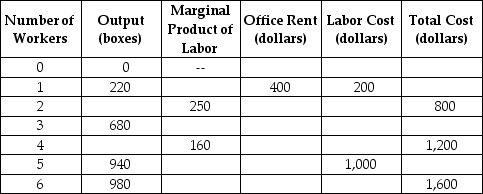 -Refer to Table 11-5. Suzette's Fancy Packaging subcontracts with Sunshineland Pecans to box dried fruit and nuts for Suzette's mail order business. Suzette rents space for her factory for $400 a week in a nearby strip mall. She can hire temporary workers for $200 a week. Table 11-5 above shows her output and cost data. Use the table to answer questions a-e.
a. Complete the table.
b. In the last week of summer Suzette closes her business to go on a family vacation. What are her costs during that week?
c. In one week Suzette exactly breaks even. If her revenue for the week is $1,200, how many boxes of fruit and nuts did she produce?
d. Judging from the marginal product of labor data, would you say that Suzette had to settle for increasingly unproductive workers? Explain your answer.
e. Suzette has received an order for 1,500 boxes of nuts per week for the next 3 months. If she expects the trend in the marginal product of labor will continue in the same direction, what do you think she should do? Should she not commit until she can move to a larger space or should she just hire more workers? Explain your answer.
-Refer to Table 11-5. Suzette's Fancy Packaging subcontracts with Sunshineland Pecans to box dried fruit and nuts for Suzette's mail order business. Suzette rents space for her factory for $400 a week in a nearby strip mall. She can hire temporary workers for $200 a week. Table 11-5 above shows her output and cost data. Use the table to answer questions a-e.
a. Complete the table.
b. In the last week of summer Suzette closes her business to go on a family vacation. What are her costs during that week?
c. In one week Suzette exactly breaks even. If her revenue for the week is $1,200, how many boxes of fruit and nuts did she produce?
d. Judging from the marginal product of labor data, would you say that Suzette had to settle for increasingly unproductive workers? Explain your answer.
e. Suzette has received an order for 1,500 boxes of nuts per week for the next 3 months. If she expects the trend in the marginal product of labor will continue in the same direction, what do you think she should do? Should she not commit until she can move to a larger space or should she just hire more workers? Explain your answer. (Essay)
4.9/5 (83)
(83) An important reason why diseconomies of scale arise is because firms may have to hire lower-skilled workers as firms expand.
(True/False)
4.9/5 (73)
(73) When a firm experiences negative technological change it can produce the same output with fewer inputs.
(True/False)
4.9/5 (78)
(78) When the average total cost is $16 and the total cost is $800, then the number of units the firm is producing is
(Multiple Choice)
4.9/5 (79)
(79) Figure 11-1  -Refer to Figure 11-1. The average product of the 4th worker
 (Multiple Choice)
4.9/5 (81)
(81) If production displays constant returns to scale, then all economies of scale have been exhausted.
(True/False)
4.9/5 (92)
(92) Minimum efficient scale is defined as the level of output at which
(Multiple Choice)
4.7/5 (82)
(82) Table 11-6
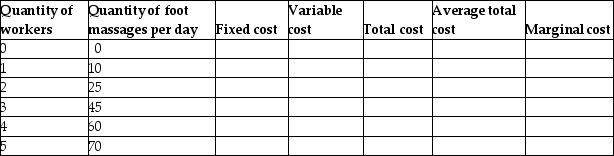 -Refer to Table 11-6. Alicia Gregory owns a foot massage business. She leases 4 computer-controlled massage booths, for which she pays $125 per day. She cannot increase the number machines she leases without giving the manufacturer 3 months notice. She can hire as many workers as she wants at a cost of $75 per day per worker. These are the only two inputs she uses in her business. Use this information to fill in the columns in the above table.
 (Essay)
4.9/5 (72)
(72) On an isoquant/isocost graph, the least cost input combination of producing a given output is
(Multiple Choice)
4.9/5 (80)
(80) If an airport decides to expand by building an additional passenger terminal, and in doing so it lowers its average cost per airplane landing, it was previously operating at
(Multiple Choice)
4.8/5 (71)
(71) Figure 11-3 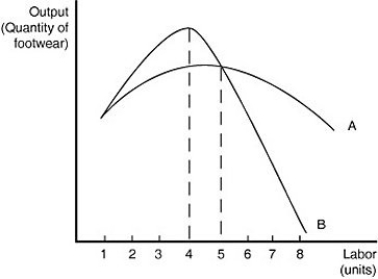 Fancy Footwear manufactures shoes. Figure 11-3 shows Fancy Footwear's marginal product of labor and average product of labor curves in the short run.
-Refer to Figure 11-3. Which of the following statements correctly describes the curves in the figure?
Fancy Footwear manufactures shoes. Figure 11-3 shows Fancy Footwear's marginal product of labor and average product of labor curves in the short run.
-Refer to Figure 11-3. Which of the following statements correctly describes the curves in the figure? (Multiple Choice)
4.8/5 (89)
(89) Table 11-9
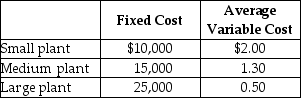 -Refer to Table 11-9. Clock It To Me manufactures clock radios. The table above shows estimates of fixed cost per period and average variable cost for three possible plant sizes.
a. You are employed as the company's cost accountant and have been asked to prepare cost estimates for various output levels for each of the three possible plant sizes. Record your calculations in the table below.
Average Cost of Production
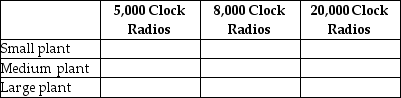 b. For each of the three output levels, which plant size will generate the lowest average total cost of production?
c. Suppose the firm currently sells 8,000 clock radios per period (using the optimal plant size for this output level). Now, however, it has just secured a long-term contract to supply 20,000 clock radios per period. In the short run, what is the average total cost of producing 20,000 clock radios? Provide a numerical value based on your answer in part a.
d. What happens to average total cost of production in the long run? Provide a numerical value based on your answer in part a.
-Refer to Table 11-9. Clock It To Me manufactures clock radios. The table above shows estimates of fixed cost per period and average variable cost for three possible plant sizes.
a. You are employed as the company's cost accountant and have been asked to prepare cost estimates for various output levels for each of the three possible plant sizes. Record your calculations in the table below.
Average Cost of Production
b. For each of the three output levels, which plant size will generate the lowest average total cost of production?
c. Suppose the firm currently sells 8,000 clock radios per period (using the optimal plant size for this output level). Now, however, it has just secured a long-term contract to supply 20,000 clock radios per period. In the short run, what is the average total cost of producing 20,000 clock radios? Provide a numerical value based on your answer in part a.
d. What happens to average total cost of production in the long run? Provide a numerical value based on your answer in part a. (Essay)
4.9/5 (84)
(84) Assume that you observe the long-run average cost curve of ACME Bookstores, a national chain. Starting from the point on the curve where output is zero and moving to the right, which of the following lists the behavior of long-run average costs in the correct sequence (that is, which will be observed first, second, etc.)?
(Multiple Choice)
4.8/5 (88)
(88) 
Filters
- Essay(0)
- Multiple Choice(0)
- Short Answer(0)
- True False(0)
- Matching(0)