



 Chat with AI
Exam 11: Technology, Production, and Costs

Exam 1: Economics: Foundations and Models459 Questions
Exam 2: Trade-Offs, Comparative Advantage, and the Market System492 Questions
Exam 3: Where Prices Come From: the Interaction of Demand and Supply476 Questions
Exam 4: Economic Efficiency, Government Price Setting, and Taxes420 Questions
Exam 5: Externalities, Environmental Policy, and Public Goods262 Questions
Exam 6: Elasticity: the Responsiveness of Demand and Supply293 Questions
Exam 7: The Economics of Health Care337 Questions
Exam 8: Firms, the Stock Market, and Corporate Governance512 Questions
Exam 9: Comparative Advantage and the Gains From International Trade377 Questions
Exam 10: Consumer Choice and Behavioral Economics304 Questions
Exam 11: Technology, Production, and Costs326 Questions
Exam 12: Firms in Perfectly Competitive Markets296 Questions
Exam 13: Monopolistic Competition: the Competitive Model in a More Realistic Setting272 Questions
Exam 14: Oligopoly: Firms in Less Competitive Markets256 Questions
Exam 15: Monopoly and Antitrust Policy279 Questions
Exam 16: Pricing Strategy258 Questions
Exam 17: The Markets for Labor and Other Factors of Production279 Questions
Exam 18: Public Choice, Taxes, and the Distribution of Income258 Questions
Exam 19: Gdp: Measuring Total Production and Income260 Questions
Exam 20: Unemployment and Inflation290 Questions
Exam 21: Economic Growth, the Financial System, and Business Cycles251 Questions
Exam 22: Long-Run Economic Growth: Sources and Policies261 Questions
Exam 23: Aggregate Expenditure and Output in the Short Run305 Questions
Exam 24: Aggregate Demand and Aggregate Supply Analysis286 Questions
Exam 25: Money, Banks, and the Federal Reserve System278 Questions
Exam 26: Monetary Policy280 Questions
Exam 27: Fiscal Policy313 Questions
Exam 28: Inflation, Unemployment, and Federal Reserve Policy257 Questions
Exam 29: Macroeconomics in an Open Economy277 Questions
Exam 30: The International Financial System258 Questions
Select questions type


Figure 11-15  -Refer to Figure 11-15. Suppose Hilda hires labor at $8 per hour and capital costs $10 per unit. What is the minimum cost of producing 200 gooseberry pies?
 (Multiple Choice)
4.8/5  (88)
(88) Which of the following are implicit costs for a typical firm?
(Multiple Choice)
4.8/5 (81)
(81) Table 11-8
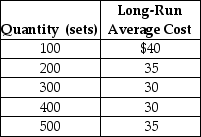 Elegant Settings manufactures stainless steel cutlery. Table 11-8 shows the company's cost data.
-Refer to Table 11-8. Elegant Settings experiences
Elegant Settings manufactures stainless steel cutlery. Table 11-8 shows the company's cost data.
-Refer to Table 11-8. Elegant Settings experiences (Multiple Choice)
4.8/5 (88)
(88) Which of the following are examples of a firm experiencing a positive technological change?
a. A firm is able to reduce its inputs by 15 percent and still produce the same level of output.
b. A seminar attended by the firm's workers makes them more productive.
c. A firm adds 5 percent to its workforce and is able to maintain its initial level of output.
d. A firm restructures its distribution system and is able to save on its shipping times.
e. A firm rearranges its warehouse and finds that it can use fewer workers to maintain its productivity level.
(Essay)
4.8/5 (78)
(78) As output increases, the distance between average total cost and average variable cost increases.
(True/False)
4.9/5 (67)
(67) Stan owns a software design business. He obtained a bank loan to buy computer equipment for his business. He pays $1,000 per month for interest on the loan. He has 10 employees, each of whom is paid $4,000 per month. Because his business has been successful, next month he will increase employee wages to $5,000. If the revenue from his business remains at its current level, Stan is considering an addition to his office. Which of the following statements regarding Stan's business is false?
(Multiple Choice)
4.9/5 (66)
(66) Use the following graph to answer the following questions. 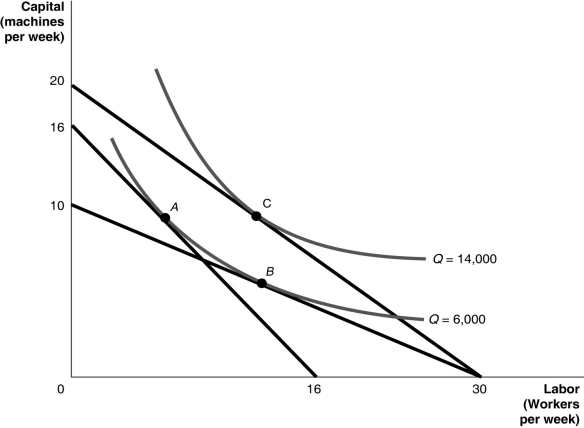 a. If the wage rate and the rental price of machines are both $50 and total cost is $800, is the cost-minimizing point A, B, or C?
b. If the wage rate is $40, the rental price of equipment is $120, and total cost is $1,200, is the cost-minimizing point A, B, or C?
c. If the wage rate is $60, the rental price of equipment is $90, and total cost is $1,800, is the cost-minimizing point A, B, or C?
a. If the wage rate and the rental price of machines are both $50 and total cost is $800, is the cost-minimizing point A, B, or C?
b. If the wage rate is $40, the rental price of equipment is $120, and total cost is $1,200, is the cost-minimizing point A, B, or C?
c. If the wage rate is $60, the rental price of equipment is $90, and total cost is $1,800, is the cost-minimizing point A, B, or C? (Essay)
4.9/5 (76)
(76) A change in the slope of an isocost line is due to a change in
(Multiple Choice)
4.8/5 (89)
(89) Table 11-7
 Table 11-7 shows cost data for Lotus Lanterns, a producer of whimsical night lights.
-Refer to Table 11-7. What is the variable cost of production when the firm produces 115 lanterns?
Table 11-7 shows cost data for Lotus Lanterns, a producer of whimsical night lights.
-Refer to Table 11-7. What is the variable cost of production when the firm produces 115 lanterns? (Multiple Choice)
4.7/5 (77)
(77) Figure 11-1  -Refer to Figure 11-1. The marginal product of the 3rd worker is
 (Multiple Choice)
4.8/5 (79)
(79) Golda Rush quit her job as a manager for Home Depot to start her own hair dressing salon, Goldilocks. She gave up a salary of $40,000 per year, invested her savings of $30,000 (which was earning 5 percent interest) and borrowed $10,000 from a close friend, agreeing to pay 5 percent interest per year. In her first year, Golda spent $18,000 to rent a salon, hired a part-time assistant for $12,000 and incurred another $15,000 in expenses on equipment and hairdressing material. Based on this information, what is the amount of her explicit costs for the first year?
(Multiple Choice)
4.8/5 (87)
(87) If, when a firm doubles all its inputs, its average cost of production increases, then production displays
(Multiple Choice)
4.7/5 (91)
(91) If production displays diseconomies of scale, the long-run average cost curve is
(Multiple Choice)
4.8/5 (81)
(81) If a firm produces 20 units of output and incurs a total cost of $1,000 and a variable cost is $700, calculate the firm's average fixed cost of production if it expands output to 25 units.
(Multiple Choice)
4.9/5 (81)
(81) Figure 11-13  -Refer to Figure 11-13. The lines shown in the diagram are isocost lines. Which of the following shows an increase in the price of labor while the price of capital remains unchanged?
 (Multiple Choice)
4.8/5 (77)
(77) 
Filters
- Essay(0)
- Multiple Choice(0)
- Short Answer(0)
- True False(0)
- Matching(0)