



 Chat with AI
Exam 11: Technology, Production, and Costs

Exam 1: Economics: Foundations and Models459 Questions
Exam 2: Trade-Offs, Comparative Advantage, and the Market System492 Questions
Exam 3: Where Prices Come From: the Interaction of Demand and Supply476 Questions
Exam 4: Economic Efficiency, Government Price Setting, and Taxes420 Questions
Exam 5: Externalities, Environmental Policy, and Public Goods262 Questions
Exam 6: Elasticity: the Responsiveness of Demand and Supply293 Questions
Exam 7: The Economics of Health Care337 Questions
Exam 8: Firms, the Stock Market, and Corporate Governance512 Questions
Exam 9: Comparative Advantage and the Gains From International Trade377 Questions
Exam 10: Consumer Choice and Behavioral Economics304 Questions
Exam 11: Technology, Production, and Costs326 Questions
Exam 12: Firms in Perfectly Competitive Markets296 Questions
Exam 13: Monopolistic Competition: the Competitive Model in a More Realistic Setting272 Questions
Exam 14: Oligopoly: Firms in Less Competitive Markets256 Questions
Exam 15: Monopoly and Antitrust Policy279 Questions
Exam 16: Pricing Strategy258 Questions
Exam 17: The Markets for Labor and Other Factors of Production279 Questions
Exam 18: Public Choice, Taxes, and the Distribution of Income258 Questions
Exam 19: Gdp: Measuring Total Production and Income260 Questions
Exam 20: Unemployment and Inflation290 Questions
Exam 21: Economic Growth, the Financial System, and Business Cycles251 Questions
Exam 22: Long-Run Economic Growth: Sources and Policies261 Questions
Exam 23: Aggregate Expenditure and Output in the Short Run305 Questions
Exam 24: Aggregate Demand and Aggregate Supply Analysis286 Questions
Exam 25: Money, Banks, and the Federal Reserve System278 Questions
Exam 26: Monetary Policy280 Questions
Exam 27: Fiscal Policy313 Questions
Exam 28: Inflation, Unemployment, and Federal Reserve Policy257 Questions
Exam 29: Macroeconomics in an Open Economy277 Questions
Exam 30: The International Financial System258 Questions
Select questions type


The slope of a typical isoquant is negative because to produce a given output, a producer
(Multiple Choice)
4.9/5  (81)
(81) Table 11-2
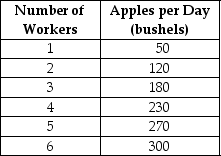 Table 11-2 summarizes production at the Crunchy Apple Orchard for the month of April.
-Refer to Table 11-2. What is the average product of labor when the orchard employs 5 workers?
Table 11-2 summarizes production at the Crunchy Apple Orchard for the month of April.
-Refer to Table 11-2. What is the average product of labor when the orchard employs 5 workers? (Multiple Choice)
4.7/5 (84)
(84) What is minimum efficient scale? What is likely to happen in the long run to firms that do not reach minimum efficient scale?
(Essay)
4.8/5 (84)
(84) Ford Motor Company started producing the Model A at plants scattered around the United States
(Multiple Choice)
4.8/5 (72)
(72) Which of the following statements regarding a firm's long-run average total cost (LRATC) curve and its short-run average total cost (SRATC) curve is true?
(Multiple Choice)
4.9/5 (87)
(87) Which of the following can a firm do in the long run but not in the short run?
(Multiple Choice)
4.8/5 (92)
(92) Figure 11-16 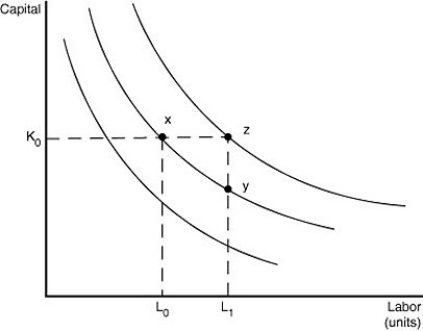 -Refer to Figure 11-16. The figure above illustrates a series of isoquants. Which of the following statements is true?
 (Multiple Choice)
4.9/5 (69)
(69) Figure 11-18  -Refer to Figure 11-18. Starting from point D, a movement along isoquant2 to point F
 (Multiple Choice)
4.8/5 (82)
(82) Table 11-2
Table 11-2 summarizes production at the Crunchy Apple Orchard for the month of April.
-Refer to Table 11-2. What is the marginal product of the 4th worker?
Table 11-2 summarizes production at the Crunchy Apple Orchard for the month of April.
-Refer to Table 11-2. What is the marginal product of the 4th worker? (Multiple Choice)
4.9/5 (78)
(78) Are the costs of utilities always fixed, always variable, or can they be both? Briefly explain.
(Essay)
4.8/5 (83)
(83) If a firm decreases its plant size and finds that its long-run average costs have decreased, then
(Multiple Choice)
4.7/5 (91)
(91) After Suzie, owner of Suzie's Sweet Shop, hires her 8th worker the average product of labor declines. Which of the following statements must be true?
(Multiple Choice)
4.8/5 (67)
(67) Diminishing marginal product of labor occurs when adding another unit of labor
(Multiple Choice)
5.0/5 (89)
(89) Which of the following is a factor of production that generally is fixed in the short run?
(Multiple Choice)
4.9/5 (73)
(73) Table 11-1
 Table 11-1 shows the technology of production at the Matsuko's Mushroom Farm for the month of May.
-Refer to Table 11-1. What is the average product of labor when the farm hires 5 workers?
Table 11-1 shows the technology of production at the Matsuko's Mushroom Farm for the month of May.
-Refer to Table 11-1. What is the average product of labor when the farm hires 5 workers? (Multiple Choice)
4.9/5 (72)
(72) If average product is decreasing, then marginal product must be negative.
(True/False)
4.7/5 (87)
(87) The absolute value of the slope of an isocost line equals the ratio of
(Multiple Choice)
4.8/5 (86)
(86) 
Filters
- Essay(0)
- Multiple Choice(0)
- Short Answer(0)
- True False(0)
- Matching(0)