



 Chat with AI
Exam 21: Economic Growth, the Financial System, and Business Cycles

Exam 1: Economics: Foundations and Models459 Questions
Exam 2: Trade-Offs, Comparative Advantage, and the Market System492 Questions
Exam 3: Where Prices Come From: the Interaction of Demand and Supply476 Questions
Exam 4: Economic Efficiency, Government Price Setting, and Taxes420 Questions
Exam 5: Externalities, Environmental Policy, and Public Goods262 Questions
Exam 6: Elasticity: the Responsiveness of Demand and Supply293 Questions
Exam 7: The Economics of Health Care337 Questions
Exam 8: Firms, the Stock Market, and Corporate Governance512 Questions
Exam 9: Comparative Advantage and the Gains From International Trade377 Questions
Exam 10: Consumer Choice and Behavioral Economics304 Questions
Exam 11: Technology, Production, and Costs326 Questions
Exam 12: Firms in Perfectly Competitive Markets296 Questions
Exam 13: Monopolistic Competition: the Competitive Model in a More Realistic Setting272 Questions
Exam 14: Oligopoly: Firms in Less Competitive Markets256 Questions
Exam 15: Monopoly and Antitrust Policy279 Questions
Exam 16: Pricing Strategy258 Questions
Exam 17: The Markets for Labor and Other Factors of Production279 Questions
Exam 18: Public Choice, Taxes, and the Distribution of Income258 Questions
Exam 19: Gdp: Measuring Total Production and Income260 Questions
Exam 20: Unemployment and Inflation290 Questions
Exam 21: Economic Growth, the Financial System, and Business Cycles251 Questions
Exam 22: Long-Run Economic Growth: Sources and Policies261 Questions
Exam 23: Aggregate Expenditure and Output in the Short Run305 Questions
Exam 24: Aggregate Demand and Aggregate Supply Analysis286 Questions
Exam 25: Money, Banks, and the Federal Reserve System278 Questions
Exam 26: Monetary Policy280 Questions
Exam 27: Fiscal Policy313 Questions
Exam 28: Inflation, Unemployment, and Federal Reserve Policy257 Questions
Exam 29: Macroeconomics in an Open Economy277 Questions
Exam 30: The International Financial System258 Questions
Select questions type


If, between 2008 and 2018, the economy's real GDP grew from $20 billion to $40 billion, what was the average annual growth rate in the economy?

Free
(Multiple Choice)
4.8/5  (94)
(94) Correct Answer: Verified
B
An increase in the real interest rate results in which of the following?
Free
(Multiple Choice)
4.8/5 (83)
(83) Correct Answer:Verified
VerifiedC
Countries with high rates of economic growth tend to have
Free
(Multiple Choice)
4.9/5 (79)
(79) Correct Answer:Verified
VerifiedA
Potential GDP was estimated to grow at a rate of 3.2% from 1949-2017 in the United States. Actual GDP in the U.S.
(Multiple Choice)
4.8/5 (86)
(86) An increase in the real interest rate will decrease consumption and investment.
(True/False)
4.9/5 (79)
(79) Workers in high-income countries have ________ to work with than do workers in low-income countries.
(Multiple Choice)
4.8/5 (66)
(66) If an economy is growing at a rate of 2.5% per year, how long will it take the economy to double in size?
(Multiple Choice)
4.8/5 (79)
(79) Which of the following financial securities is most liquid?
(Multiple Choice)
4.9/5 (77)
(77) If taxes are less than transfers plus government spending, then
(Multiple Choice)
4.9/5 (84)
(84) The U.S. federal government has experienced dramatic swings in the state of its budget over the past 20 years.
(True/False)
4.8/5 (72)
(72) A period of economic expansion ends with a business cycle trough.
(True/False)
4.8/5 (72)
(72) Table 21-1
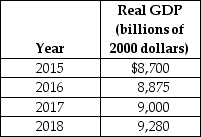 -Refer to Table 21-1. Using the table above, what is the approximate average annual growth rate from 2015 to 2018?
 (Multiple Choice)
4.9/5 (99)
(99) Most economists believe that the return of ________ during the 2007-2009 recession is a key reason why the recession was so severe.
(Multiple Choice)
4.8/5 (65)
(65) In a closed economy, private saving is equal to which of the following? (Y = GDP, C = Consumption, G = Government purchases, T = Taxes, and TR = Transfers)
(Multiple Choice)
4.9/5 (88)
(88) 
Filters
- Essay(0)
- Multiple Choice(0)
- Short Answer(0)
- True False(0)
- Matching(0)