



 Chat with AI
Exam 21: Economic Growth, the Financial System, and Business Cycles

Exam 1: Economics: Foundations and Models459 Questions
Exam 2: Trade-Offs, Comparative Advantage, and the Market System492 Questions
Exam 3: Where Prices Come From: the Interaction of Demand and Supply476 Questions
Exam 4: Economic Efficiency, Government Price Setting, and Taxes420 Questions
Exam 5: Externalities, Environmental Policy, and Public Goods262 Questions
Exam 6: Elasticity: the Responsiveness of Demand and Supply293 Questions
Exam 7: The Economics of Health Care337 Questions
Exam 8: Firms, the Stock Market, and Corporate Governance512 Questions
Exam 9: Comparative Advantage and the Gains From International Trade377 Questions
Exam 10: Consumer Choice and Behavioral Economics304 Questions
Exam 11: Technology, Production, and Costs326 Questions
Exam 12: Firms in Perfectly Competitive Markets296 Questions
Exam 13: Monopolistic Competition: the Competitive Model in a More Realistic Setting272 Questions
Exam 14: Oligopoly: Firms in Less Competitive Markets256 Questions
Exam 15: Monopoly and Antitrust Policy279 Questions
Exam 16: Pricing Strategy258 Questions
Exam 17: The Markets for Labor and Other Factors of Production279 Questions
Exam 18: Public Choice, Taxes, and the Distribution of Income258 Questions
Exam 19: Gdp: Measuring Total Production and Income260 Questions
Exam 20: Unemployment and Inflation290 Questions
Exam 21: Economic Growth, the Financial System, and Business Cycles251 Questions
Exam 22: Long-Run Economic Growth: Sources and Policies261 Questions
Exam 23: Aggregate Expenditure and Output in the Short Run305 Questions
Exam 24: Aggregate Demand and Aggregate Supply Analysis286 Questions
Exam 25: Money, Banks, and the Federal Reserve System278 Questions
Exam 26: Monetary Policy280 Questions
Exam 27: Fiscal Policy313 Questions
Exam 28: Inflation, Unemployment, and Federal Reserve Policy257 Questions
Exam 29: Macroeconomics in an Open Economy277 Questions
Exam 30: The International Financial System258 Questions
Select questions type


Economic growth depends more on technological change than on increases on capital per hour worked.
(True/False)
4.8/5  (86)
(86) If Ebenezer Scrooge spends rather than saves his vast wealth, he will
(Multiple Choice)
4.8/5 (70)
(70) ________ are financial securities that represent promises to repay a fixed amount of funds.
(Multiple Choice)
4.9/5 (85)
(85) Suppose you are an advisor to the Business Cycle Dating Committee. You are asked to look at macroeconomic data to evaluate whether the economy has entered a recession this year. Which data do you look at? How does the economy behave at the onset of a recession?
(Essay)
4.8/5 (83)
(83) The key to sustained economic growth is increasing labor productivity.
(True/False)
4.8/5 (88)
(88) Because of technological change, oil companies like Chevron were able to produce almost twice as much output from refineries in 2016 as in 1950 while using 60 percent fewer workers. This represents ________ in output per worker, which is also known as ________.
(Multiple Choice)
4.7/5 (86)
(86) ________ is the ease with which a financial security can be exchanged for money.
(Multiple Choice)
4.7/5 (78)
(78) If, in a closed economy, real GDP is $30 billion, consumption is $20 billion, and government purchases are $5 billion, what is total saving in the economy?
(Multiple Choice)
4.8/5 (73)
(73) What factors increase potential GDP? Include a definition of potential GDP in your answer.
(Essay)
4.9/5 (92)
(92) Under which of the following circumstances would the government be running a deficit?
(Multiple Choice)
4.9/5 (69)
(69) Figure 21-6  -Refer to Figure 21-6. The loanable funds market is in equilibrium, as shown in the figure above. As a result of an increase in the government budget deficit, the ________ for loanable funds will ________, thereby ________ the equilibrium real interest rate and ________ the equilibrium quantity of loanable funds.
 (Multiple Choice)
4.8/5 (71)
(71) The demand for loanable funds has a ________ slope because the lower the interest rate, the ________ number of investment projects are profitable, and the ________ the quantity of loanable funds demanded.
(Multiple Choice)
4.8/5 (70)
(70) Figure 21-3 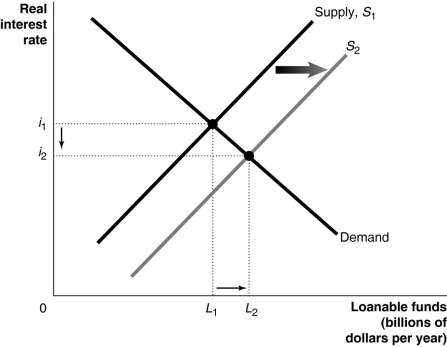 -Refer to Figure 21-3. Which of the following is consistent with the graph depicted above?
 (Multiple Choice)
4.7/5 (88)
(88) Describe what happens to inflation during the business cycle. Give an intuitive explanation as to why inflation changes the way it does over the business cycle.
(Essay)
4.8/5 (83)
(83) As the economy nears the end of an expansion, which of the following do we typically see?
(Multiple Choice)
4.8/5 (91)
(91) According to Robert Fogel, economic growth ________ health, and health ________ economic growth.
(Multiple Choice)
4.8/5 (84)
(84) How has economist Robert Fogel explained that economic growth is connected to life expectancy? Based on this connection, in what country would you expect to have a longer life expectancy, the United States or India? Explain.
(Essay)
5.0/5 (77)
(77) How does a decrease in the tax rate on income earned on saving affect saving, investment, the interest rate, and economic growth?
(Essay)
4.8/5 (74)
(74) 
Filters
- Essay(0)
- Multiple Choice(0)
- Short Answer(0)
- True False(0)
- Matching(0)