



 Chat with AI
Exam 21: Economic Growth, the Financial System, and Business Cycles

Exam 1: Economics: Foundations and Models459 Questions
Exam 2: Trade-Offs, Comparative Advantage, and the Market System492 Questions
Exam 3: Where Prices Come From: the Interaction of Demand and Supply476 Questions
Exam 4: Economic Efficiency, Government Price Setting, and Taxes420 Questions
Exam 5: Externalities, Environmental Policy, and Public Goods262 Questions
Exam 6: Elasticity: the Responsiveness of Demand and Supply293 Questions
Exam 7: The Economics of Health Care337 Questions
Exam 8: Firms, the Stock Market, and Corporate Governance512 Questions
Exam 9: Comparative Advantage and the Gains From International Trade377 Questions
Exam 10: Consumer Choice and Behavioral Economics304 Questions
Exam 11: Technology, Production, and Costs326 Questions
Exam 12: Firms in Perfectly Competitive Markets296 Questions
Exam 13: Monopolistic Competition: the Competitive Model in a More Realistic Setting272 Questions
Exam 14: Oligopoly: Firms in Less Competitive Markets256 Questions
Exam 15: Monopoly and Antitrust Policy279 Questions
Exam 16: Pricing Strategy258 Questions
Exam 17: The Markets for Labor and Other Factors of Production279 Questions
Exam 18: Public Choice, Taxes, and the Distribution of Income258 Questions
Exam 19: Gdp: Measuring Total Production and Income260 Questions
Exam 20: Unemployment and Inflation290 Questions
Exam 21: Economic Growth, the Financial System, and Business Cycles251 Questions
Exam 22: Long-Run Economic Growth: Sources and Policies261 Questions
Exam 23: Aggregate Expenditure and Output in the Short Run305 Questions
Exam 24: Aggregate Demand and Aggregate Supply Analysis286 Questions
Exam 25: Money, Banks, and the Federal Reserve System278 Questions
Exam 26: Monetary Policy280 Questions
Exam 27: Fiscal Policy313 Questions
Exam 28: Inflation, Unemployment, and Federal Reserve Policy257 Questions
Exam 29: Macroeconomics in an Open Economy277 Questions
Exam 30: The International Financial System258 Questions
Select questions type


The NBER's Business Cycle Dating Committee defines a recession as at least two consecutive quarters of falling real GDP.
(True/False)
4.8/5  (72)
(72) Which of the following explains why fluctuations in real GDP have become less volatile in the United States since 1950?
(Multiple Choice)
4.8/5 (73)
(73) Long-run economic growth requires all of the following except
(Multiple Choice)
4.9/5 (70)
(70) During a recession, spending on ________ tends to fall more dramatically than spending on ________.
(Multiple Choice)
4.9/5 (69)
(69) Which of the following will result in an increase in labor productivity?
(Multiple Choice)
4.9/5 (82)
(82) Figure 21-1 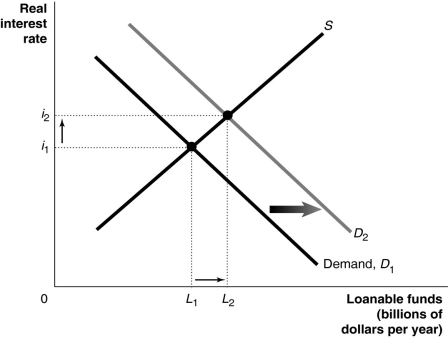 -Refer to Figure 21-1. Which of the following is consistent with the graph depicted above?
 (Multiple Choice)
4.8/5 (71)
(71) Financial securities that represent promises to repay a fixed amount of funds are known as
(Multiple Choice)
4.7/5 (74)
(74) The response of investment spending to an increase in the government budget deficit is called
(Multiple Choice)
4.9/5 (86)
(86) Retained earnings are always sufficient to finance a firm's rapid expansion in a high-growth economy.
(True/False)
4.8/5 (80)
(80) Which of the following would encourage economic growth through increases in the capital stock?
(Multiple Choice)
5.0/5 (79)
(79) An increase in the government budget deficit will shift the ________ curve for loanable funds to the ________ and the equilibrium real interest rate will ________.
(Multiple Choice)
4.9/5 (80)
(80) At the end of an expansion, wages of workers are usually rising faster than prices.
(True/False)
4.9/5 (90)
(90) What is labor productivity? How does a country's standard of living relate to labor productivity?
(Essay)
4.9/5 (83)
(83) Economist Robert Fogel has estimated that by the year 2040, individuals in the United States will be spending
(Multiple Choice)
4.9/5 (75)
(75) Figure 21-2 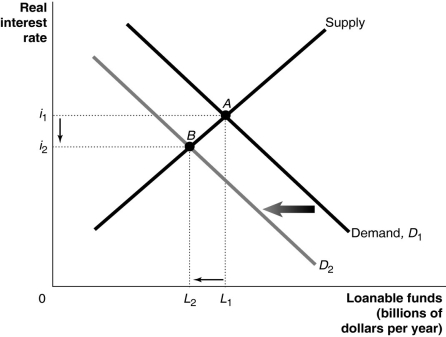 -Refer to Figure 21-2. Which of the following is consistent with the graph depicted above?
 (Multiple Choice)
4.9/5 (71)
(71) Recessions typically cause the unemployment rate to ________ and the inflation rate to ________.
(Multiple Choice)
4.9/5 (80)
(80) Accumulating a greater number of inputs will ensure that an economy will experience economic growth.
(True/False)
4.8/5 (90)
(90) Inflation tends to ________ during the expansion phase of the business cycle and ________ during the recession phase of the business cycle.
(Multiple Choice)
4.8/5 (80)
(80) 
Filters
- Essay(0)
- Multiple Choice(0)
- Short Answer(0)
- True False(0)
- Matching(0)