



 Chat with AI
Exam 21: Economic Growth, the Financial System, and Business Cycles

Exam 1: Economics: Foundations and Models459 Questions
Exam 2: Trade-Offs, Comparative Advantage, and the Market System492 Questions
Exam 3: Where Prices Come From: the Interaction of Demand and Supply476 Questions
Exam 4: Economic Efficiency, Government Price Setting, and Taxes420 Questions
Exam 5: Externalities, Environmental Policy, and Public Goods262 Questions
Exam 6: Elasticity: the Responsiveness of Demand and Supply293 Questions
Exam 7: The Economics of Health Care337 Questions
Exam 8: Firms, the Stock Market, and Corporate Governance512 Questions
Exam 9: Comparative Advantage and the Gains From International Trade377 Questions
Exam 10: Consumer Choice and Behavioral Economics304 Questions
Exam 11: Technology, Production, and Costs326 Questions
Exam 12: Firms in Perfectly Competitive Markets296 Questions
Exam 13: Monopolistic Competition: the Competitive Model in a More Realistic Setting272 Questions
Exam 14: Oligopoly: Firms in Less Competitive Markets256 Questions
Exam 15: Monopoly and Antitrust Policy279 Questions
Exam 16: Pricing Strategy258 Questions
Exam 17: The Markets for Labor and Other Factors of Production279 Questions
Exam 18: Public Choice, Taxes, and the Distribution of Income258 Questions
Exam 19: Gdp: Measuring Total Production and Income260 Questions
Exam 20: Unemployment and Inflation290 Questions
Exam 21: Economic Growth, the Financial System, and Business Cycles251 Questions
Exam 22: Long-Run Economic Growth: Sources and Policies261 Questions
Exam 23: Aggregate Expenditure and Output in the Short Run305 Questions
Exam 24: Aggregate Demand and Aggregate Supply Analysis286 Questions
Exam 25: Money, Banks, and the Federal Reserve System278 Questions
Exam 26: Monetary Policy280 Questions
Exam 27: Fiscal Policy313 Questions
Exam 28: Inflation, Unemployment, and Federal Reserve Policy257 Questions
Exam 29: Macroeconomics in an Open Economy277 Questions
Exam 30: The International Financial System258 Questions
Select questions type


In 2003, Congress passed a tax cut that included a reduction in the marginal tax rate on stock dividends. This essentially increased the after-tax rate of return on stocks that offer dividends. Using the loanable funds market, describe what will happen to saving, investment, economic growth, the real interest rate, and the quantity of loanable funds exchanged.
(Essay)
4.9/5  (79)
(79) Given the following economic data, what is the value of investment in a closed economy? Y = $10 trillion
C = $5 trillion
TR = $2 trillion
G = $2 trillion
(Multiple Choice)
4.9/5 (70)
(70) In comparison to a government that runs a balanced budget, when the government runs a budget deficit
(Multiple Choice)
4.9/5 (86)
(86) Table 21-1
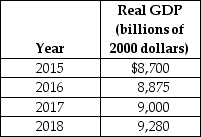 -Refer to Table 21-1. Using the table above, what is the approximate growth rate of real GDP from 2017 to 2018?
 (Multiple Choice)
4.9/5 (78)
(78) The only way the standard of living of the average person in a country can increase is if ________ increases faster than ________.
(Multiple Choice)
4.8/5 (84)
(84) Which of the following is not a reason why the U.S. economy has been more stable since 1950?
(Multiple Choice)
4.9/5 (78)
(78) In the United States, the average length of expansions from 1950 to 2009 was more than twice as long than they were from 1900 to 1950.
(True/False)
5.0/5 (81)
(81) Increases in real GDP since 1900 can actually underestimate growth in the standard of living for Americans since 1900 because
(Multiple Choice)
4.9/5 (81)
(81) According to the "Rule of 70," it will take 4 years for real GDP per capita to double when the growth rate of real GDP per capita is
(Multiple Choice)
4.8/5 (70)
(70) Figure 21-6  -Refer to Figure 21-6. The loanable funds market is in equilibrium, as shown in the figure above. An increase in the supply of loanable funds could result in which of the following combinations of the real interest rate and quantity of loanable funds at a new equilibrium?
 (Multiple Choice)
4.9/5 (81)
(81) A recession often begins with a(n) ________ in spending by firms on capital goods and a(n) ________ in spending on durable goods by households.
(Multiple Choice)
4.9/5 (79)
(79) Which of the following statements describes the experiences of Chevron since it became independent in 1911?
(Multiple Choice)
4.9/5 (81)
(81) Which of the following is not one of the key services provided by the financial system?
(Multiple Choice)
4.9/5 (71)
(71) According to the National Bureau of Economic Research, the recession that began in December 2007
(Multiple Choice)
4.9/5 (77)
(77) Give three reasons why the U.S. economy was more stable from 1950-2007 than it was prior to 1950.
(Essay)
4.9/5 (88)
(88) Economists have not found a way to predict when recessions will begin and end.
(True/False)
4.8/5 (73)
(73) Outline the various actions the government sector could take to promote growth.
(Essay)
4.7/5 (80)
(80) 
Filters
- Essay(0)
- Multiple Choice(0)
- Short Answer(0)
- True False(0)
- Matching(0)