



 Chat with AI
Exam 11: Technology, Production, and Costs

Exam 1: Economics: Foundations and Models459 Questions
Exam 2: Trade-Offs, Comparative Advantage, and the Market System492 Questions
Exam 3: Where Prices Come From: the Interaction of Demand and Supply476 Questions
Exam 4: Economic Efficiency, Government Price Setting, and Taxes420 Questions
Exam 5: Externalities, Environmental Policy, and Public Goods262 Questions
Exam 6: Elasticity: the Responsiveness of Demand and Supply293 Questions
Exam 7: The Economics of Health Care337 Questions
Exam 8: Firms, the Stock Market, and Corporate Governance512 Questions
Exam 9: Comparative Advantage and the Gains From International Trade377 Questions
Exam 10: Consumer Choice and Behavioral Economics304 Questions
Exam 11: Technology, Production, and Costs326 Questions
Exam 12: Firms in Perfectly Competitive Markets296 Questions
Exam 13: Monopolistic Competition: the Competitive Model in a More Realistic Setting272 Questions
Exam 14: Oligopoly: Firms in Less Competitive Markets256 Questions
Exam 15: Monopoly and Antitrust Policy279 Questions
Exam 16: Pricing Strategy258 Questions
Exam 17: The Markets for Labor and Other Factors of Production279 Questions
Exam 18: Public Choice, Taxes, and the Distribution of Income258 Questions
Exam 19: Gdp: Measuring Total Production and Income260 Questions
Exam 20: Unemployment and Inflation290 Questions
Exam 21: Economic Growth, the Financial System, and Business Cycles251 Questions
Exam 22: Long-Run Economic Growth: Sources and Policies261 Questions
Exam 23: Aggregate Expenditure and Output in the Short Run305 Questions
Exam 24: Aggregate Demand and Aggregate Supply Analysis286 Questions
Exam 25: Money, Banks, and the Federal Reserve System278 Questions
Exam 26: Monetary Policy280 Questions
Exam 27: Fiscal Policy313 Questions
Exam 28: Inflation, Unemployment, and Federal Reserve Policy257 Questions
Exam 29: Macroeconomics in an Open Economy277 Questions
Exam 30: The International Financial System258 Questions
Select questions type


Figure 11-18  -Refer to Figure 11-18. A curve that connects points A, D, and E is called
 (Multiple Choice)
4.9/5  (93)
(93) A firm has successfully adopted a positive technological change when
(Multiple Choice)
4.7/5 (88)
(88) Two stores-Lazy Guys and Ralph's Recliners-are located in the same city. Both stores buy recliner chairs from the same manufacturer at the same price and both stores are about the same size, so that the fixed costs of production for both stores are the same. Ralph's Recliners sells more recliners per month and Ralph's has a lower average total cost of production. Which of the following can explain why the average total cost of production is lower for Ralph's Recliners?
(Multiple Choice)
4.9/5 (73)
(73) Figure 11-12  -Refer to Figure 11-12. Which of the following statements about the input combinations shown in the diagram is false?
 (Multiple Choice)
4.8/5 (81)
(81) Adam spent $10,000 on new equipment for his small business, "Adam's Fitness Studio." Membership at his fitness center is very low and at this rate, Adam needs an additional $12,000 per year to keep his studio open. Which of the following is true?
(Multiple Choice)
4.8/5 (78)
(78) Figure 11-13  -Refer to Figure 11-13. The lines shown in the diagram are isocost lines. A movement from CE to BD occurs when
 (Multiple Choice)
4.7/5 (88)
(88) Figure 11-10 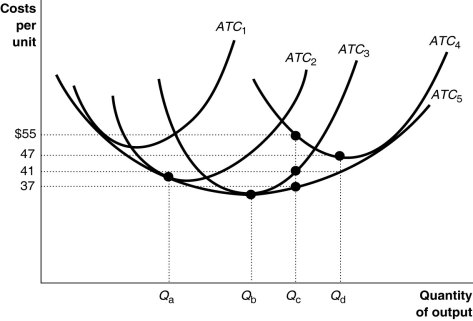 -Refer to Figure 11-10. Identify the minimum efficient scale of production.
 (Multiple Choice)
5.0/5 (68)
(68) To improve delivery, Joe's Pizza Emporium made a change that involved taking better account of traffic to avoid delays in delivering pizzas. This is an example of
(Multiple Choice)
4.8/5 (90)
(90) Which of the following is not a source of technological advancement for a producer?
(Multiple Choice)
4.7/5 (84)
(84) Is it possible for average total cost to be decreasing over a range of output where marginal cost is increasing? Briefly explain.
(Essay)
4.7/5 (74)
(74) If a firm's long-run average total curve shows that it can produce 5,000 DVDs at an average cost of $2.00 and 15,000 DVDs at an average cost of $1.50, this is evidence of
(Multiple Choice)
4.8/5 (85)
(85) The slope of an isoquant is equal to the ratio of the price of the input on the horizontal axis divided by the price of the input on the vertical axis, multiplied by -1.
(True/False)
5.0/5 (70)
(70) In economics, what is the difference between the short run and the long run?
(Essay)
4.9/5 (87)
(87) 
Filters
- Essay(0)
- Multiple Choice(0)
- Short Answer(0)
- True False(0)
- Matching(0)