



 Chat with AI
Exam 27: Fiscal Policy

Exam 1: Economics: Foundations and Models459 Questions
Exam 2: Trade-Offs, Comparative Advantage, and the Market System492 Questions
Exam 3: Where Prices Come From: the Interaction of Demand and Supply476 Questions
Exam 4: Economic Efficiency, Government Price Setting, and Taxes420 Questions
Exam 5: Externalities, Environmental Policy, and Public Goods262 Questions
Exam 6: Elasticity: the Responsiveness of Demand and Supply293 Questions
Exam 7: The Economics of Health Care337 Questions
Exam 8: Firms, the Stock Market, and Corporate Governance512 Questions
Exam 9: Comparative Advantage and the Gains From International Trade377 Questions
Exam 10: Consumer Choice and Behavioral Economics304 Questions
Exam 11: Technology, Production, and Costs326 Questions
Exam 12: Firms in Perfectly Competitive Markets296 Questions
Exam 13: Monopolistic Competition: the Competitive Model in a More Realistic Setting272 Questions
Exam 14: Oligopoly: Firms in Less Competitive Markets256 Questions
Exam 15: Monopoly and Antitrust Policy279 Questions
Exam 16: Pricing Strategy258 Questions
Exam 17: The Markets for Labor and Other Factors of Production279 Questions
Exam 18: Public Choice, Taxes, and the Distribution of Income258 Questions
Exam 19: Gdp: Measuring Total Production and Income260 Questions
Exam 20: Unemployment and Inflation290 Questions
Exam 21: Economic Growth, the Financial System, and Business Cycles251 Questions
Exam 22: Long-Run Economic Growth: Sources and Policies261 Questions
Exam 23: Aggregate Expenditure and Output in the Short Run305 Questions
Exam 24: Aggregate Demand and Aggregate Supply Analysis286 Questions
Exam 25: Money, Banks, and the Federal Reserve System278 Questions
Exam 26: Monetary Policy280 Questions
Exam 27: Fiscal Policy313 Questions
Exam 28: Inflation, Unemployment, and Federal Reserve Policy257 Questions
Exam 29: Macroeconomics in an Open Economy277 Questions
Exam 30: The International Financial System258 Questions
Select questions type


Active changes in tax and spending by government intended to smooth out the business cycle are called ________, and changes in taxes and spending that occur passively over the business cycle are called ________.
(Multiple Choice)
4.8/5  (76)
(76) Which of the following statements about the Social Security, Medicare, and Medicaid programs is true?
(Multiple Choice)
4.9/5 (79)
(79) The tax multiplier equals the change in ________ divided by the change in ________.
(Multiple Choice)
4.9/5 (60)
(60) Tax cuts on business income increase aggregate demand by increasing
(Multiple Choice)
4.7/5 (74)
(74) The Trump administration hopes that its program of infrastructure spending might expand employment by luring some prime-age workers back into the labor force. This would ________ the employment-population ratio, which would increase ________.
(Multiple Choice)
4.8/5 (90)
(90) In recent economic history, the U.S. federal budget was in surplus from
(Multiple Choice)
4.9/5 (95)
(95) Historically, the largest U.S. federal budget deficits as a percentage of GDP in the 20th century occurred during
(Multiple Choice)
4.8/5 (72)
(72) Which of the following is a government expenditure, but is not a government purchase?
(Multiple Choice)
4.9/5 (91)
(91) In an open economy, the government purchases multiplier will be
(Multiple Choice)
4.8/5 (92)
(92) Figure 27-1 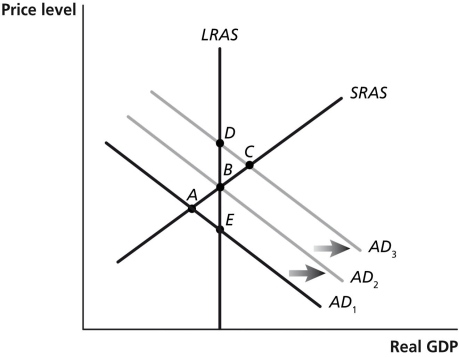 -Refer to Figure 27-1. Suppose the economy is in a recession and expansionary fiscal policy is pursued. Using the basic AD-AS model in the figure above, this would be depicted as a movement from
 (Multiple Choice)
5.0/5 (72)
(72) Article Summary
In November 2017, the House Ways and Means Committee announced a tax reform bill which includes hundreds of changes to the tax code. Overall, the tax plan represents a move in the direction of greater neutrality and global competitiveness. Following are eight of the most important provisions in the tax bill.
1. The corporate tax rate would be reduced to 20 percent.
2. Pass-through business income would be taxed at a maximum rate of 25 percent.
3. Some disincentives to investment would be rolled back.
4. The country would move to a territorial tax system.
5. Many itemized deductions would be eliminated.
6. The estate tax would be repealed.
7. The tax treatment of interest would change.
8. Tax expenditures would be curtailed.
-Refer to the Article Summary. A reduction in the corporate tax rate to 20 percent would ________ the return corporations receive from new investments in equipment and factories, and this would ________ aggregate supply.
(Multiple Choice)
5.0/5 (83)
(83) Which of the following is the largest category of federal government expenditures?
(Multiple Choice)
4.9/5 (70)
(70) What is expansionary fiscal policy? What is contractionary fiscal policy?
(Essay)
4.8/5 (78)
(78) If policymakers implement an expansionary fiscal policy but do not take into account the potential for crowding out, the new equilibrium level of GDP is likely to
(Multiple Choice)
4.7/5 (80)
(80) The Federal Reserve plays a larger role than Congress and the president in stabilizing the economy because
(Multiple Choice)
4.7/5 (73)
(73) Expansionary fiscal policy to prevent real GDP from falling below potential real GDP would cause the inflation rate to be ________ and real GDP to be ________.
(Multiple Choice)
4.9/5 (85)
(85) In an open economy, the government purchases multiplier will be smaller the
(Multiple Choice)
4.8/5 (84)
(84) Assume a country is required by law to balance the budget every year. Suppose aggregate demand falls, causing a recession and a budget deficit. To balance the budget, what would the government need to do with the level of government spending and taxes? How would these changes in government spending and taxes affect aggregate demand and the economy?
(Essay)
4.8/5 (74)
(74) If real equilibrium GDP is above potential GDP, expansionary fiscal policy should be pursued.
(True/False)
4.9/5 (82)
(82) As a percentage of GDP, federal expenditures ________ from 1992 to 2001, ________ from 2001 to 2011, and have ________ since 2011 .
(Multiple Choice)
4.9/5 (77)
(77) 
Filters
- Essay(0)
- Multiple Choice(0)
- Short Answer(0)
- True False(0)
- Matching(0)