



 Chat with AI
Exam 27: Fiscal Policy

Exam 1: Economics: Foundations and Models459 Questions
Exam 2: Trade-Offs, Comparative Advantage, and the Market System492 Questions
Exam 3: Where Prices Come From: the Interaction of Demand and Supply476 Questions
Exam 4: Economic Efficiency, Government Price Setting, and Taxes420 Questions
Exam 5: Externalities, Environmental Policy, and Public Goods262 Questions
Exam 6: Elasticity: the Responsiveness of Demand and Supply293 Questions
Exam 7: The Economics of Health Care337 Questions
Exam 8: Firms, the Stock Market, and Corporate Governance512 Questions
Exam 9: Comparative Advantage and the Gains From International Trade377 Questions
Exam 10: Consumer Choice and Behavioral Economics304 Questions
Exam 11: Technology, Production, and Costs326 Questions
Exam 12: Firms in Perfectly Competitive Markets296 Questions
Exam 13: Monopolistic Competition: the Competitive Model in a More Realistic Setting272 Questions
Exam 14: Oligopoly: Firms in Less Competitive Markets256 Questions
Exam 15: Monopoly and Antitrust Policy279 Questions
Exam 16: Pricing Strategy258 Questions
Exam 17: The Markets for Labor and Other Factors of Production279 Questions
Exam 18: Public Choice, Taxes, and the Distribution of Income258 Questions
Exam 19: Gdp: Measuring Total Production and Income260 Questions
Exam 20: Unemployment and Inflation290 Questions
Exam 21: Economic Growth, the Financial System, and Business Cycles251 Questions
Exam 22: Long-Run Economic Growth: Sources and Policies261 Questions
Exam 23: Aggregate Expenditure and Output in the Short Run305 Questions
Exam 24: Aggregate Demand and Aggregate Supply Analysis286 Questions
Exam 25: Money, Banks, and the Federal Reserve System278 Questions
Exam 26: Monetary Policy280 Questions
Exam 27: Fiscal Policy313 Questions
Exam 28: Inflation, Unemployment, and Federal Reserve Policy257 Questions
Exam 29: Macroeconomics in an Open Economy277 Questions
Exam 30: The International Financial System258 Questions
Select questions type


Describe the differences (in sign and relative magnitude) between the government purchases multiplier and the tax multiplier.
(Essay)
4.8/5  (73)
(73) Raising taxes on interest and dividend income will increase the level of investment and economic growth.
(True/False)
4.9/5 (80)
(80) During the twentieth century, the largest budget deficits as a percentage of GDP occurred
(Multiple Choice)
4.7/5 (73)
(73) The growth rate of hours worked depends on all of the following except
(Multiple Choice)
4.7/5 (74)
(74) The larger the marginal propensity to import, the larger the government purchases multiplier.
(True/False)
4.8/5 (91)
(91) Suppose the president is successful in passing a $10 billion tax increase. Assume that taxes are fixed, the economy is closed, and the marginal propensity to consume is 0.8. What happens to equilibrium GDP?
(Multiple Choice)
4.8/5 (81)
(81) Table 27-4
 -Refer to Table 27-4. Consider the hypothetical information in the table above for potential real GDP, real GDP, and the price level in 2018 and in 2019 if Congress and the president do not use fiscal policy. If Congress and the president use fiscal policy successfully to keep real GDP at its potential level in 2019, which of the following will be lower than if Congress and the president had taken no action?
 (Multiple Choice)
4.7/5 (82)
(82) The crowding out of private spending by government spending will be greater the
(Multiple Choice)
4.9/5 (66)
(66) Consider a tax cut which affects not only consumer disposable income, but also after-tax earnings from labor supplied to labor markets and from financial assets acquired through saving. In the long run we would expect this tax cut to
(Multiple Choice)
4.9/5 (87)
(87) Suppose real GDP is $12.1 trillion and potential GDP is $12.6 trillion. To move the economy back to potential GDP, Congress should
(Multiple Choice)
4.9/5 (69)
(69) Suppose Political Party A proposes a tax cut on business income to stimulate the economy. Political Party B opposes the tax cut on business income asserting that it would only help businesses, not the average working man and woman. If you were hired as an economist for Political Party A, explain how the tax cut on business income would help the average working man and woman.
(Essay)
4.9/5 (70)
(70) Figure 27-9 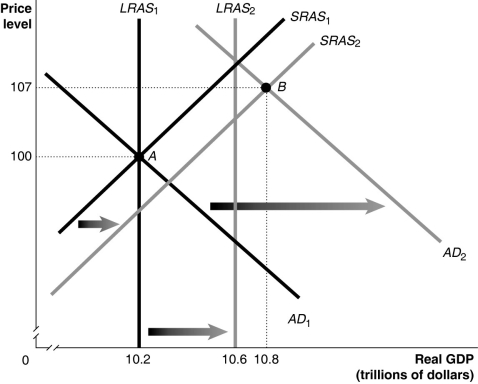 -Refer to Figure 27-9. Given that the economy has moved from point A to point B in the graph above, which of the following would be the appropriate fiscal policy to achieve potential GDP?
 (Multiple Choice)
4.9/5 (70)
(70) Contractionary fiscal policy to prevent real GDP from rising above potential real GDP would cause the inflation rate to be ________ and real GDP to be ________.
(Multiple Choice)
4.8/5 (73)
(73) A cut in tax rates effects equilibrium real GDP through two channels: ________ disposable income and consumer spending, and ________ the size of the multiplier effect.
(Multiple Choice)
4.9/5 (69)
(69) Contractionary fiscal policy to prevent real GDP from rising above potential real GDP would cause the inflation rate to be ________ and real GDP to be ________.
(Multiple Choice)
4.8/5 (80)
(80) Economists who believe the supply-side effects of tax cuts are small essentially believe that
(Multiple Choice)
4.9/5 (86)
(86) Calculate the value of the government purchases multiplier if the marginal propensity to consume equals 0.8, the tax rate equals 0.2, and the marginal propensity to import equals 0.05.
(Essay)
4.9/5 (89)
(89) The use of fiscal policy to stabilize the economy is limited because
(Multiple Choice)
4.9/5 (75)
(75) 
Filters
- Essay(0)
- Multiple Choice(0)
- Short Answer(0)
- True False(0)
- Matching(0)