



 Chat with AI
Exam 27: Fiscal Policy

Exam 1: Economics: Foundations and Models459 Questions
Exam 2: Trade-Offs, Comparative Advantage, and the Market System492 Questions
Exam 3: Where Prices Come From: the Interaction of Demand and Supply476 Questions
Exam 4: Economic Efficiency, Government Price Setting, and Taxes420 Questions
Exam 5: Externalities, Environmental Policy, and Public Goods262 Questions
Exam 6: Elasticity: the Responsiveness of Demand and Supply293 Questions
Exam 7: The Economics of Health Care337 Questions
Exam 8: Firms, the Stock Market, and Corporate Governance512 Questions
Exam 9: Comparative Advantage and the Gains From International Trade377 Questions
Exam 10: Consumer Choice and Behavioral Economics304 Questions
Exam 11: Technology, Production, and Costs326 Questions
Exam 12: Firms in Perfectly Competitive Markets296 Questions
Exam 13: Monopolistic Competition: the Competitive Model in a More Realistic Setting272 Questions
Exam 14: Oligopoly: Firms in Less Competitive Markets256 Questions
Exam 15: Monopoly and Antitrust Policy279 Questions
Exam 16: Pricing Strategy258 Questions
Exam 17: The Markets for Labor and Other Factors of Production279 Questions
Exam 18: Public Choice, Taxes, and the Distribution of Income258 Questions
Exam 19: Gdp: Measuring Total Production and Income260 Questions
Exam 20: Unemployment and Inflation290 Questions
Exam 21: Economic Growth, the Financial System, and Business Cycles251 Questions
Exam 22: Long-Run Economic Growth: Sources and Policies261 Questions
Exam 23: Aggregate Expenditure and Output in the Short Run305 Questions
Exam 24: Aggregate Demand and Aggregate Supply Analysis286 Questions
Exam 25: Money, Banks, and the Federal Reserve System278 Questions
Exam 26: Monetary Policy280 Questions
Exam 27: Fiscal Policy313 Questions
Exam 28: Inflation, Unemployment, and Federal Reserve Policy257 Questions
Exam 29: Macroeconomics in an Open Economy277 Questions
Exam 30: The International Financial System258 Questions
Select questions type


Which of the following is considered contractionary fiscal policy?
(Multiple Choice)
4.8/5  (70)
(70) Increases in government spending result in ________ in the short run, and permanent increases in government spending result in ________ in the long run.
(Multiple Choice)
4.8/5 (82)
(82) Table 27-1
 -Refer to Table 27-1. Consider the hypothetical information in the table above for potential real GDP, real GDP, and the price level in 2018 and in 2019 if Congress and the president do not use fiscal policy. If Congress and the president want to keep real GDP at its potential level in 2019, they should
 (Multiple Choice)
4.8/5 (78)
(78) Figure 27-6  -Refer to Figure 27-6. In the dynamic model of AD-AS in the figure above, if the economy is at point A in year 1 and is expected to go to point B in year 2, Congress and the president would most likely pursue
 (Multiple Choice)
4.9/5 (82)
(82) Congress and the president carry out fiscal policy through changes in
(Multiple Choice)
4.9/5 (84)
(84) The largest source of federal government revenue in 2016 was
(Multiple Choice)
4.7/5 (83)
(83) If the economy is slipping into a recession, which of the following would be an appropriate fiscal policy?
(Multiple Choice)
4.8/5 (78)
(78) Figure 27-1 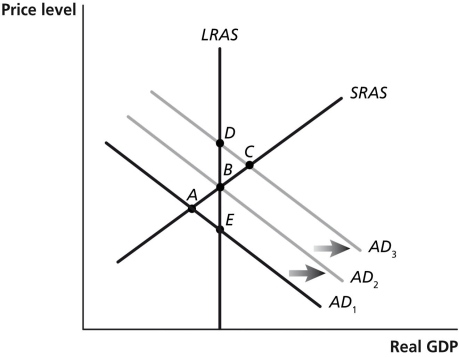 -Refer to Figure 27-1. Suppose the economy is in short-run equilibrium above potential GDP and wages and prices are rising. If contractionary policy is used to move the economy back to long run equilibrium, this would be depicted as a movement from ________ using the basic AD-AS model in the figure above.
 (Multiple Choice)
4.8/5 (81)
(81) A study by Edward Prescott found that the ________ marginal tax rates in the United States relative to Europe resulted in a ________ quantity of labor supplied in the United States.
(Multiple Choice)
4.9/5 (73)
(73) If the federal budget goes from a budget deficit in Year 1 to a budget surplus in Year 2, does it follow that the federal government acted to raise taxes or cut government spending in Year 2?
(Essay)
4.9/5 (77)
(77) Why will there be less crowding out of private spending by government spending the less sensitive consumption, investment, and net exports are to changes in interest rates?
(Essay)
4.9/5 (88)
(88) Included in government expenditures are government purchases and transfer payments.
(True/False)
4.9/5 (70)
(70) Expansionary fiscal policy is used to increase aggregate demand in an attempt to fight rising inflation.
(True/False)
4.8/5 (83)
(83) The federal budget exhibited a $128.7 billion surplus in 2001 but moved to a deficit of $157.8 billion in 2002. Some argued the deficit was opened up because of the Bush 2001 tax cuts, but others argued that the deficit grew because of the recession suffered in 2001. Evaluate the validity of the second argument.
(Essay)
4.8/5 (98)
(98) Use the dynamic aggregate demand and aggregate supply model and start with Year 1 in a long-run macroeconomic equilibrium. For Year 2, graph aggregate demand, long-run aggregate supply, and short-run aggregate supply such that the condition of the economy will induce the president and Congress to conduct contractionary fiscal policy. Briefly explain the condition of the economy and what the president and Congress are attempting to do.
(Essay)
5.0/5 (85)
(85) Crowding out, following an increase in government spending, results from (the exchange rate is the foreign exchange price of the domestic currency)
(Multiple Choice)
4.9/5 (78)
(78) If the federal government's expenditures are less than its tax revenues, then
(Multiple Choice)
4.8/5 (77)
(77) 
Filters
- Essay(0)
- Multiple Choice(0)
- Short Answer(0)
- True False(0)
- Matching(0)