



 Chat with AI
Exam 27: Fiscal Policy

Exam 1: Economics: Foundations and Models459 Questions
Exam 2: Trade-Offs, Comparative Advantage, and the Market System492 Questions
Exam 3: Where Prices Come From: the Interaction of Demand and Supply476 Questions
Exam 4: Economic Efficiency, Government Price Setting, and Taxes420 Questions
Exam 5: Externalities, Environmental Policy, and Public Goods262 Questions
Exam 6: Elasticity: the Responsiveness of Demand and Supply293 Questions
Exam 7: The Economics of Health Care337 Questions
Exam 8: Firms, the Stock Market, and Corporate Governance512 Questions
Exam 9: Comparative Advantage and the Gains From International Trade377 Questions
Exam 10: Consumer Choice and Behavioral Economics304 Questions
Exam 11: Technology, Production, and Costs326 Questions
Exam 12: Firms in Perfectly Competitive Markets296 Questions
Exam 13: Monopolistic Competition: the Competitive Model in a More Realistic Setting272 Questions
Exam 14: Oligopoly: Firms in Less Competitive Markets256 Questions
Exam 15: Monopoly and Antitrust Policy279 Questions
Exam 16: Pricing Strategy258 Questions
Exam 17: The Markets for Labor and Other Factors of Production279 Questions
Exam 18: Public Choice, Taxes, and the Distribution of Income258 Questions
Exam 19: Gdp: Measuring Total Production and Income260 Questions
Exam 20: Unemployment and Inflation290 Questions
Exam 21: Economic Growth, the Financial System, and Business Cycles251 Questions
Exam 22: Long-Run Economic Growth: Sources and Policies261 Questions
Exam 23: Aggregate Expenditure and Output in the Short Run305 Questions
Exam 24: Aggregate Demand and Aggregate Supply Analysis286 Questions
Exam 25: Money, Banks, and the Federal Reserve System278 Questions
Exam 26: Monetary Policy280 Questions
Exam 27: Fiscal Policy313 Questions
Exam 28: Inflation, Unemployment, and Federal Reserve Policy257 Questions
Exam 29: Macroeconomics in an Open Economy277 Questions
Exam 30: The International Financial System258 Questions
Select questions type


A(n) ________ in private expenditures as a result of a(n) ________ in government purchases is called crowding out.
(Multiple Choice)
4.9/5  (79)
(79) Figure 27-11 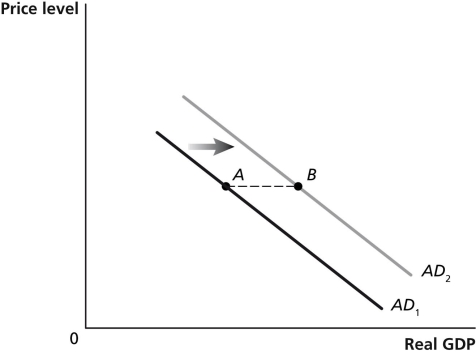 -Refer to Figure 27-11. If government purchases increase by $100 billion and lead to an ultimate increase in aggregate demand as shown in the graph, the difference in real GDP between point A and point B will be
 (Multiple Choice)
4.9/5 (84)
(84) Figure 27-2  -Refer to Figure 27-2. In the graph above, if the economy is at point A, an appropriate fiscal policy by Congress and the president would be to
 (Multiple Choice)
5.0/5 (76)
(76) Expansionary fiscal policy involves increasing government purchases or increasing taxes.
(True/False)
5.0/5 (71)
(71) The total value of U.S. Treasury bonds outstanding is called the federal government debt.
(True/False)
4.8/5 (84)
(84) The problem typically during a recession is not that there is too little money, but too little spending. If the problem was too little money, what would be its cause? If the problem was too little spending, what could be its cause?
(Essay)
4.9/5 (80)
(80) A recession tends to cause the federal budget deficit to ________ because tax revenues ________ and government spending on transfer payments ________.
(Multiple Choice)
4.7/5 (82)
(82) Figure 27-6  -Refer to Figure 27-6. In the dynamic model of AD-AS in the figure above, if the economy is at point A in year 1 and is expected to go to point B in year 2, and no fiscal or monetary policy is pursued, then at point B
 (Multiple Choice)
4.9/5 (88)
(88) How does expansionary monetary policy increase spending in the economy compared to how expansionary fiscal policy increases spending in the economy?
(Essay)
4.8/5 (76)
(76) A tax rebate, which is expected to be offered in this and all future years, will
(Multiple Choice)
4.8/5 (74)
(74) Government transfer payments include which of the following?
(Multiple Choice)
4.8/5 (93)
(93) In the case of an upward-sloping aggregate supply curve, the change in real GDP brought about by a change in government spending will be less than that predicted by the simple government purchases multiplier.
(True/False)
4.9/5 (75)
(75) The aggregate demand curve will shift to the left ________ the initial decrease in government purchases.
(Multiple Choice)
4.8/5 (74)
(74) Figure 27-7  -Refer to Figure 27-7. Given that the economy has moved from A to B in the graph above, which of the following would be the appropriate fiscal policy to achieve potential GDP?
 (Multiple Choice)
4.9/5 (75)
(75) The Trump administration hopes to expand apprenticeship programs that provide skills needed by workers. This would ________ the employment-population ratio, which would increase ________.
(Multiple Choice)
4.7/5 (85)
(85) An increase in government purchases will increase aggregate demand because
(Multiple Choice)
4.9/5 (89)
(89) Expansionary fiscal policy ________ the price level and ________ equilibrium real GDP.
(Multiple Choice)
4.8/5 (75)
(75) 
Filters
- Essay(0)
- Multiple Choice(0)
- Short Answer(0)
- True False(0)
- Matching(0)