



 Chat with AI
Exam 27: Fiscal Policy

Exam 1: Economics: Foundations and Models459 Questions
Exam 2: Trade-Offs, Comparative Advantage, and the Market System492 Questions
Exam 3: Where Prices Come From: the Interaction of Demand and Supply476 Questions
Exam 4: Economic Efficiency, Government Price Setting, and Taxes420 Questions
Exam 5: Externalities, Environmental Policy, and Public Goods262 Questions
Exam 6: Elasticity: the Responsiveness of Demand and Supply293 Questions
Exam 7: The Economics of Health Care337 Questions
Exam 8: Firms, the Stock Market, and Corporate Governance512 Questions
Exam 9: Comparative Advantage and the Gains From International Trade377 Questions
Exam 10: Consumer Choice and Behavioral Economics304 Questions
Exam 11: Technology, Production, and Costs326 Questions
Exam 12: Firms in Perfectly Competitive Markets296 Questions
Exam 13: Monopolistic Competition: the Competitive Model in a More Realistic Setting272 Questions
Exam 14: Oligopoly: Firms in Less Competitive Markets256 Questions
Exam 15: Monopoly and Antitrust Policy279 Questions
Exam 16: Pricing Strategy258 Questions
Exam 17: The Markets for Labor and Other Factors of Production279 Questions
Exam 18: Public Choice, Taxes, and the Distribution of Income258 Questions
Exam 19: Gdp: Measuring Total Production and Income260 Questions
Exam 20: Unemployment and Inflation290 Questions
Exam 21: Economic Growth, the Financial System, and Business Cycles251 Questions
Exam 22: Long-Run Economic Growth: Sources and Policies261 Questions
Exam 23: Aggregate Expenditure and Output in the Short Run305 Questions
Exam 24: Aggregate Demand and Aggregate Supply Analysis286 Questions
Exam 25: Money, Banks, and the Federal Reserve System278 Questions
Exam 26: Monetary Policy280 Questions
Exam 27: Fiscal Policy313 Questions
Exam 28: Inflation, Unemployment, and Federal Reserve Policy257 Questions
Exam 29: Macroeconomics in an Open Economy277 Questions
Exam 30: The International Financial System258 Questions
Select questions type


Data indicates that recessions following financial crises ________ recessions which do not follow financial crises.
(Multiple Choice)
4.8/5  (97)
(97) If government increases taxes by the same amount it increases government spending, there will be no effect on aggregate demand: the increase in government spending is offset by an equal decrease in consumption spending by households.
(True/False)
5.0/5 (74)
(74) Long lags associated with the legislative process in implementing fiscal policy make it more difficult to use than monetary policy.
(True/False)
4.9/5 (80)
(80) Following a decrease in government spending, as the price level falls we would expect the level of interest rates to ________ and investment to ________.
(Multiple Choice)
4.8/5 (77)
(77) Suppose real GDP is $13 trillion, potential real GDP is $13.5 trillion, and Congress and the president plan to use fiscal policy to restore the economy to potential real GDP. Assuming a constant price level, Congress and the president would need to increase government purchases by
(Multiple Choice)
4.8/5 (66)
(66) Figure 27-1  -Refer to Figure 27-1. Suppose the economy is in short-run equilibrium below potential GDP and no fiscal or monetary policy is pursued. Using the basic AD-AS model in the figure above, this would be depicted as a movement from
 (Multiple Choice)
4.8/5 (84)
(84) Which of the following would not be considered an automatic stabilizer?
(Multiple Choice)
4.7/5 (79)
(79) It is ________ difficult to effectively time fiscal policy than monetary policy because ________.
(Multiple Choice)
4.8/5 (89)
(89) Figure 27-10 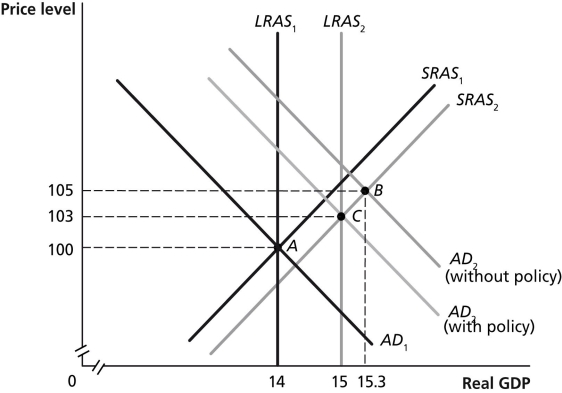 -Refer to Figure 27-10. In the graph above, suppose the economy in Year 1 is at point A and is expected in Year 2 to be at point B. Which of the following policies could Congress and the president use to move the economy to point C?
 (Multiple Choice)
4.8/5 (71)
(71) Assume a closed economy with fixed taxes and the marginal propensity to consume is equal to 0.9. What is the government spending multiplier?
(Multiple Choice)
4.9/5 (65)
(65) Which of the following would be considered a fiscal policy action?
(Multiple Choice)
4.9/5 (92)
(92) The federal budget was in deficit from 1931 to 1939, except in the year 1937. Given this fact, how do you explain E. Cary Brown's statement, "Fiscal policy, then, seems to have been an unsuccessful recovery device in the 'thirties-not because it did not work, but because it was not tried."
(Essay)
4.9/5 (73)
(73) An increase in individual income taxes ________ disposable income, which ________ consumption spending.
(Multiple Choice)
4.8/5 (84)
(84) Suppose real GDP is currently $12.5 trillion and potential real GDP is $13 trillion. If the president and Congress increased government purchases by $500 billion, what would be the result on the economy?
(Essay)
4.7/5 (84)
(84) To complement actions by the Fed to reduce inflation, Congress and the President can cut spending and/or raise taxes.
(True/False)
4.7/5 (81)
(81) Explain why the timing of fiscal policy may be more difficult than the timing of monetary policy.
(Essay)
4.9/5 (78)
(78) Which of the following would be most likely to induce Congress and the president to conduct contractionary fiscal policy? A significant
(Multiple Choice)
4.9/5 (68)
(68) If policymakers are concerned that the economy is in danger of rising inflation because aggregate demand is increasing faster than aggregate supply, the appropriate fiscal policy response is to
(Multiple Choice)
4.7/5 (72)
(72) 
Filters
- Essay(0)
- Multiple Choice(0)
- Short Answer(0)
- True False(0)
- Matching(0)