



 Chat with AI
Exam 27: Fiscal Policy

Exam 1: Economics: Foundations and Models459 Questions
Exam 2: Trade-Offs, Comparative Advantage, and the Market System492 Questions
Exam 3: Where Prices Come From: the Interaction of Demand and Supply476 Questions
Exam 4: Economic Efficiency, Government Price Setting, and Taxes420 Questions
Exam 5: Externalities, Environmental Policy, and Public Goods262 Questions
Exam 6: Elasticity: the Responsiveness of Demand and Supply293 Questions
Exam 7: The Economics of Health Care337 Questions
Exam 8: Firms, the Stock Market, and Corporate Governance512 Questions
Exam 9: Comparative Advantage and the Gains From International Trade377 Questions
Exam 10: Consumer Choice and Behavioral Economics304 Questions
Exam 11: Technology, Production, and Costs326 Questions
Exam 12: Firms in Perfectly Competitive Markets296 Questions
Exam 13: Monopolistic Competition: the Competitive Model in a More Realistic Setting272 Questions
Exam 14: Oligopoly: Firms in Less Competitive Markets256 Questions
Exam 15: Monopoly and Antitrust Policy279 Questions
Exam 16: Pricing Strategy258 Questions
Exam 17: The Markets for Labor and Other Factors of Production279 Questions
Exam 18: Public Choice, Taxes, and the Distribution of Income258 Questions
Exam 19: Gdp: Measuring Total Production and Income260 Questions
Exam 20: Unemployment and Inflation290 Questions
Exam 21: Economic Growth, the Financial System, and Business Cycles251 Questions
Exam 22: Long-Run Economic Growth: Sources and Policies261 Questions
Exam 23: Aggregate Expenditure and Output in the Short Run305 Questions
Exam 24: Aggregate Demand and Aggregate Supply Analysis286 Questions
Exam 25: Money, Banks, and the Federal Reserve System278 Questions
Exam 26: Monetary Policy280 Questions
Exam 27: Fiscal Policy313 Questions
Exam 28: Inflation, Unemployment, and Federal Reserve Policy257 Questions
Exam 29: Macroeconomics in an Open Economy277 Questions
Exam 30: The International Financial System258 Questions
Select questions type


Figure 27-2 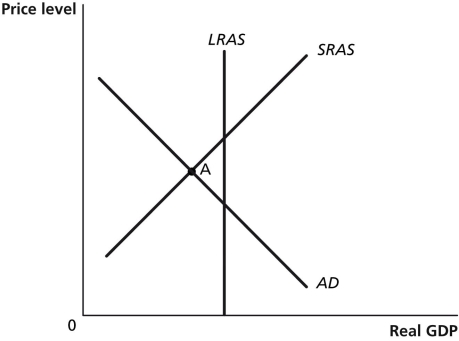 -Refer to Figure 27-2. In the graph above, if the economy is at point A, an appropriate fiscal policy by Congress and the president would be to
 (Multiple Choice)
5.0/5  (84)
(84) A government tax rebate of $1,000 would ________ your disposable income by ________.
(Multiple Choice)
4.7/5 (74)
(74) The multiplier effect following an increase in expenditure is generated by induced increases in consumption expenditure as income rises.
(True/False)
4.9/5 (86)
(86) Crowding out refers to a decrease in government purchases as a result of an increase in private expenditures.
(True/False)
4.9/5 (76)
(76) Explain why the tax multiplier is different from the government purchases multiplier, in both sign and relative magnitude.
(Essay)
4.7/5 (87)
(87) In preparing their estimates of the stimulus package's effect on GDP, Obama administration economists estimated a government purchases multiplier of 1.57. This indicates that a ________ increase in government purchases would increase equilibrium real GDP by $157 billion
(Multiple Choice)
4.9/5 (87)
(87) Illustrate and explain the effects of tax reduction and simplification using the dynamic aggregate demand and supply model. To simplify the analysis, assume that aggregate demand is not affected by the tax cut.
(Essay)
4.9/5 (74)
(74) If Congress and the president pursue an expansionary fiscal policy at the same time as the Federal Reserve pursues an expansionary monetary policy, how might the expansionary monetary policy affect the extent of crowding out in the short run?
(Essay)
4.9/5 (82)
(82) A decrease in which of the following would decrease the tax wedge?
(Multiple Choice)
4.9/5 (82)
(82) If the government purchases multiplier equals 2, and real GDP is $14 trillion with potential real GDP $14.5 trillion, then government purchases would need to increase by ________ to restore the economy to potential real GDP.
(Multiple Choice)
4.7/5 (81)
(81) The majority of dollars spent by government prior to the Great Depression was spending at the ________. In the post World War II period, two-thirds to three quarters of all dollars spent by government in the United States are spent at the ________.
(Multiple Choice)
4.7/5 (80)
(80) A change in consumption spending caused by income changes is ________ change in spending, and a change in government spending that occurs to improve roads and bridges is ________ change in spending.
(Multiple Choice)
4.9/5 (81)
(81) The aggregate demand curve will shift to the right ________ the initial decrease in taxes.
(Multiple Choice)
4.7/5 (85)
(85) Which of the following would be classified as fiscal policy?
(Multiple Choice)
4.8/5 (78)
(78) Figure 27-1 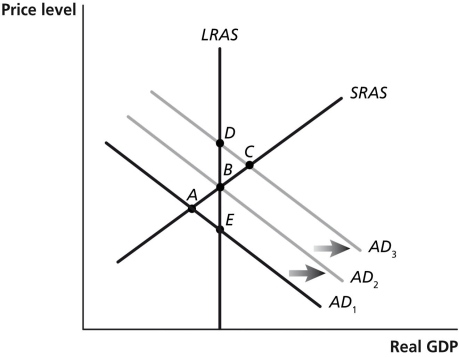 -Refer to Figure 27-1. Suppose the economy is in short-run equilibrium below potential GDP and Congress and the president lower taxes to move the economy back to long-run equilibrium. Using the basic AD-AS model in the figure above, this would be depicted as a movement from
 (Multiple Choice)
4.9/5 (86)
(86) A law requiring the government to balance its budget in each year would serve as an automatic destabilizer.
(True/False)
4.8/5 (85)
(85) In an open economy, the government purchases multiplier will be larger the
(Multiple Choice)
4.7/5 (82)
(82) Suppose that the current equilibrium GDP is $14.5 trillion and that potential GDP is $14.3 trillion. Will decreasing government purchases by $200 billion, or raising taxes by $200 billion, restore the economy to potential GDP? Explain.
(Essay)
4.9/5 (70)
(70) 
Filters
- Essay(0)
- Multiple Choice(0)
- Short Answer(0)
- True False(0)
- Matching(0)