



 Chat with AI
Exam 2: Trade-Offs, Comparative Advantage, and the Market System

Exam 1: Economics: Foundations and Models459 Questions
Exam 2: Trade-Offs, Comparative Advantage, and the Market System492 Questions
Exam 3: Where Prices Come From: the Interaction of Demand and Supply476 Questions
Exam 4: Economic Efficiency, Government Price Setting, and Taxes420 Questions
Exam 5: Externalities, Environmental Policy, and Public Goods262 Questions
Exam 6: Elasticity: the Responsiveness of Demand and Supply293 Questions
Exam 7: The Economics of Health Care337 Questions
Exam 8: Firms, the Stock Market, and Corporate Governance512 Questions
Exam 9: Comparative Advantage and the Gains From International Trade377 Questions
Exam 10: Consumer Choice and Behavioral Economics304 Questions
Exam 11: Technology, Production, and Costs326 Questions
Exam 12: Firms in Perfectly Competitive Markets296 Questions
Exam 13: Monopolistic Competition: the Competitive Model in a More Realistic Setting272 Questions
Exam 14: Oligopoly: Firms in Less Competitive Markets256 Questions
Exam 15: Monopoly and Antitrust Policy279 Questions
Exam 16: Pricing Strategy258 Questions
Exam 17: The Markets for Labor and Other Factors of Production279 Questions
Exam 18: Public Choice, Taxes, and the Distribution of Income258 Questions
Exam 19: Gdp: Measuring Total Production and Income260 Questions
Exam 20: Unemployment and Inflation290 Questions
Exam 21: Economic Growth, the Financial System, and Business Cycles251 Questions
Exam 22: Long-Run Economic Growth: Sources and Policies261 Questions
Exam 23: Aggregate Expenditure and Output in the Short Run305 Questions
Exam 24: Aggregate Demand and Aggregate Supply Analysis286 Questions
Exam 25: Money, Banks, and the Federal Reserve System278 Questions
Exam 26: Monetary Policy280 Questions
Exam 27: Fiscal Policy313 Questions
Exam 28: Inflation, Unemployment, and Federal Reserve Policy257 Questions
Exam 29: Macroeconomics in an Open Economy277 Questions
Exam 30: The International Financial System258 Questions
Select questions type


Table 2-10
 Table 2-10 shows the output per month of two people, Fred and Barney. They can either devote their time to making pogo sticks or making unicycles.
-Refer to Table 2-10. Which of the following statements is true?
Table 2-10 shows the output per month of two people, Fred and Barney. They can either devote their time to making pogo sticks or making unicycles.
-Refer to Table 2-10. Which of the following statements is true? (Multiple Choice)
4.9/5  (71)
(71) In the desire to have a celebrity's image protected to prevent it from being used in ways he would not approve, a celebrity's estate
(Multiple Choice)
4.9/5 (61)
(61) A welding machine is an example of a factor of production if it is being used to produce automobiles.
(True/False)
4.8/5 (71)
(71) Economic decline (negative growth) is represented on a production possibilities frontier model by the production possibility frontier
(Multiple Choice)
4.7/5 (76)
(76) If a country is producing efficiently and is on the production possibilities frontier, the only way to produce more of one good is to produce less of the other.
(True/False)
5.0/5 (76)
(76) Table 2-12
 Table 2-12 shows the number of labor hours required to produce a canoe and a sailboat in Guatemala and Honduras.
-Refer to Table 2-12. Honduras has a comparative advantage in the production of
Table 2-12 shows the number of labor hours required to produce a canoe and a sailboat in Guatemala and Honduras.
-Refer to Table 2-12. Honduras has a comparative advantage in the production of (Multiple Choice)
5.0/5 (73)
(73) Figure 2-8  Figure 2-8 above shows the production possibilities frontier for Vidalia, a nation that produces two goods, roses and orchids.
-Refer to Figure 2-8. The linear production possibilities frontier in the figure indicates that
Figure 2-8 above shows the production possibilities frontier for Vidalia, a nation that produces two goods, roses and orchids.
-Refer to Figure 2-8. The linear production possibilities frontier in the figure indicates that (Multiple Choice)
4.9/5 (83)
(83) Figure 2-3 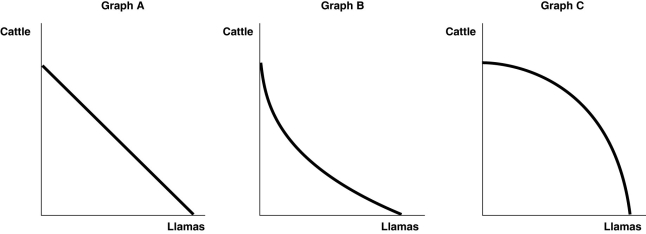 -Refer to Figure 2-3. Sergio Vignetto raises cattle and llamas on his land. A portion of his land is more suitable for raising cattle, and the other portion is better suited for raising llamas. Which of the graphs in Figure 2-3 represent his production possibilities frontier that displays increasing opportunity costs?
 (Multiple Choice)
4.9/5 (88)
(88) Table 2-12
Table 2-12 shows the number of labor hours required to produce a canoe and a sailboat in Guatemala and Honduras.
-Refer to Table 2-12. What is Honduras's opportunity cost of producing one canoe?
Table 2-12 shows the number of labor hours required to produce a canoe and a sailboat in Guatemala and Honduras.
-Refer to Table 2-12. What is Honduras's opportunity cost of producing one canoe? (Multiple Choice)
4.7/5 (88)
(88) Figure 2-13  Figure 2-13 shows the production possibilities frontiers for Costa Rica and Guatemala. Each country produces two goods, pineapples and coconuts.
-Refer to Figure 2-13. Which country has a comparative advantage in the production of pineapples?
Figure 2-13 shows the production possibilities frontiers for Costa Rica and Guatemala. Each country produces two goods, pineapples and coconuts.
-Refer to Figure 2-13. Which country has a comparative advantage in the production of pineapples? (Multiple Choice)
4.9/5 (75)
(75) In a two-good, two country world, if one country has an absolute advantage in the production of both goods, it can still benefit by trading with the other country.
(True/False)
4.8/5 (75)
(75) Table 2-11
 Table 2-11 shows the number of labor hours required to produce a digital camera and a pound of wheat in China and South Korea.
-Refer to Table 2-11. What is China's opportunity cost of producing one digital camera?
Table 2-11 shows the number of labor hours required to produce a digital camera and a pound of wheat in China and South Korea.
-Refer to Table 2-11. What is China's opportunity cost of producing one digital camera? (Multiple Choice)
4.9/5 (83)
(83) If additional units of a good are produced at an increasing opportunity cost, the production possibilities frontier would be bowed outward (concave).
(True/False)
4.9/5 (75)
(75) Table 2-6
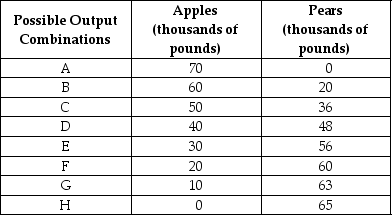 -Refer to Table 2-6. The Fruit Farm produces only apples and pears. The table above shows the maximum possible output combinations of the two fruits using all resources and currently available technology.
a. Graph the Fruit Farm's production possibilities frontier. Put apples on the horizontal axis and pears on the vertical axis. Be sure to identify the output combination points on your diagram.
b. Suppose the Fruit Farm is currently producing at point D. What is the opportunity cost of producing an additional 8,000 pounds of pears?
c. Suppose the Fruit Farm is currently producing at point D. What happens to the opportunity cost of producing more and more pears? Does it increase, decrease, or remain constant? Explain your answer.
d. Suppose the Fruit Farm is currently producing at point G. What happens to the opportunity cost of producing more and more apples? Does it increase, decrease, or remain constant? Explain your answer.
e. Suppose the Fruit Farm is plagued by the apple maggot infestation which destroys apple trees but not pear trees. Show in a graph what happens to its PPF.
-Refer to Table 2-6. The Fruit Farm produces only apples and pears. The table above shows the maximum possible output combinations of the two fruits using all resources and currently available technology.
a. Graph the Fruit Farm's production possibilities frontier. Put apples on the horizontal axis and pears on the vertical axis. Be sure to identify the output combination points on your diagram.
b. Suppose the Fruit Farm is currently producing at point D. What is the opportunity cost of producing an additional 8,000 pounds of pears?
c. Suppose the Fruit Farm is currently producing at point D. What happens to the opportunity cost of producing more and more pears? Does it increase, decrease, or remain constant? Explain your answer.
d. Suppose the Fruit Farm is currently producing at point G. What happens to the opportunity cost of producing more and more apples? Does it increase, decrease, or remain constant? Explain your answer.
e. Suppose the Fruit Farm is plagued by the apple maggot infestation which destroys apple trees but not pear trees. Show in a graph what happens to its PPF. (Essay)
4.9/5 (74)
(74) ________ marginal opportunity cost implies that the more resources already devoted to any activity, the payoff from allocating yet more resources to that activity increases by progressively smaller amounts.
(Multiple Choice)
4.8/5 (65)
(65) Figure 2-14  Figure 2-14 shows the production possibilities frontiers for Greenland and Iceland. Each country produces two goods, snow cones and popsicles.
-Refer to Figure 2-14. What is the opportunity cost of producing 1 snow cone in Greenland?
Figure 2-14 shows the production possibilities frontiers for Greenland and Iceland. Each country produces two goods, snow cones and popsicles.
-Refer to Figure 2-14. What is the opportunity cost of producing 1 snow cone in Greenland? (Multiple Choice)
4.9/5 (95)
(95) Table 2-3
Production Choices for Dina's Diner
 -Refer to Table 2-3. Dina faces ________ opportunity costs in the production of sliders and hot wings.
 (Multiple Choice)
4.9/5 (87)
(87) In a production possibilities frontier, a point inside the frontier is
(Multiple Choice)
4.8/5 (88)
(88) If a country is producing efficiently and is on the production possibilities frontier, the only way to produce more of one good is with an advance in technology.
(True/False)
4.9/5 (86)
(86) 
Filters
- Essay(0)
- Multiple Choice(0)
- Short Answer(0)
- True False(0)
- Matching(0)