



 Chat with AI
Exam 2: Trade-Offs, Comparative Advantage, and the Market System

Exam 1: Economics: Foundations and Models459 Questions
Exam 2: Trade-Offs, Comparative Advantage, and the Market System492 Questions
Exam 3: Where Prices Come From: the Interaction of Demand and Supply476 Questions
Exam 4: Economic Efficiency, Government Price Setting, and Taxes420 Questions
Exam 5: Externalities, Environmental Policy, and Public Goods262 Questions
Exam 6: Elasticity: the Responsiveness of Demand and Supply293 Questions
Exam 7: The Economics of Health Care337 Questions
Exam 8: Firms, the Stock Market, and Corporate Governance512 Questions
Exam 9: Comparative Advantage and the Gains From International Trade377 Questions
Exam 10: Consumer Choice and Behavioral Economics304 Questions
Exam 11: Technology, Production, and Costs326 Questions
Exam 12: Firms in Perfectly Competitive Markets296 Questions
Exam 13: Monopolistic Competition: the Competitive Model in a More Realistic Setting272 Questions
Exam 14: Oligopoly: Firms in Less Competitive Markets256 Questions
Exam 15: Monopoly and Antitrust Policy279 Questions
Exam 16: Pricing Strategy258 Questions
Exam 17: The Markets for Labor and Other Factors of Production279 Questions
Exam 18: Public Choice, Taxes, and the Distribution of Income258 Questions
Exam 19: Gdp: Measuring Total Production and Income260 Questions
Exam 20: Unemployment and Inflation290 Questions
Exam 21: Economic Growth, the Financial System, and Business Cycles251 Questions
Exam 22: Long-Run Economic Growth: Sources and Policies261 Questions
Exam 23: Aggregate Expenditure and Output in the Short Run305 Questions
Exam 24: Aggregate Demand and Aggregate Supply Analysis286 Questions
Exam 25: Money, Banks, and the Federal Reserve System278 Questions
Exam 26: Monetary Policy280 Questions
Exam 27: Fiscal Policy313 Questions
Exam 28: Inflation, Unemployment, and Federal Reserve Policy257 Questions
Exam 29: Macroeconomics in an Open Economy277 Questions
Exam 30: The International Financial System258 Questions
Select questions type


Table 2-9
 Table 2-9 shows the output per week of two jewelers, Serena and Haley. They can either devote their time to making bracelets or making necklaces.
-Refer to Table 2-9. Which of the following statements is true?
Table 2-9 shows the output per week of two jewelers, Serena and Haley. They can either devote their time to making bracelets or making necklaces.
-Refer to Table 2-9. Which of the following statements is true? (Multiple Choice)
5.0/5  (78)
(78) Table 2-14
 Table 2-14 shows the number of labor hours required to produce a motorcycle and a guitar in Ireland and Scotland.
-Refer to Table 2-14. What is Ireland's opportunity cost of producing one guitar?
Table 2-14 shows the number of labor hours required to produce a motorcycle and a guitar in Ireland and Scotland.
-Refer to Table 2-14. What is Ireland's opportunity cost of producing one guitar? (Multiple Choice)
4.8/5 (98)
(98) The payment received by suppliers of entrepreneurial skills is called wages.
(True/False)
4.8/5 (76)
(76) Table 2-1
Production choices for Tomaso's Trattoria
 -Refer to Table 2-1. Assume that Tomaso's Trattoria only produces pizzas and calzones. A combination of 24 pizzas and 15 calzones would appear
 (Multiple Choice)
4.8/5 (96)
(96) In a two-good, two country world, if one country has an absolute advantage in the production of both goods, it cannot benefit by trading with the other country.
(True/False)
4.8/5 (74)
(74) Figure 2-17 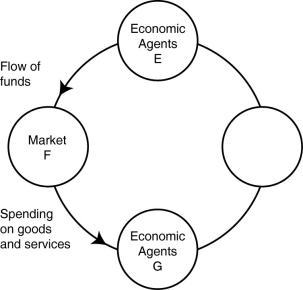 -Refer to Figure 2-17. One segment of the circular flow diagram in the Figure shows the flow of funds from market F to economic agents G. The funds represent spending on goods and services. What is market F and who are economic agents G?
 (Multiple Choice)
4.7/5 (87)
(87) Table 2-11
 Table 2-11 shows the number of labor hours required to produce a digital camera and a pound of wheat in China and South Korea.
-Refer to Table 2-11. China has a comparative advantage in the production of
Table 2-11 shows the number of labor hours required to produce a digital camera and a pound of wheat in China and South Korea.
-Refer to Table 2-11. China has a comparative advantage in the production of (Multiple Choice)
4.7/5 (87)
(87) An outward shift of a nation's production possibilities frontier can occur due to
(Multiple Choice)
4.9/5 (73)
(73) Figure 2-13  Figure 2-13 shows the production possibilities frontiers for Costa Rica and Guatemala. Each country produces two goods, pineapples and coconuts.
-Refer to Figure 2-13. What is the opportunity cost of producing 1 ton of pineapples in Guatemala?
Figure 2-13 shows the production possibilities frontiers for Costa Rica and Guatemala. Each country produces two goods, pineapples and coconuts.
-Refer to Figure 2-13. What is the opportunity cost of producing 1 ton of pineapples in Guatemala? (Multiple Choice)
4.7/5 (82)
(82) Figure 2-3 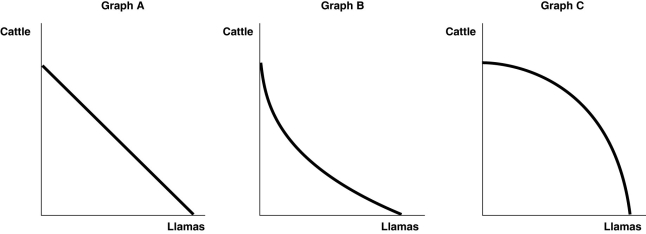 -Refer to Figure 2-3. Sergio Vignetto raises cattle and llamas on his land. His land is equally suitable for raising either animal. Which of the graphs in Figure 2-3 represent his production possibilities frontier?
 (Multiple Choice)
4.9/5 (80)
(80) A bed of oysters is not an example of a factor of production but the shucked oysters used to make oyster stew are a factor of production.
(True/False)
4.9/5 (82)
(82) The resource income earned by those who supply labor services is called
(Multiple Choice)
4.7/5 (72)
(72) Figure 2-4  Figure 2-4 shows various points on three different production possibilities frontiers for a nation.
-Refer to Figure 2-4. Consider the following movements:
a. from point V to point W
b. from point W to point Y
c. from point Y to point Z
Which of the movements listed above represents advancements in technology with respect to only plastic production?
Figure 2-4 shows various points on three different production possibilities frontiers for a nation.
-Refer to Figure 2-4. Consider the following movements:
a. from point V to point W
b. from point W to point Y
c. from point Y to point Z
Which of the movements listed above represents advancements in technology with respect to only plastic production? (Multiple Choice)
4.9/5 (92)
(92) Table 2-2
Production choices for Billie's Bedroom Shop
 -Refer to Table 2-2. Assume that Billie's Bedroom Shop only produces pillows and blankets. A combination of 5 pillows and 21 blankets would appear
 (Multiple Choice)
4.8/5 (74)
(74) Individuals who have never been the best at doing anything
(Multiple Choice)
4.9/5 (77)
(77) Table 2-3
Production Choices for Dina's Diner
 -Refer to Table 2-3. Assume Dina's Diner only produces sliders and hot wings. A combination of 80 sliders and 100 hot wings would appear
 (Multiple Choice)
4.8/5 (85)
(85) Bella can produce either a combination of 60 silk roses and 80 silk leaves or a combination of 70 silk roses and 55 silk leaves. If she now produces 60 silk roses and 80 silk leaves, what is the opportunity cost of producing an additional 10 silk roses?
(Multiple Choice)
4.9/5 (81)
(81) Table 2-17
 Table 2-17 shows the output per week of two people, James and Lucy. They can either devote their time to making wagons or making tricycles.
-Refer to Table 2-17. What is James's opportunity cost of making a wagon?
Table 2-17 shows the output per week of two people, James and Lucy. They can either devote their time to making wagons or making tricycles.
-Refer to Table 2-17. What is James's opportunity cost of making a wagon? (Multiple Choice)
4.9/5 (72)
(72) Suppose that in the United States, the opportunity cost of producing a motor engine is 4 auto bodies. In Canada, the opportunity cost of producing a motor engine is 2 auto bodies.
a. What is the opportunity cost of producing an auto body for the United States?
b. What is the opportunity cost of producing an auto body for Canada?
c. Which country has a comparative advantage in the production of auto bodies?
d. Which country has a comparative advantage in the production of motor engines?
(Essay)
4.9/5 (77)
(77) 
Filters
- Essay(0)
- Multiple Choice(0)
- Short Answer(0)
- True False(0)
- Matching(0)