



 Chat with AI
Exam 14: Oligopoly: Firms in Less Competitive Markets

Exam 1: Economics: Foundations and Models459 Questions
Exam 2: Trade-Offs, Comparative Advantage, and the Market System492 Questions
Exam 3: Where Prices Come From: the Interaction of Demand and Supply476 Questions
Exam 4: Economic Efficiency, Government Price Setting, and Taxes420 Questions
Exam 5: Externalities, Environmental Policy, and Public Goods262 Questions
Exam 6: Elasticity: the Responsiveness of Demand and Supply293 Questions
Exam 7: The Economics of Health Care337 Questions
Exam 8: Firms, the Stock Market, and Corporate Governance512 Questions
Exam 9: Comparative Advantage and the Gains From International Trade377 Questions
Exam 10: Consumer Choice and Behavioral Economics304 Questions
Exam 11: Technology, Production, and Costs326 Questions
Exam 12: Firms in Perfectly Competitive Markets296 Questions
Exam 13: Monopolistic Competition: the Competitive Model in a More Realistic Setting272 Questions
Exam 14: Oligopoly: Firms in Less Competitive Markets256 Questions
Exam 15: Monopoly and Antitrust Policy279 Questions
Exam 16: Pricing Strategy258 Questions
Exam 17: The Markets for Labor and Other Factors of Production279 Questions
Exam 18: Public Choice, Taxes, and the Distribution of Income258 Questions
Exam 19: Gdp: Measuring Total Production and Income260 Questions
Exam 20: Unemployment and Inflation290 Questions
Exam 21: Economic Growth, the Financial System, and Business Cycles251 Questions
Exam 22: Long-Run Economic Growth: Sources and Policies261 Questions
Exam 23: Aggregate Expenditure and Output in the Short Run305 Questions
Exam 24: Aggregate Demand and Aggregate Supply Analysis286 Questions
Exam 25: Money, Banks, and the Federal Reserve System278 Questions
Exam 26: Monetary Policy280 Questions
Exam 27: Fiscal Policy313 Questions
Exam 28: Inflation, Unemployment, and Federal Reserve Policy257 Questions
Exam 29: Macroeconomics in an Open Economy277 Questions
Exam 30: The International Financial System258 Questions
Select questions type


An equilibrium in a game in which players pursue their own self-interests and do not cooperate is called a
(Multiple Choice)
4.9/5  (74)
(74) Figure 14-5 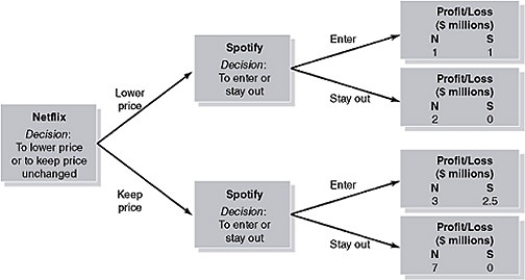 Netflix (N) was one of the first companies to offer streaming video services and is still considered a leader in the industry. Spotify (S) offers a music streaming service and in 2015 considered entering the video streaming business. At that point, Netflix had to decide whether or not to lower its subscription price in order to deter Spotify's entry into the market. Figure 14-5 shows a hypothetical decision tree for the Netflix-Spotify entry game.
-Refer to Figure 14-5. Does it make sense for Netflix to lower its price in order to deter Spotify's entry into the streaming video market?
Netflix (N) was one of the first companies to offer streaming video services and is still considered a leader in the industry. Spotify (S) offers a music streaming service and in 2015 considered entering the video streaming business. At that point, Netflix had to decide whether or not to lower its subscription price in order to deter Spotify's entry into the market. Figure 14-5 shows a hypothetical decision tree for the Netflix-Spotify entry game.
-Refer to Figure 14-5. Does it make sense for Netflix to lower its price in order to deter Spotify's entry into the streaming video market? (Multiple Choice)
4.9/5 (81)
(81) Which of the following is the best example of an oligopolistic industry?
(Multiple Choice)
4.9/5 (91)
(91) Why are decision trees useful to managers who plan business strategies?
(Multiple Choice)
4.7/5 (89)
(89) The "Discount Department Stores" industry is highly concentrated. What does this mean?
(Multiple Choice)
4.8/5 (79)
(79) Table 14-2  Table 14-2 shows the payoff matrix for Walmart and Target from every combination of pricing strategies for the popular PlayStation 4. At the start of the game each firm charges a low price and each earns a profit of $7,000.
-Refer to Table 14-2. Suppose pricing PlayStations is a repeated game in which Walmart and Target will be selling the game system in competition over a long period of time. In this case, what is the most likely outcome?
Table 14-2 shows the payoff matrix for Walmart and Target from every combination of pricing strategies for the popular PlayStation 4. At the start of the game each firm charges a low price and each earns a profit of $7,000.
-Refer to Table 14-2. Suppose pricing PlayStations is a repeated game in which Walmart and Target will be selling the game system in competition over a long period of time. In this case, what is the most likely outcome? (Multiple Choice)
4.9/5 (85)
(85) Since 1972, the world price of oil has been largely determined by OPEC, which controls about 75 percent of the world's proven oil reserves. Since 1972 the price of oil has
(Multiple Choice)
4.8/5 (85)
(85) Occupational licensing is an example of an entry barrier that improves a country's standard of living.
(True/False)
4.8/5 (95)
(95) Which of the following is important in determining the extent of competition in an industry?
(Multiple Choice)
4.8/5 (78)
(78) Table 14-8  Two rival oligopolists in the coffee industry, Wide Awake and Zuma, have to decide on their pricing strategy. Each can choose either a high price or a low price. Table 14-8 shows the payoff matrix with the profits that each firm can expect to earn depending on the pricing strategy it adopts.
-Refer to Table 14-8. If the firms cooperate, what prices will they select?
Two rival oligopolists in the coffee industry, Wide Awake and Zuma, have to decide on their pricing strategy. Each can choose either a high price or a low price. Table 14-8 shows the payoff matrix with the profits that each firm can expect to earn depending on the pricing strategy it adopts.
-Refer to Table 14-8. If the firms cooperate, what prices will they select? (Multiple Choice)
4.7/5 (77)
(77) Competition in the form of advertising, better customer service, or longer warranties can also reduce profits by raising costs.
(True/False)
4.8/5 (71)
(71) Each member of OPEC can increase its income by selling more oil than its output quota because
(Multiple Choice)
4.9/5 (90)
(90) An agreement among firms to charge the same price or otherwise not to compete is called
(Multiple Choice)
5.0/5 (86)
(86) 
Filters
- Essay(0)
- Multiple Choice(0)
- Short Answer(0)
- True False(0)
- Matching(0)