



 Chat with AI
Exam 14: Oligopoly: Firms in Less Competitive Markets

Exam 1: Economics: Foundations and Models459 Questions
Exam 2: Trade-Offs, Comparative Advantage, and the Market System492 Questions
Exam 3: Where Prices Come From: the Interaction of Demand and Supply476 Questions
Exam 4: Economic Efficiency, Government Price Setting, and Taxes420 Questions
Exam 5: Externalities, Environmental Policy, and Public Goods262 Questions
Exam 6: Elasticity: the Responsiveness of Demand and Supply293 Questions
Exam 7: The Economics of Health Care337 Questions
Exam 8: Firms, the Stock Market, and Corporate Governance512 Questions
Exam 9: Comparative Advantage and the Gains From International Trade377 Questions
Exam 10: Consumer Choice and Behavioral Economics304 Questions
Exam 11: Technology, Production, and Costs326 Questions
Exam 12: Firms in Perfectly Competitive Markets296 Questions
Exam 13: Monopolistic Competition: the Competitive Model in a More Realistic Setting272 Questions
Exam 14: Oligopoly: Firms in Less Competitive Markets256 Questions
Exam 15: Monopoly and Antitrust Policy279 Questions
Exam 16: Pricing Strategy258 Questions
Exam 17: The Markets for Labor and Other Factors of Production279 Questions
Exam 18: Public Choice, Taxes, and the Distribution of Income258 Questions
Exam 19: Gdp: Measuring Total Production and Income260 Questions
Exam 20: Unemployment and Inflation290 Questions
Exam 21: Economic Growth, the Financial System, and Business Cycles251 Questions
Exam 22: Long-Run Economic Growth: Sources and Policies261 Questions
Exam 23: Aggregate Expenditure and Output in the Short Run305 Questions
Exam 24: Aggregate Demand and Aggregate Supply Analysis286 Questions
Exam 25: Money, Banks, and the Federal Reserve System278 Questions
Exam 26: Monetary Policy280 Questions
Exam 27: Fiscal Policy313 Questions
Exam 28: Inflation, Unemployment, and Federal Reserve Policy257 Questions
Exam 29: Macroeconomics in an Open Economy277 Questions
Exam 30: The International Financial System258 Questions
Select questions type


Ocean Spray is considered to be an oligopoly firm because, until the 1990s, it faced little competition in the market for fresh and frozen cranberries. Why?
(Multiple Choice)
4.8/5  (77)
(77) An oligopolistic industry is characterized by a few large firms acting independently.
(True/False)
4.8/5 (80)
(80) Figure 14-3 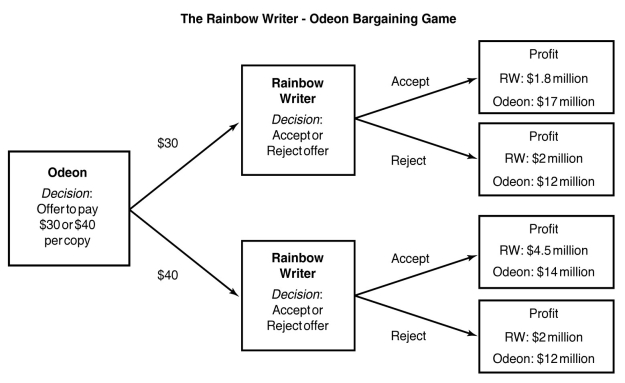 Rainbow Writer (RW) is a small online company selling a highly rated software package for engraving words onto objects produced by 3D printers. The firm currently earns a profit of $2 million per year selling its package exclusively on its Website. Odeon, the producer of the most popular 3D printers has expressed interest in bundling Rainbow Writer's product with its printers. Odeon expects that bundling would further boost its sales and allow it to sell its printers at a higher price, thus raising its profits beyond its current profit of $12 million. Figure 14.3 shows the decision tree for the Rainbow Writer-Odeon bargaining game.
-Refer to Figure 14-3. How will Rainbow Writer respond to Odeon's two possible offers?
Rainbow Writer (RW) is a small online company selling a highly rated software package for engraving words onto objects produced by 3D printers. The firm currently earns a profit of $2 million per year selling its package exclusively on its Website. Odeon, the producer of the most popular 3D printers has expressed interest in bundling Rainbow Writer's product with its printers. Odeon expects that bundling would further boost its sales and allow it to sell its printers at a higher price, thus raising its profits beyond its current profit of $12 million. Figure 14.3 shows the decision tree for the Rainbow Writer-Odeon bargaining game.
-Refer to Figure 14-3. How will Rainbow Writer respond to Odeon's two possible offers? (Multiple Choice)
4.8/5 (82)
(82) Which government agency publishes four-firm concentration ratios?
(Multiple Choice)
4.9/5 (79)
(79) A situation in which each firm chooses the best strategy given the strategies chosen by other firms is called a
(Multiple Choice)
4.8/5 (93)
(93) Which of the following is not among Porter's competitive forces?
(Multiple Choice)
4.7/5 (79)
(79) Figure 14-2  The government of a developing country plans to award two firms, Gigacom and Xenophone, the exclusive rights to share the market for high speed internet service. Gigacom and Xenophone can both provide the service either via television cable lines or via direct subscriber line (DSL). Suppose the government is considering a proposal to delay one firm's entry into the market on the grounds that it wants to prevent "harmful" competition. Figure 14-2 shows the decision tree for this game.
-Refer to Figure 14-2. Now suppose that the government delays Xenophone's entry and Gigacom moves first, what is the likely outcome in the market?
The government of a developing country plans to award two firms, Gigacom and Xenophone, the exclusive rights to share the market for high speed internet service. Gigacom and Xenophone can both provide the service either via television cable lines or via direct subscriber line (DSL). Suppose the government is considering a proposal to delay one firm's entry into the market on the grounds that it wants to prevent "harmful" competition. Figure 14-2 shows the decision tree for this game.
-Refer to Figure 14-2. Now suppose that the government delays Xenophone's entry and Gigacom moves first, what is the likely outcome in the market? (Multiple Choice)
4.8/5 (70)
(70) Table 14-8  Two rival oligopolists in the coffee industry, Wide Awake and Zuma, have to decide on their pricing strategy. Each can choose either a high price or a low price. Table 14-8 shows the payoff matrix with the profits that each firm can expect to earn depending on the pricing strategy it adopts.
-Refer to Table 14-8. If Zuma selects a high price, what is Wide Awake's best strategy and what will Wide Awake earn as a result of this strategy?
Two rival oligopolists in the coffee industry, Wide Awake and Zuma, have to decide on their pricing strategy. Each can choose either a high price or a low price. Table 14-8 shows the payoff matrix with the profits that each firm can expect to earn depending on the pricing strategy it adopts.
-Refer to Table 14-8. If Zuma selects a high price, what is Wide Awake's best strategy and what will Wide Awake earn as a result of this strategy? (Multiple Choice)
4.9/5 (79)
(79) All of the following are characteristics of game theory except
(Multiple Choice)
4.9/5 (74)
(74) Most economists are concerned about entry barriers. Why is this so important to them?
(Essay)
4.8/5 (81)
(81) What is meant by the term "government-imposed barrier to entry"? Why would a government be willing to impose barriers to entering an industry?
(Essay)
4.8/5 (78)
(78) An example of a supplier that used its bargaining power to charge high prices to its customers is
(Multiple Choice)
4.7/5 (86)
(86) Which of the following is not a characteristic of an oligopoly?
(Multiple Choice)
4.8/5 (82)
(82) How does the demand curve for an oligopoly firm differ from the demand curves for firms in competitive market structures?
(Essay)
4.9/5 (83)
(83) Figure 14-3 Rainbow Writer (RW) is a small online company selling a highly rated software package for engraving words onto objects produced by 3D printers. The firm currently earns a profit of $2 million per year selling its package exclusively on its Website. Odeon, the producer of the most popular 3D printers has expressed interest in bundling Rainbow Writer's product with its printers. Odeon expects that bundling would further boost its sales and allow it to sell its printers at a higher price, thus raising its profits beyond its current profit of $12 million. Figure 14.3 shows the decision tree for the Rainbow Writer-Odeon bargaining game.
-Refer to Figure 14-3. What is the equilibrium outcome in this game and is this a subgame-perfect equilibrium?
Rainbow Writer (RW) is a small online company selling a highly rated software package for engraving words onto objects produced by 3D printers. The firm currently earns a profit of $2 million per year selling its package exclusively on its Website. Odeon, the producer of the most popular 3D printers has expressed interest in bundling Rainbow Writer's product with its printers. Odeon expects that bundling would further boost its sales and allow it to sell its printers at a higher price, thus raising its profits beyond its current profit of $12 million. Figure 14.3 shows the decision tree for the Rainbow Writer-Odeon bargaining game.
-Refer to Figure 14-3. What is the equilibrium outcome in this game and is this a subgame-perfect equilibrium? (Multiple Choice)
4.9/5 (82)
(82) Table 14-5  Martin and Lewis each run one of the two bingo parlors in Schenectady. Both consider offering free rides to and from the parlors. Table 14-5 shows the payoff matrix containing the expected weekly profits for each bingo parlor.
-Refer to Table 14-5. What is the Nash equilibrium in this game?
Martin and Lewis each run one of the two bingo parlors in Schenectady. Both consider offering free rides to and from the parlors. Table 14-5 shows the payoff matrix containing the expected weekly profits for each bingo parlor.
-Refer to Table 14-5. What is the Nash equilibrium in this game? (Multiple Choice)
4.9/5 (88)
(88) The barrier to entry that allowed Alcoa to make persistent economic profits was ownership of an essential input.
(True/False)
4.8/5 (86)
(86) 
Filters
- Essay(0)
- Multiple Choice(0)
- Short Answer(0)
- True False(0)
- Matching(0)