



 Chat with AI
Exam 14: Oligopoly: Firms in Less Competitive Markets

Exam 1: Economics: Foundations and Models459 Questions
Exam 2: Trade-Offs, Comparative Advantage, and the Market System492 Questions
Exam 3: Where Prices Come From: the Interaction of Demand and Supply476 Questions
Exam 4: Economic Efficiency, Government Price Setting, and Taxes420 Questions
Exam 5: Externalities, Environmental Policy, and Public Goods262 Questions
Exam 6: Elasticity: the Responsiveness of Demand and Supply293 Questions
Exam 7: The Economics of Health Care337 Questions
Exam 8: Firms, the Stock Market, and Corporate Governance512 Questions
Exam 9: Comparative Advantage and the Gains From International Trade377 Questions
Exam 10: Consumer Choice and Behavioral Economics304 Questions
Exam 11: Technology, Production, and Costs326 Questions
Exam 12: Firms in Perfectly Competitive Markets296 Questions
Exam 13: Monopolistic Competition: the Competitive Model in a More Realistic Setting272 Questions
Exam 14: Oligopoly: Firms in Less Competitive Markets256 Questions
Exam 15: Monopoly and Antitrust Policy279 Questions
Exam 16: Pricing Strategy258 Questions
Exam 17: The Markets for Labor and Other Factors of Production279 Questions
Exam 18: Public Choice, Taxes, and the Distribution of Income258 Questions
Exam 19: Gdp: Measuring Total Production and Income260 Questions
Exam 20: Unemployment and Inflation290 Questions
Exam 21: Economic Growth, the Financial System, and Business Cycles251 Questions
Exam 22: Long-Run Economic Growth: Sources and Policies261 Questions
Exam 23: Aggregate Expenditure and Output in the Short Run305 Questions
Exam 24: Aggregate Demand and Aggregate Supply Analysis286 Questions
Exam 25: Money, Banks, and the Federal Reserve System278 Questions
Exam 26: Monetary Policy280 Questions
Exam 27: Fiscal Policy313 Questions
Exam 28: Inflation, Unemployment, and Federal Reserve Policy257 Questions
Exam 29: Macroeconomics in an Open Economy277 Questions
Exam 30: The International Financial System258 Questions
Select questions type


A reason why there is more competition in the restaurant industry than in the music streaming industry is that restaurants
(Multiple Choice)
4.8/5  (75)
(75) Table 14-7 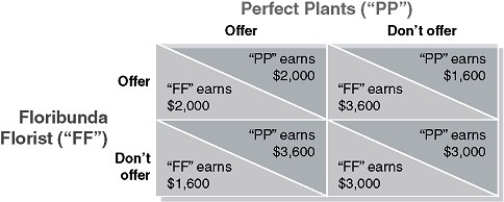 The payoff matrix shown above assumes that Perfect Plants and Floribunda Florist must decide whether to offer same-day delivery for their products. The matrix shows how much profit each firm will earn if it does or does not offer same-day delivery. The amount of profit for one firm depends on whether the other firm offers same-day delivery.
-Refer to Table 14-7. Which of the following statements is true?
The payoff matrix shown above assumes that Perfect Plants and Floribunda Florist must decide whether to offer same-day delivery for their products. The matrix shows how much profit each firm will earn if it does or does not offer same-day delivery. The amount of profit for one firm depends on whether the other firm offers same-day delivery.
-Refer to Table 14-7. Which of the following statements is true? (Multiple Choice)
4.9/5 (76)
(76) If economies of scale are significant, the typical firm will not reach the minimum point on its long-run average cost curve until it has produced a large fraction of industry sales.
(True/False)
4.8/5 (81)
(81) The Organization of Petroleum Exporting Countries (OPEC) controls about 75 percent of the world's proven oil reserves. Economists refer to OPEC as a cartel because
(Multiple Choice)
4.8/5 (69)
(69) Table 14-3  Suppose OPEC has only two producers, Saudi Arabia and Ecuador. Saudi Arabia has far more oil reserves and is the lower-cost producer compared to Ecuador. The payoff matrix in Table 14-3 shows the profits earned per day by each country. "Low output" corresponds to producing the OPEC assigned quota and "high output" corresponds to producing the maximum capacity beyond the assigned quota.
-Refer to Table 14-3. Is there a dominant strategy for Saudi Arabia and, if so, what is it?
Suppose OPEC has only two producers, Saudi Arabia and Ecuador. Saudi Arabia has far more oil reserves and is the lower-cost producer compared to Ecuador. The payoff matrix in Table 14-3 shows the profits earned per day by each country. "Low output" corresponds to producing the OPEC assigned quota and "high output" corresponds to producing the maximum capacity beyond the assigned quota.
-Refer to Table 14-3. Is there a dominant strategy for Saudi Arabia and, if so, what is it? (Multiple Choice)
5.0/5 (76)
(76) Which of the following economists did not help to develop game theory analysis?
(Multiple Choice)
4.8/5 (69)
(69) Prices of PlayStation 4 game systems are similar at almost every large retailer and little price competition occurs among these retailers. An explanation for this is
(Multiple Choice)
4.9/5 (66)
(66) The approach economists use to analyze competition among oligopolists is called
(Multiple Choice)
4.8/5 (71)
(71) Explain how collusion makes firms better off. Given the incentives to collude, briefly explain why every industry does not become a cartel.
(Essay)
5.0/5 (76)
(76) What is a sequential game? How are decision trees used to analyze sequential games?
(Essay)
4.7/5 (81)
(81) Figure 14-6 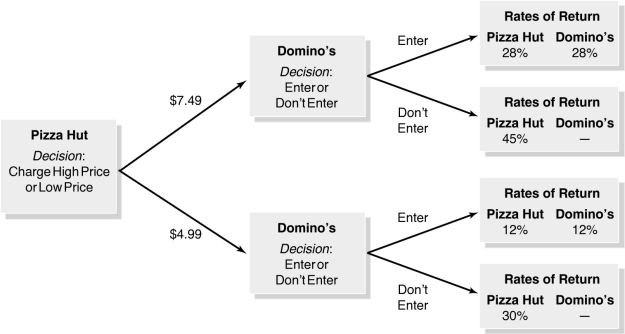 -Refer to Figure 14-6 Use the decision tree to determine whether Pizza Hut should deter Domino's from entering the market for pasta salad. Assume that each firm must earn a 25% return on investment to break even. Explain Pizza Hut's decision process.
 (Essay)
4.9/5 (79)
(79) In Michael Porter's five competitive forces model, what do the competitive forces determine?
(Essay)
4.7/5 (88)
(88) The justification for occupational licensing laws is that they protect the public from incompetent practitioners (for example, lawyers and medical doctors), but the laws also result in
(Multiple Choice)
4.8/5 (81)
(81) A table that shows the possible payoffs each firm earns from every combination of strategies by all firms is called
(Multiple Choice)
4.9/5 (83)
(83) Table 14-4  Alpha and Beta are the only firms selling gyros in the upscale town of Delphi. Each firm must decide on whether to offer a discount to students to compete for customers. If one firm offers a discount but the other does not, then the firm that offers the discount will increase its profit. Table 14-4 shows the payoff matrix for this game.
-Refer to Table 14-4. How are the firms in this game caught in a prisoner's dilemma?
Alpha and Beta are the only firms selling gyros in the upscale town of Delphi. Each firm must decide on whether to offer a discount to students to compete for customers. If one firm offers a discount but the other does not, then the firm that offers the discount will increase its profit. Table 14-4 shows the payoff matrix for this game.
-Refer to Table 14-4. How are the firms in this game caught in a prisoner's dilemma? (Multiple Choice)
4.8/5 (68)
(68) Firms in an oligopoly are said to be interdependent. What does this mean?
(Essay)
4.9/5 (78)
(78) On January 2, 1971, all cigarette advertising was banned on U.S. television and radio stations. Assuming that advertising is a prisoner's dilemma, and that if one company advertises, its competitors will also choose to spend money to advertise, did this ban likely increase or decrease the profits of cigarette companies in 1971? Briefly explain.
(Essay)
4.8/5 (70)
(70) 
Filters
- Essay(0)
- Multiple Choice(0)
- Short Answer(0)
- True False(0)
- Matching(0)