



 Chat with AI
Exam 14: Oligopoly: Firms in Less Competitive Markets

Exam 1: Economics: Foundations and Models459 Questions
Exam 2: Trade-Offs, Comparative Advantage, and the Market System492 Questions
Exam 3: Where Prices Come From: the Interaction of Demand and Supply476 Questions
Exam 4: Economic Efficiency, Government Price Setting, and Taxes420 Questions
Exam 5: Externalities, Environmental Policy, and Public Goods262 Questions
Exam 6: Elasticity: the Responsiveness of Demand and Supply293 Questions
Exam 7: The Economics of Health Care337 Questions
Exam 8: Firms, the Stock Market, and Corporate Governance512 Questions
Exam 9: Comparative Advantage and the Gains From International Trade377 Questions
Exam 10: Consumer Choice and Behavioral Economics304 Questions
Exam 11: Technology, Production, and Costs326 Questions
Exam 12: Firms in Perfectly Competitive Markets296 Questions
Exam 13: Monopolistic Competition: the Competitive Model in a More Realistic Setting272 Questions
Exam 14: Oligopoly: Firms in Less Competitive Markets256 Questions
Exam 15: Monopoly and Antitrust Policy279 Questions
Exam 16: Pricing Strategy258 Questions
Exam 17: The Markets for Labor and Other Factors of Production279 Questions
Exam 18: Public Choice, Taxes, and the Distribution of Income258 Questions
Exam 19: Gdp: Measuring Total Production and Income260 Questions
Exam 20: Unemployment and Inflation290 Questions
Exam 21: Economic Growth, the Financial System, and Business Cycles251 Questions
Exam 22: Long-Run Economic Growth: Sources and Policies261 Questions
Exam 23: Aggregate Expenditure and Output in the Short Run305 Questions
Exam 24: Aggregate Demand and Aggregate Supply Analysis286 Questions
Exam 25: Money, Banks, and the Federal Reserve System278 Questions
Exam 26: Monetary Policy280 Questions
Exam 27: Fiscal Policy313 Questions
Exam 28: Inflation, Unemployment, and Federal Reserve Policy257 Questions
Exam 29: Macroeconomics in an Open Economy277 Questions
Exam 30: The International Financial System258 Questions
Select questions type


The Brooks Appliance Store and the Lefingwell Appliance Store (both are located in the same city) each sell an identical washer-dryer pair. The owner of each store considered offering the washer-dryer pair for $700, but decided on a price of $500. If this is a Nash equilibrium we can conclude that
(Multiple Choice)
4.8/5  (74)
(74) Which of the following is an example of a way in which an oligopolistic firm can escape the prisoner's dilemma?
(Multiple Choice)
5.0/5 (82)
(82) If the painting firms in a city sign a contract outlining a pricing plan, they are involved in
(Multiple Choice)
4.8/5 (75)
(75) The four-firm concentration ratio of the aircraft industry is over 80 percent. Most economists would consider this industry an oligopoly.
(True/False)
4.7/5 (92)
(92) Figure 14-9 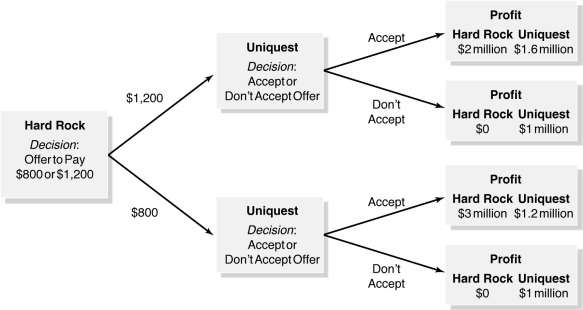 -Refer to Figure 14-9. Uniquest, Inc. is a company that provides PCs with internet access and touch-sensitive screens to hotels. Suppose the Hard Rock Hotel and Casino in Las Vegas informs Uniquest that it is considering installing these systems in its hotel rooms. The Hard Rock expects to be able to charge higher prices for these rooms if it installs Uniquest's systems in its rooms. The two companies begin bargaining over what price the Hard Rock will pay Uniquest for its systems, and the decision tree shown above illustrates this bargaining game. Note that the profit figures listed in the decision tree are additional profits for the Hard Rock and total profits for Uniquest.
a. Suppose the Hard Rock offers Uniquest $1,200 per system. Will Uniquest accept or reject this offer? Why?
b. Suppose the Hard Rock offers Uniquest $800 per system. Will Uniquest accept or reject this offer? Why?
c. Suppose Uniquest attempts to obtain a favorable outcome from the bargaining by telling the Hard Rock it will reject an $800-per-system offer. If the Hard Rock does not believe the threat is credible, what will it do? Why? What will Uniquest do? Why?
d. Is there a subgame-perfect equilibrium in this situation? Explain.
-Refer to Figure 14-9. Uniquest, Inc. is a company that provides PCs with internet access and touch-sensitive screens to hotels. Suppose the Hard Rock Hotel and Casino in Las Vegas informs Uniquest that it is considering installing these systems in its hotel rooms. The Hard Rock expects to be able to charge higher prices for these rooms if it installs Uniquest's systems in its rooms. The two companies begin bargaining over what price the Hard Rock will pay Uniquest for its systems, and the decision tree shown above illustrates this bargaining game. Note that the profit figures listed in the decision tree are additional profits for the Hard Rock and total profits for Uniquest.
a. Suppose the Hard Rock offers Uniquest $1,200 per system. Will Uniquest accept or reject this offer? Why?
b. Suppose the Hard Rock offers Uniquest $800 per system. Will Uniquest accept or reject this offer? Why?
c. Suppose Uniquest attempts to obtain a favorable outcome from the bargaining by telling the Hard Rock it will reject an $800-per-system offer. If the Hard Rock does not believe the threat is credible, what will it do? Why? What will Uniquest do? Why?
d. Is there a subgame-perfect equilibrium in this situation? Explain. (Essay)
4.8/5 (79)
(79) A sequential game can be used to analyze whether a retail firm should build a large store or a small store in a city, when the correct choice depends on whether a competing firm will build a new store in the same city. Which of the following is used to analyze this type of decision?
(Multiple Choice)
4.9/5 (82)
(82) Which of the following best explains why airlines often cut their ticket prices at the last-minute in order to fill the remaining empty seats on their flights?
(Multiple Choice)
4.8/5 (85)
(85) Table 14-7 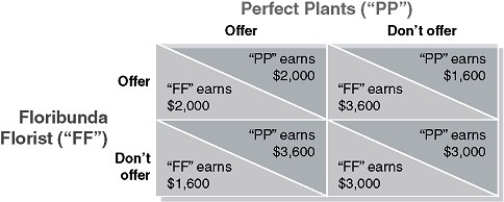 The payoff matrix shown above assumes that Perfect Plants and Floribunda Florist must decide whether to offer same-day delivery for their products. The matrix shows how much profit each firm will earn if it does or does not offer same-day delivery. The amount of profit for one firm depends on whether the other firm offers same-day delivery.
-Refer to Table 14-7. Which of the following statements is true?
The payoff matrix shown above assumes that Perfect Plants and Floribunda Florist must decide whether to offer same-day delivery for their products. The matrix shows how much profit each firm will earn if it does or does not offer same-day delivery. The amount of profit for one firm depends on whether the other firm offers same-day delivery.
-Refer to Table 14-7. Which of the following statements is true? (Multiple Choice)
4.9/5 (65)
(65) Which of the following is not part of an oligopolist's business strategy?
(Multiple Choice)
4.9/5 (78)
(78) Selling baked goods out of your home or apartment is illegal in Wisconsin and New Jersey. In these states, baked goods must be prepared in commercial kitchens that are subject to state inspection if they are to be sold to the public. For home bakers in these two states, they barrier to entry they face is
(Multiple Choice)
4.8/5 (78)
(78) The people firms hire to attempt to convince state legislators and members of Congress to pass laws that are favorable to the economic interests of the firms are called
(Multiple Choice)
4.8/5 (74)
(74) There are two firms in the residential paint industry, Cool Shades (C) and Warm Hues (W). They collude to share the market equally. They jointly set a monopoly price and split the quantity demanded at that price. Here are their options:
i. They continue to collude (no cheating) and make $36 million each in profits.
ii. One firm cheats and the other does not. The firm that cheats makes a profit of $42 million whereas the firm that doesn't makes a profit of $27 million.
iii. They both cheat and each firm makes a profit of $21 million.
a. Construct a payoff matrix for these two firms.
b. How does this situation relate to the prisoner's dilemma?
c. If each firm acted noncooperatively, how much profit would each make?
d. Are the firms better off colluding (with no cheating) or competing? Explain.
(Essay)
4.8/5 (80)
(80) Table 14-3  Suppose OPEC has only two producers, Saudi Arabia and Ecuador. Saudi Arabia has far more oil reserves and is the lower-cost producer compared to Ecuador. The payoff matrix in Table 14-3 shows the profits earned per day by each country. "Low output" corresponds to producing the OPEC assigned quota and "high output" corresponds to producing the maximum capacity beyond the assigned quota.
-Refer to Table 14-3. Which of the following statements is true?
Suppose OPEC has only two producers, Saudi Arabia and Ecuador. Saudi Arabia has far more oil reserves and is the lower-cost producer compared to Ecuador. The payoff matrix in Table 14-3 shows the profits earned per day by each country. "Low output" corresponds to producing the OPEC assigned quota and "high output" corresponds to producing the maximum capacity beyond the assigned quota.
-Refer to Table 14-3. Which of the following statements is true? (Multiple Choice)
4.9/5 (92)
(92) Producing a differentiated product occurs in which of the following industries?
(Multiple Choice)
4.7/5 (76)
(76) Why does a prisoner's dilemma lead to a noncooperative equilibrium?
(Multiple Choice)
4.8/5 (77)
(77) Which of the following statements regarding concentration ratios is most accurate?
(Multiple Choice)
4.8/5 (86)
(86) 
Filters
- Essay(0)
- Multiple Choice(0)
- Short Answer(0)
- True False(0)
- Matching(0)