



 Chat with AI
Exam 15: Oligopoly and Antitrust Policy

Exam 1: Economics and Economic Reasoning158 Questions
Exam 2: The Production Possibility Model, Trade, and Globalization133 Questions
Exam 3: Economic Institutions163 Questions
Exam 4: Supply and Demand182 Questions
Exam 5: Using Supply and Demand163 Questions
Exam 6: Describing Supply and Demand: Elasticities216 Questions
Exam 7: Taxation and Government Intervention201 Questions
Exam 8: Market Failure Versus Government Failure197 Questions
Exam 9: Comparative Advantage, Exchange Rates, and Globalization118 Questions
Exam 10: International Trade Policy99 Questions
Exam 11: Production and Cost Analysis I194 Questions
Exam 12: Production and Cost Analysis II152 Questions
Exam 13: Perfect Competition170 Questions
Exam 14: Monopoly and Monopolistic Competition274 Questions
Exam 15: Oligopoly and Antitrust Policy142 Questions
Exam 16: Real-World Competition and Technology108 Questions
Exam 17: Work and the Labor Market150 Questions
Exam 18: Who Gets What the Distribution of Income131 Questions
Exam 19: The Logic of Individual Choice: the Foundation of Supply and Demand170 Questions
Exam 20: Game Theory, Strategic Decision Making, and Behavioral Economics103 Questions
Exam 21: Thinking Like a Modern Economist97 Questions
Exam 22: Behavioral Economics and Modern Economic Policy126 Questions
Exam 23: Microeconomic Policy, Economic Reasoning, and Beyond134 Questions
Exam 24: Economic Growth, Business Cycles, and Unemployment124 Questions
Exam 25: Measuring and Describing the Aggregate Economy229 Questions
Exam 26: The Keynesian Short-Run Policy Model: Demand-Side Policies220 Questions
Exam 27: The Classical Long-Run Policy Model: Growth and Supply-Side Policies133 Questions
Exam 28: The Financial Sector and the Economy214 Questions
Exam 29: Monetary Policy243 Questions
Exam 30: Financial Crises, Panics, and Unconventional Monetary Policy109 Questions
Exam 31: Deficits and Debt: the Austerity Debate150 Questions
Exam 32: The Fiscal Policy Dilemma119 Questions
Exam 33: Jobs and Unemployment78 Questions
Exam 34: Inflation, Deflation, and Macro Policy175 Questions
Exam 35: International Financial Policy211 Questions
Exam 36: Macro Policy in a Global Setting134 Questions
Exam 37: Structural Stagnation and Globalization125 Questions
Exam 38: Macro Policy in Developing Countries142 Questions
Select questions type


The Herfindahl index is calculated by adding the squared value of the market shares of all the firms in the industry.
(True/False)
4.9/5  (87)
(87) One reason fewer antitrust cases have been brought before the courts is:
(Multiple Choice)
4.7/5 (75)
(75) An important way in which globalization changed U.S. antitrust policy is:
(Multiple Choice)
4.8/5 (80)
(80) When government uses the judgment by performance criterion, a firm is considered a monopoly if it controls a significant segment of the market.
(True/False)
4.7/5 (77)
(77) Refer to the graph shown, which shows an oligopolist facing a kinked demand curve. The firm will not increase price when marginal costs fluctuate between which two points? 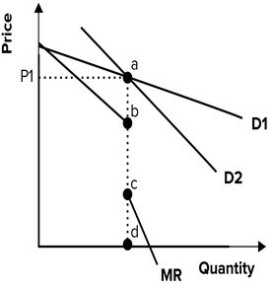
(Multiple Choice)
4.8/5 (73)
(73) Suppose there are no barriers to entry in the market for facial tissues, where two brands dominate the industry. According to the theory of contestable markets, the price charged for facial tissues will be:
(Multiple Choice)
4.9/5 (79)
(79) Implicit collusion occurs when oligopolistic firms negotiate a common price.
(True/False)
5.0/5 (75)
(75) In the ALCOA antitrust case in 1945, the Court ruled that the:
(Multiple Choice)
4.9/5 (89)
(89) The basis of judgment for the Standard Oil case was ________, whereas the basis of judgment for the ALCOA case was ________:
(Multiple Choice)
4.9/5 (78)
(78) If an industry has a Herfindahl index of 3,000, the contestable market model probably would predict that the industry would be more likely to have a:
(Multiple Choice)
4.7/5 (85)
(85) Why was antitrust policy in other countries not as restrictive as in the U.S.and how has increased international competition changed antitrust policy in the United States?
(Essay)
4.8/5 (86)
(86) Refer to the table shown. Using the four-firm concentration ratio, the tire industry is best categorized as: Industry Number of sellers \% of shipments accuunted far by the 4 larget comnanies Tires 15 95 Upholstered furniture 2,000 15
(Multiple Choice)
4.8/5 (77)
(77) When four Infineon Technologies executives participated in an international conspiracy to fix prices for computer memory chips, they were acting with other firms as:
(Multiple Choice)
4.7/5 (67)
(67) Consumers of Google and Facebook services are disadvantaged because:
(Multiple Choice)
4.8/5 (75)
(75) In a market, there are many firms selling differentiated products. This market is:
(Multiple Choice)
4.9/5 (65)
(65) The primary criterion governing U.S. antitrust policy until 1945 was:
(Multiple Choice)
4.9/5 (71)
(71) 
Filters
- Essay(0)
- Multiple Choice(0)
- Short Answer(0)
- True False(0)
- Matching(0)