



 Chat with AI
Exam 15: Oligopoly and Antitrust Policy

Exam 1: Economics and Economic Reasoning158 Questions
Exam 2: The Production Possibility Model, Trade, and Globalization133 Questions
Exam 3: Economic Institutions163 Questions
Exam 4: Supply and Demand182 Questions
Exam 5: Using Supply and Demand163 Questions
Exam 6: Describing Supply and Demand: Elasticities216 Questions
Exam 7: Taxation and Government Intervention201 Questions
Exam 8: Market Failure Versus Government Failure197 Questions
Exam 9: Comparative Advantage, Exchange Rates, and Globalization118 Questions
Exam 10: International Trade Policy99 Questions
Exam 11: Production and Cost Analysis I194 Questions
Exam 12: Production and Cost Analysis II152 Questions
Exam 13: Perfect Competition170 Questions
Exam 14: Monopoly and Monopolistic Competition274 Questions
Exam 15: Oligopoly and Antitrust Policy142 Questions
Exam 16: Real-World Competition and Technology108 Questions
Exam 17: Work and the Labor Market150 Questions
Exam 18: Who Gets What the Distribution of Income131 Questions
Exam 19: The Logic of Individual Choice: the Foundation of Supply and Demand170 Questions
Exam 20: Game Theory, Strategic Decision Making, and Behavioral Economics103 Questions
Exam 21: Thinking Like a Modern Economist97 Questions
Exam 22: Behavioral Economics and Modern Economic Policy126 Questions
Exam 23: Microeconomic Policy, Economic Reasoning, and Beyond134 Questions
Exam 24: Economic Growth, Business Cycles, and Unemployment124 Questions
Exam 25: Measuring and Describing the Aggregate Economy229 Questions
Exam 26: The Keynesian Short-Run Policy Model: Demand-Side Policies220 Questions
Exam 27: The Classical Long-Run Policy Model: Growth and Supply-Side Policies133 Questions
Exam 28: The Financial Sector and the Economy214 Questions
Exam 29: Monetary Policy243 Questions
Exam 30: Financial Crises, Panics, and Unconventional Monetary Policy109 Questions
Exam 31: Deficits and Debt: the Austerity Debate150 Questions
Exam 32: The Fiscal Policy Dilemma119 Questions
Exam 33: Jobs and Unemployment78 Questions
Exam 34: Inflation, Deflation, and Macro Policy175 Questions
Exam 35: International Financial Policy211 Questions
Exam 36: Macro Policy in a Global Setting134 Questions
Exam 37: Structural Stagnation and Globalization125 Questions
Exam 38: Macro Policy in Developing Countries142 Questions
Select questions type


Why,in recent years,have many potential mergers never even proposed? Give three reasons why the government has been lenient in interpreting anti-trust laws.
(Essay)
4.9/5  (84)
(84) Refer to the graph shown. If a firm operating as if it were faced with a kinked demand curve believes that if it raises price from P2 to P1, its rival will not go along, then: 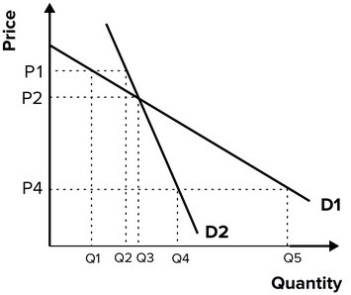
(Multiple Choice)
4.8/5 (91)
(91) Refer to the graph shown. If a firm operating as if it were faced with a kinked demand curve believes that if it lowers price from P2 to P4, its rival will match the price cut, then: 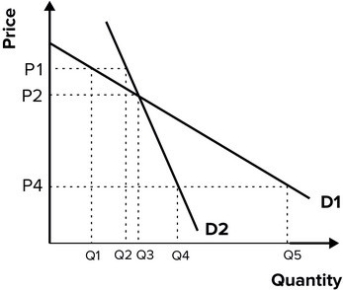
(Multiple Choice)
4.8/5 (75)
(75) Which of the following market structures is characterized by interdependent pricing and output decisions?
(Multiple Choice)
4.7/5 (93)
(93) Firms base decisions on the decisions of other firms in the market in:
(Multiple Choice)
4.9/5 (77)
(77) A problem in using the judgment by market structure criterion is that:
(Multiple Choice)
4.9/5 (68)
(68) One of the reasons fewer antitrust cases have been brought before the courts is:
(Multiple Choice)
5.0/5 (82)
(82) An industry in which 5 firms each have a 10 percent market share and 50 firms each have a 1 percent market share will have a Herfindahl index equal to:
(Multiple Choice)
4.7/5 (65)
(65) To measure industry structure economists use the concentration ratio and the Herfindahl index.Describe each of these indexes.How is the Herfindahl index used in determining public policy? Why is the Herfindahl index the preferred index of market concentration in setting government policy?
(Essay)
4.8/5 (90)
(90) Refer to the table above. Using the four-firm concentration ratio, the upholstered furniture industry is best categorized as: Industry Number of sellers \% of shipments accuunted far by the 4 larget comnanies Tires 15 95 Upholstered furniture 2,000 15
(Multiple Choice)
4.8/5 (71)
(71) Explain the difference between the judgment by performance and the judgment by structure methods of assessing competition.
(Essay)
4.9/5 (76)
(76) The contestable market model of oligopoly bases pricing and output decisions on:
(Multiple Choice)
4.7/5 (83)
(83) To be successful in increasing prices for their product, members of a cartel:
(Multiple Choice)
4.7/5 (83)
(83) The top four firms in the industry have 10 percent, 8 percent, 8 percent, and 6 percent of the market. The Herfindahl index of this market is closest to which of the following?
(Multiple Choice)
4.9/5 (80)
(80) Both structure and performance criteria have ambiguities,and in the real world there are no definitive criteria for judging whether a firm has violated the antitrust statutes.Explain.
(Essay)
4.8/5 (84)
(84) The difference between a three-digit North American Industry Classification System (NAICS)industry and a six-digit NAICS industry is that:
(Multiple Choice)
4.9/5 (87)
(87) In a contestable market model of oligopoly, prices are determined by:
(Multiple Choice)
4.9/5 (73)
(73) 
Filters
- Essay(0)
- Multiple Choice(0)
- Short Answer(0)
- True False(0)
- Matching(0)