



 Chat with AI
Exam 37: Structural Stagnation and Globalization

Exam 1: Economics and Economic Reasoning158 Questions
Exam 2: The Production Possibility Model, Trade, and Globalization133 Questions
Exam 3: Economic Institutions163 Questions
Exam 4: Supply and Demand182 Questions
Exam 5: Using Supply and Demand163 Questions
Exam 6: Describing Supply and Demand: Elasticities216 Questions
Exam 7: Taxation and Government Intervention201 Questions
Exam 8: Market Failure Versus Government Failure197 Questions
Exam 9: Comparative Advantage, Exchange Rates, and Globalization118 Questions
Exam 10: International Trade Policy99 Questions
Exam 11: Production and Cost Analysis I194 Questions
Exam 12: Production and Cost Analysis II152 Questions
Exam 13: Perfect Competition170 Questions
Exam 14: Monopoly and Monopolistic Competition274 Questions
Exam 15: Oligopoly and Antitrust Policy142 Questions
Exam 16: Real-World Competition and Technology108 Questions
Exam 17: Work and the Labor Market150 Questions
Exam 18: Who Gets What the Distribution of Income131 Questions
Exam 19: The Logic of Individual Choice: the Foundation of Supply and Demand170 Questions
Exam 20: Game Theory, Strategic Decision Making, and Behavioral Economics103 Questions
Exam 21: Thinking Like a Modern Economist97 Questions
Exam 22: Behavioral Economics and Modern Economic Policy126 Questions
Exam 23: Microeconomic Policy, Economic Reasoning, and Beyond134 Questions
Exam 24: Economic Growth, Business Cycles, and Unemployment124 Questions
Exam 25: Measuring and Describing the Aggregate Economy229 Questions
Exam 26: The Keynesian Short-Run Policy Model: Demand-Side Policies220 Questions
Exam 27: The Classical Long-Run Policy Model: Growth and Supply-Side Policies133 Questions
Exam 28: The Financial Sector and the Economy214 Questions
Exam 29: Monetary Policy243 Questions
Exam 30: Financial Crises, Panics, and Unconventional Monetary Policy109 Questions
Exam 31: Deficits and Debt: the Austerity Debate150 Questions
Exam 32: The Fiscal Policy Dilemma119 Questions
Exam 33: Jobs and Unemployment78 Questions
Exam 34: Inflation, Deflation, and Macro Policy175 Questions
Exam 35: International Financial Policy211 Questions
Exam 36: Macro Policy in a Global Setting134 Questions
Exam 37: Structural Stagnation and Globalization125 Questions
Exam 38: Macro Policy in Developing Countries142 Questions
Select questions type


Demonstrate what would happen to a country's trade deficit if the value of a country's exchange rate fell.Assume the economy begins with LAS,SAS and WAS0. 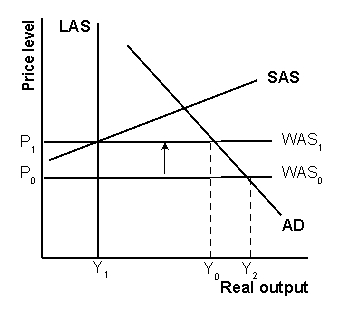
(Essay)
4.8/5  (74)
(74) What does a fall in the exchange rate do to a country's potential output and long run aggregate supply?
(Essay)
4.7/5 (90)
(90) Which group has fared the worst in the globalization process?
(Multiple Choice)
4.8/5 (75)
(75) Refer to the graph. 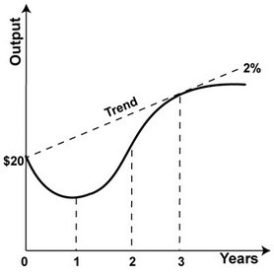 The economy begins at a level of output of $20 billion and experiences a one-year recession in which output declines by 4 percent. What is output in year 1?
 (Multiple Choice)
4.7/5 (89)
(89) Which of the following would shift the world supply curve up?
(Multiple Choice)
4.7/5 (79)
(79) The globalized AS/AD model takes trade into account, while the standard AD/AS model does not.
(True/False)
4.8/5 (65)
(65) According to the hypothesis, when did structural stagnation begin?
(Multiple Choice)
4.7/5 (75)
(75) Why does fiscal policy in the globalized AS/AD model have a different effect than fiscal policy in the standard AS/AD model?
(Essay)
4.7/5 (67)
(67) After the Great Depression, an explanation for why output growth would stop is called:
(Multiple Choice)
4.8/5 (80)
(80) To remain on its growth trend, an economy must grow more in an expansion than it fell during a recession.
(True/False)
4.9/5 (74)
(74) Which of the following would help eliminate the trade deficit?
(Multiple Choice)
4.7/5 (69)
(69) What adjustment forces would one have expected to resolve structural stagnation in the globalized AS/AD model? Why didn't they occur in the recent U.S.case?
(Essay)
4.8/5 (67)
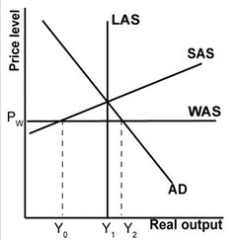
(67) 
Refer to the graph. Economic output in year 0 is $20 billion. What is potential output in year 1? 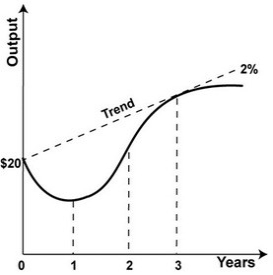
(Multiple Choice)
4.8/5 (86)
(86) According to structural stagnationists, expansionary monetary and fiscal policy has allowed the economy to address its structural problems and adjust in an expedient manner.
(True/False)
4.8/5 (90)
(90) A trade surplus results when the world supply curve is below the domestic economy's price level.
(True/False)
4.8/5 (70)
(70) 
Filters
- Essay(0)
- Multiple Choice(0)
- Short Answer(0)
- True False(0)
- Matching(0)