



 Chat with AI
Exam 37: Structural Stagnation and Globalization

Exam 1: Economics and Economic Reasoning158 Questions
Exam 2: The Production Possibility Model, Trade, and Globalization133 Questions
Exam 3: Economic Institutions163 Questions
Exam 4: Supply and Demand182 Questions
Exam 5: Using Supply and Demand163 Questions
Exam 6: Describing Supply and Demand: Elasticities216 Questions
Exam 7: Taxation and Government Intervention201 Questions
Exam 8: Market Failure Versus Government Failure197 Questions
Exam 9: Comparative Advantage, Exchange Rates, and Globalization118 Questions
Exam 10: International Trade Policy99 Questions
Exam 11: Production and Cost Analysis I194 Questions
Exam 12: Production and Cost Analysis II152 Questions
Exam 13: Perfect Competition170 Questions
Exam 14: Monopoly and Monopolistic Competition274 Questions
Exam 15: Oligopoly and Antitrust Policy142 Questions
Exam 16: Real-World Competition and Technology108 Questions
Exam 17: Work and the Labor Market150 Questions
Exam 18: Who Gets What the Distribution of Income131 Questions
Exam 19: The Logic of Individual Choice: the Foundation of Supply and Demand170 Questions
Exam 20: Game Theory, Strategic Decision Making, and Behavioral Economics103 Questions
Exam 21: Thinking Like a Modern Economist97 Questions
Exam 22: Behavioral Economics and Modern Economic Policy126 Questions
Exam 23: Microeconomic Policy, Economic Reasoning, and Beyond134 Questions
Exam 24: Economic Growth, Business Cycles, and Unemployment124 Questions
Exam 25: Measuring and Describing the Aggregate Economy229 Questions
Exam 26: The Keynesian Short-Run Policy Model: Demand-Side Policies220 Questions
Exam 27: The Classical Long-Run Policy Model: Growth and Supply-Side Policies133 Questions
Exam 28: The Financial Sector and the Economy214 Questions
Exam 29: Monetary Policy243 Questions
Exam 30: Financial Crises, Panics, and Unconventional Monetary Policy109 Questions
Exam 31: Deficits and Debt: the Austerity Debate150 Questions
Exam 32: The Fiscal Policy Dilemma119 Questions
Exam 33: Jobs and Unemployment78 Questions
Exam 34: Inflation, Deflation, and Macro Policy175 Questions
Exam 35: International Financial Policy211 Questions
Exam 36: Macro Policy in a Global Setting134 Questions
Exam 37: Structural Stagnation and Globalization125 Questions
Exam 38: Macro Policy in Developing Countries142 Questions
Select questions type


Suppose a young person asked you for job advice in a globalized economy. Which of the following sectors would you try to dissuade them most from entering?
(Multiple Choice)
4.8/5  (81)
(81) In the globalized AS/AD model, what curve indicates the amount of tradable goods that other countries will supply to a country at a given price level and exchange rate?
(Multiple Choice)
4.7/5 (75)
(75) Based on what we know about the globalized AS/AD model, the standard model does not include an analysis of:
(Multiple Choice)
5.0/5 (82)
(82) In the graph shown, the globally constrained potential output is: 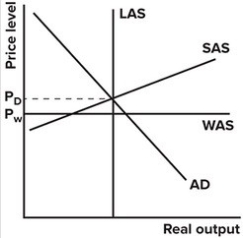
(Multiple Choice)
4.7/5 (75)
(75) 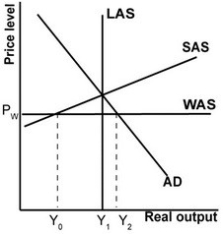
Suppose an economy's trend growth rate is 3 percent and current output is $10 trillion. If the economy enters a recession where output declines by 5 percent in one year, by how much does output have to rise to return to its trend? Assume it takes two years for the economy to return to its trend.
(Multiple Choice)
4.8/5 (79)
(79) In the globalized model, the eventual equivalency of domestic and world prices follows from the:
(Multiple Choice)
4.8/5 (77)
(77) Looking at the graph shown, the structural adjustments necessary to bring the economy back to domestic and international equilibrium include: 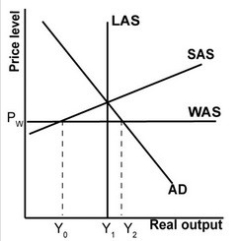
(Multiple Choice)
4.9/5 (79)
(79) Which of the following will be least effective in dealing with the structural adjustment problems?
(Multiple Choice)
4.8/5 (77)
(77) The United States has done very poorly at the high end of the value-added chain.
(True/False)
4.8/5 (85)
(85) Which of the following will help address structural stagnation problems?
(Multiple Choice)
4.8/5 (70)
(70) Which of the following would not shift the world supply curve up?
(Multiple Choice)
4.8/5 (78)
(78) The central difference between the structural stagnation hypothesis and the secular stagnation theory is that:
(Multiple Choice)
4.8/5 (91)
(91) What are three ways in which a country might deal with a structural stagnation?
(Essay)
5.0/5 (82)
(82) Explain the role that globalization and technological change play in the structural stagnation hypothesis.
(Essay)
4.9/5 (68)
(68) 
Filters
- Essay(0)
- Multiple Choice(0)
- Short Answer(0)
- True False(0)
- Matching(0)