



 Chat with AI
Exam 23: The Skeletal System

Exam 1: Introduction to Medical Assisting76 Questions
Exam 2: Healthcare and the Healthcare Team80 Questions
Exam 3: Professionalism and Success75 Questions
Exam 4: Interpersonal Communication97 Questions
Exam 5: Legal and Ethical Issues85 Questions
Exam 6: Infection Control Fundamentals74 Questions
Exam 7: Safety and Patient Reception73 Questions
Exam 8: Office Equipment and Supplies155 Questions
Exam 9: Examination and Treatment Areas97 Questions
Exam 10: Written and Electronic Communication84 Questions
Exam 11: Medical Records and Documentation75 Questions
Exam 12: Electronic Health Records72 Questions
Exam 13: Managing Medical Records74 Questions
Exam 14: Telephone Techniques89 Questions
Exam 15: Patient Education75 Questions
Exam 16: Schedule Management80 Questions
Exam 17: Insurance Billing80 Questions
Exam 18: Diagnostic Coding74 Questions
Exam 19: Procedure Coding75 Questions
Exam 20: Patient Collections and Financial Management142 Questions
Exam 21: Organization of the Body145 Questions
Exam 22: The Integumentary System100 Questions
Exam 23: The Skeletal System154 Questions
Exam 24: The Muscular System100 Questions
Exam 25: The Cardiovascular System89 Questions
Exam 26: The Blood74 Questions
Exam 27: The Lymphatic and Immune Systems78 Questions
Exam 28: The Respiratory System91 Questions
Exam 29: The Nervous System130 Questions
Exam 30: The Urinary System91 Questions
Exam 31: The Reproductive Systems124 Questions
Exam 32: The Digestive System112 Questions
Exam 33: The Endocrine System80 Questions
Exam 34: Special Senses92 Questions
Exam 35: Infection Control Practices105 Questions
Exam 36: Patient Interview and History96 Questions
Exam 37: Vital Signs and Measurements93 Questions
Exam 38: Assisting With a General Physical Exam75 Questions
Exam 39: Assisting in Reproductive and Urinary Specialties74 Questions
Exam 40: Assisting in Pediatrics75 Questions
Exam 41: Assisting in Geriatrics75 Questions
Exam 42: Assisting in Other Medical Specialties75 Questions
Exam 43: Assisting in Eye and Ear Care75 Questions
Exam 44: Assisting in Minor Surgery92 Questions
Exam 45: Orientation to the Lab85 Questions
Exam 46: Microbiology and Disease117 Questions
Exam 47: Processing and Testing Urine and Stool Samples95 Questions
Exam 48: Collecting, Processing, and Testing Blood Specimens75 Questions
Exam 49: Electrocardiography and Pulmonary Function Testing94 Questions
Exam 50: Diagnostic Imaging79 Questions
Exam 51: Principles of Pharmacology104 Questions
Exam 52: Math and Dosage Calculations74 Questions
Exam 53: Medication Administration76 Questions
Exam 54: Physical Therapy and Rehabilitation78 Questions
Exam 55: Nutrition and Health90 Questions
Exam 56: Practice Management76 Questions
Exam 57: Emergency Preparedness105 Questions
Exam 58: Preparing for the World of Work76 Questions
Select questions type


The ________ is the lower jawbone and is the only movable bone in the skull.
(Short Answer)
4.9/5  (86)
(86) The ________ is a membrane that surrounds the diaphysis and contains bone-forming cells, dense fibrous connective tissue, nerves, and blood vessels.
(Short Answer)
4.7/5 (75)
(75) The ________ bones of each coxal bone join together to form the pelvic girdle.
(Short Answer)
4.7/5 (73)
(73) ________ is a condition that occurs due to hypocalcemia. Bone is broken down to release calcium and is not replaced in sufficient amounts, so bone density decreases.
(Short Answer)
4.7/5 (66)
(66) In order to maintain healthy dense bones, what advice would be given to patients?
(Multiple Choice)
4.9/5 (84)
(84) ____ can be used to treat the Ewing sarcoma family of tumors and osteosarcoma.
(Multiple Choice)
4.7/5 (80)
(80) 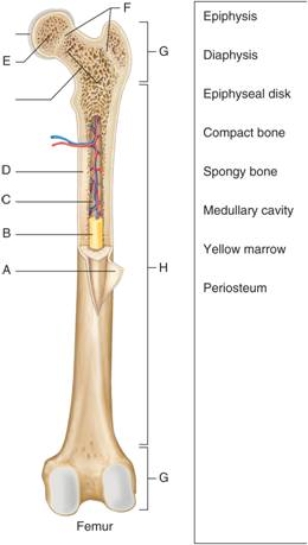 -Letter A on figure of the femur is the ________.
_________ is the term for the shaft of a long bone that is tubular and consists of a thick collar of compact bone that surrounds the central medullary cavity.
(Short Answer)
4.8/5 (78)
(78) Mrs. Jefferson has visible deformities in the fingers on both hands, and she says her fingers hurt most of the time. The practitioner has diagnosed rheumatoid arthritis. Mrs. Jefferson confesses that she does not know much about this disorder and asks what causes it. What should the medical assistant tell her?
(Multiple Choice)
4.8/5 (81)
(81) The ________ is the lateral bone of the lower leg and, at its distal end, joins with the anklebones.
(Short Answer)
4.8/5 (78)
(78) The bones that form most of the top and sides of the skull are the ________ bones.
(Short Answer)
4.9/5 (75)
(75) The layers of bone surrounding the canals of osteons are the ________.
(Short Answer)
4.8/5 (87)
(87) A type of bone cancer that originates from osteoblasts is ________.
(Short Answer)
4.9/5 (83)
(83) The ________ forms the upper jawbone of the facial skeleton, to which the upper teeth anchor.
(Short Answer)
4.8/5 (77)
(77) 
Filters
- Essay(0)
- Multiple Choice(0)
- Short Answer(0)
- True False(0)
- Matching(0)