



 Chat with AI
Exam 24: The Muscular System

Exam 1: Introduction to Medical Assisting76 Questions
Exam 2: Healthcare and the Healthcare Team80 Questions
Exam 3: Professionalism and Success75 Questions
Exam 4: Interpersonal Communication97 Questions
Exam 5: Legal and Ethical Issues85 Questions
Exam 6: Infection Control Fundamentals74 Questions
Exam 7: Safety and Patient Reception73 Questions
Exam 8: Office Equipment and Supplies155 Questions
Exam 9: Examination and Treatment Areas97 Questions
Exam 10: Written and Electronic Communication84 Questions
Exam 11: Medical Records and Documentation75 Questions
Exam 12: Electronic Health Records72 Questions
Exam 13: Managing Medical Records74 Questions
Exam 14: Telephone Techniques89 Questions
Exam 15: Patient Education75 Questions
Exam 16: Schedule Management80 Questions
Exam 17: Insurance Billing80 Questions
Exam 18: Diagnostic Coding74 Questions
Exam 19: Procedure Coding75 Questions
Exam 20: Patient Collections and Financial Management142 Questions
Exam 21: Organization of the Body145 Questions
Exam 22: The Integumentary System100 Questions
Exam 23: The Skeletal System154 Questions
Exam 24: The Muscular System100 Questions
Exam 25: The Cardiovascular System89 Questions
Exam 26: The Blood74 Questions
Exam 27: The Lymphatic and Immune Systems78 Questions
Exam 28: The Respiratory System91 Questions
Exam 29: The Nervous System130 Questions
Exam 30: The Urinary System91 Questions
Exam 31: The Reproductive Systems124 Questions
Exam 32: The Digestive System112 Questions
Exam 33: The Endocrine System80 Questions
Exam 34: Special Senses92 Questions
Exam 35: Infection Control Practices105 Questions
Exam 36: Patient Interview and History96 Questions
Exam 37: Vital Signs and Measurements93 Questions
Exam 38: Assisting With a General Physical Exam75 Questions
Exam 39: Assisting in Reproductive and Urinary Specialties74 Questions
Exam 40: Assisting in Pediatrics75 Questions
Exam 41: Assisting in Geriatrics75 Questions
Exam 42: Assisting in Other Medical Specialties75 Questions
Exam 43: Assisting in Eye and Ear Care75 Questions
Exam 44: Assisting in Minor Surgery92 Questions
Exam 45: Orientation to the Lab85 Questions
Exam 46: Microbiology and Disease117 Questions
Exam 47: Processing and Testing Urine and Stool Samples95 Questions
Exam 48: Collecting, Processing, and Testing Blood Specimens75 Questions
Exam 49: Electrocardiography and Pulmonary Function Testing94 Questions
Exam 50: Diagnostic Imaging79 Questions
Exam 51: Principles of Pharmacology104 Questions
Exam 52: Math and Dosage Calculations74 Questions
Exam 53: Medication Administration76 Questions
Exam 54: Physical Therapy and Rehabilitation78 Questions
Exam 55: Nutrition and Health90 Questions
Exam 56: Practice Management76 Questions
Exam 57: Emergency Preparedness105 Questions
Exam 58: Preparing for the World of Work76 Questions
Select questions type


Which of the following are characteristics of cardiac muscle?
(Multiple Choice)
4.9/5  (70)
(70)  -Monique is a 79-year-old patient who enjoys being active. Recently, however, her arthritis is getting worse, and she has been having more trouble moving around lately. She tells you that she wants to exercise and stay active, but she is not sure what kinds of exercise she can do now. Which of the following recommendations might you make?
 (Multiple Choice)
4.8/5 (87)
(87) 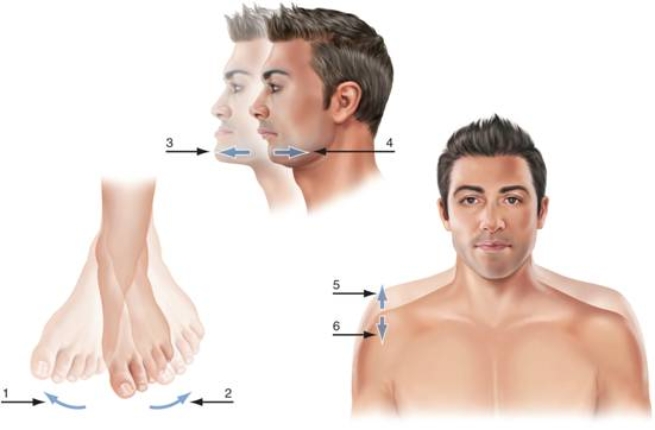 -Numbers 3 and 4 on the figure demonstrate ____.
The production of ________ is a rapid way for muscle to produce energy.
(Short Answer)
4.9/5 (82)
(82) Muscle ________ is a condition in which a muscle has lost its ability to contract. This condition usually develops because of an accumulation of lactic acid.
(Short Answer)
4.9/5 (94)
(94) Muscle fibers in ________ smooth muscle not only respond to neurotransmitters, but also stimulate each other to contract and produce peristalsis.
(Short Answer)
4.9/5 (77)
(77) ________ is a disease that infects skeletal muscles, the heart, the lungs, and the brain and is caused by worms ingested by eating undercooked meat.
(Short Answer)
4.7/5 (84)
(84) The oxygen needed for aerobic respiration is stored in the muscle pigment called ________, which also gives muscle its pinkish color.
(Short Answer)
4.7/5 (81)
(81)
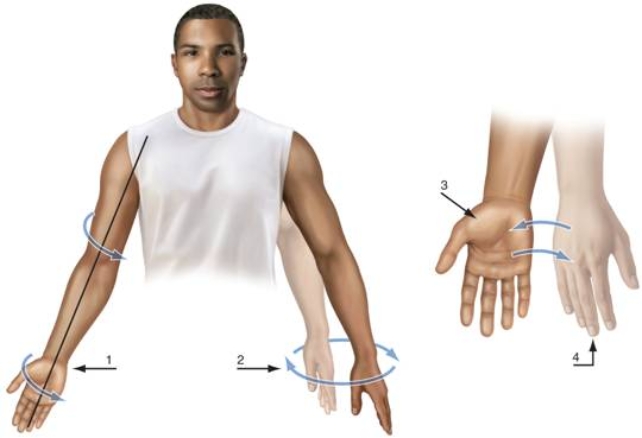
-Supination and pronation are demonstrated by numbers _____.
-Supination and pronation are demonstrated by numbers _____. (Multiple Choice)
4.8/5 (82)
(82) When working with parents of young children who are at risk of botulism, what is the most important instruction to give them to reduce this risk?
(Multiple Choice)
4.9/5 (76)
(76) When facial muscles contract, they produce different kinds of facial ________, such as smiling or frowning.
(Short Answer)
4.9/5 (76)
(76) A mother calls your office about her 8-month-old, who is not very active, has a weak cry, and has not had a wet diaper for 2 days. This mom is known to make homemade baby food. What advice would be appropriate for the medical assistant to give to this mother?
(Multiple Choice)
4.9/5 (77)
(77) Pyruvic acid is converted into acetyl coenzyme A, which begins a series of reactions known as the ________ cycle or the citric acid cycle.
(Short Answer)
4.8/5 (70)
(70) Groups of cardiac muscle are connected to each other through ________ discs that allow the fibers in each group to contract and relax together and allows the heart to work as a pump.
(Short Answer)
4.9/5 (77)
(77) The smooth muscle found in the iris of the eye and the walls of blood vessels, which contracts in response to neurotransmitters and hormones, is known as a ________ smooth muscle.
(Short Answer)
4.8/5 (84)
(84) 
Filters
- Essay(0)
- Multiple Choice(0)
- Short Answer(0)
- True False(0)
- Matching(0)