



 Chat with AI
Exam 28: The Respiratory System

Exam 1: Introduction to Medical Assisting76 Questions
Exam 2: Healthcare and the Healthcare Team80 Questions
Exam 3: Professionalism and Success75 Questions
Exam 4: Interpersonal Communication97 Questions
Exam 5: Legal and Ethical Issues85 Questions
Exam 6: Infection Control Fundamentals74 Questions
Exam 7: Safety and Patient Reception73 Questions
Exam 8: Office Equipment and Supplies155 Questions
Exam 9: Examination and Treatment Areas97 Questions
Exam 10: Written and Electronic Communication84 Questions
Exam 11: Medical Records and Documentation75 Questions
Exam 12: Electronic Health Records72 Questions
Exam 13: Managing Medical Records74 Questions
Exam 14: Telephone Techniques89 Questions
Exam 15: Patient Education75 Questions
Exam 16: Schedule Management80 Questions
Exam 17: Insurance Billing80 Questions
Exam 18: Diagnostic Coding74 Questions
Exam 19: Procedure Coding75 Questions
Exam 20: Patient Collections and Financial Management142 Questions
Exam 21: Organization of the Body145 Questions
Exam 22: The Integumentary System100 Questions
Exam 23: The Skeletal System154 Questions
Exam 24: The Muscular System100 Questions
Exam 25: The Cardiovascular System89 Questions
Exam 26: The Blood74 Questions
Exam 27: The Lymphatic and Immune Systems78 Questions
Exam 28: The Respiratory System91 Questions
Exam 29: The Nervous System130 Questions
Exam 30: The Urinary System91 Questions
Exam 31: The Reproductive Systems124 Questions
Exam 32: The Digestive System112 Questions
Exam 33: The Endocrine System80 Questions
Exam 34: Special Senses92 Questions
Exam 35: Infection Control Practices105 Questions
Exam 36: Patient Interview and History96 Questions
Exam 37: Vital Signs and Measurements93 Questions
Exam 38: Assisting With a General Physical Exam75 Questions
Exam 39: Assisting in Reproductive and Urinary Specialties74 Questions
Exam 40: Assisting in Pediatrics75 Questions
Exam 41: Assisting in Geriatrics75 Questions
Exam 42: Assisting in Other Medical Specialties75 Questions
Exam 43: Assisting in Eye and Ear Care75 Questions
Exam 44: Assisting in Minor Surgery92 Questions
Exam 45: Orientation to the Lab85 Questions
Exam 46: Microbiology and Disease117 Questions
Exam 47: Processing and Testing Urine and Stool Samples95 Questions
Exam 48: Collecting, Processing, and Testing Blood Specimens75 Questions
Exam 49: Electrocardiography and Pulmonary Function Testing94 Questions
Exam 50: Diagnostic Imaging79 Questions
Exam 51: Principles of Pharmacology104 Questions
Exam 52: Math and Dosage Calculations74 Questions
Exam 53: Medication Administration76 Questions
Exam 54: Physical Therapy and Rehabilitation78 Questions
Exam 55: Nutrition and Health90 Questions
Exam 56: Practice Management76 Questions
Exam 57: Emergency Preparedness105 Questions
Exam 58: Preparing for the World of Work76 Questions
Select questions type


Denise is a 24-year-old who has been diagnosed with SARS. She has a fever, headache, and says she just aches all over. She is very worried, though, because she is a single mother and has two young children, ages 3 and 5. She knows that SARS is highly contagious and sometimes fatal, and she does not want to transmit the disease to her children. Which of the following might be your best suggestion for Denise?
(Multiple Choice)
4.8/5  (84)
(84) ____ is a blocked artery in the lungs and is frequently the result of immobility.
(Multiple Choice)
4.8/5 (74)
(74) The opening between the vocal cords (Letter E on the figure) is the ________.
(Short Answer)
4.9/5 (74)
(74) Which of the following is caused by smoking or by exposure to radon, asbestos, or industrial carcinogens?
(Multiple Choice)
4.7/5 (82)
(82) Which of the following conditions may occur when heart function declines and fluid fills spaces of the lungs?
(Multiple Choice)
4.9/5 (81)
(81) 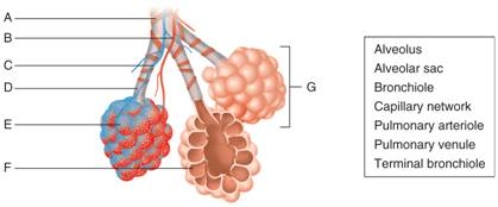 -The structure indicated by the letter F is a(n) ________.
Lung diseases that result from years of exposure to different environmental or occupational types of dust are called ________.
(Short Answer)
4.9/5 (98)
(98) Which of the following does not occur when air enters the lungs?
(Multiple Choice)
4.9/5 (75)
(75) Which of the following allow the lungs to move freely in the thorax due to the secretion of a serous fluid?
(Multiple Choice)
4.9/5 (84)
(84) 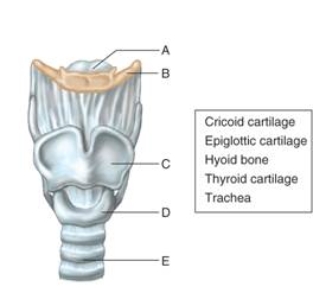 -Letter A in the figure is the ________, which forms the framework for the epiglottis.
 (Short Answer)
4.8/5 (78)
(78) The fatty substance that helps maintain the inflation of the alveoli so that they do not collapse in on themselves between inspirations is called ________.
(Short Answer)
4.8/5 (91)
(91) 
Filters
- Essay(0)
- Multiple Choice(0)
- Short Answer(0)
- True False(0)
- Matching(0)