



 Chat with AI
Exam 32: The Digestive System

Exam 1: Introduction to Medical Assisting76 Questions
Exam 2: Healthcare and the Healthcare Team80 Questions
Exam 3: Professionalism and Success75 Questions
Exam 4: Interpersonal Communication97 Questions
Exam 5: Legal and Ethical Issues85 Questions
Exam 6: Infection Control Fundamentals74 Questions
Exam 7: Safety and Patient Reception73 Questions
Exam 8: Office Equipment and Supplies155 Questions
Exam 9: Examination and Treatment Areas97 Questions
Exam 10: Written and Electronic Communication84 Questions
Exam 11: Medical Records and Documentation75 Questions
Exam 12: Electronic Health Records72 Questions
Exam 13: Managing Medical Records74 Questions
Exam 14: Telephone Techniques89 Questions
Exam 15: Patient Education75 Questions
Exam 16: Schedule Management80 Questions
Exam 17: Insurance Billing80 Questions
Exam 18: Diagnostic Coding74 Questions
Exam 19: Procedure Coding75 Questions
Exam 20: Patient Collections and Financial Management142 Questions
Exam 21: Organization of the Body145 Questions
Exam 22: The Integumentary System100 Questions
Exam 23: The Skeletal System154 Questions
Exam 24: The Muscular System100 Questions
Exam 25: The Cardiovascular System89 Questions
Exam 26: The Blood74 Questions
Exam 27: The Lymphatic and Immune Systems78 Questions
Exam 28: The Respiratory System91 Questions
Exam 29: The Nervous System130 Questions
Exam 30: The Urinary System91 Questions
Exam 31: The Reproductive Systems124 Questions
Exam 32: The Digestive System112 Questions
Exam 33: The Endocrine System80 Questions
Exam 34: Special Senses92 Questions
Exam 35: Infection Control Practices105 Questions
Exam 36: Patient Interview and History96 Questions
Exam 37: Vital Signs and Measurements93 Questions
Exam 38: Assisting With a General Physical Exam75 Questions
Exam 39: Assisting in Reproductive and Urinary Specialties74 Questions
Exam 40: Assisting in Pediatrics75 Questions
Exam 41: Assisting in Geriatrics75 Questions
Exam 42: Assisting in Other Medical Specialties75 Questions
Exam 43: Assisting in Eye and Ear Care75 Questions
Exam 44: Assisting in Minor Surgery92 Questions
Exam 45: Orientation to the Lab85 Questions
Exam 46: Microbiology and Disease117 Questions
Exam 47: Processing and Testing Urine and Stool Samples95 Questions
Exam 48: Collecting, Processing, and Testing Blood Specimens75 Questions
Exam 49: Electrocardiography and Pulmonary Function Testing94 Questions
Exam 50: Diagnostic Imaging79 Questions
Exam 51: Principles of Pharmacology104 Questions
Exam 52: Math and Dosage Calculations74 Questions
Exam 53: Medication Administration76 Questions
Exam 54: Physical Therapy and Rehabilitation78 Questions
Exam 55: Nutrition and Health90 Questions
Exam 56: Practice Management76 Questions
Exam 57: Emergency Preparedness105 Questions
Exam 58: Preparing for the World of Work76 Questions
Select questions type


The mass created in the mouth by food mixed with the saliva and mucus is called a(n) ________.
(Short Answer)
4.8/5  (74)
(74) 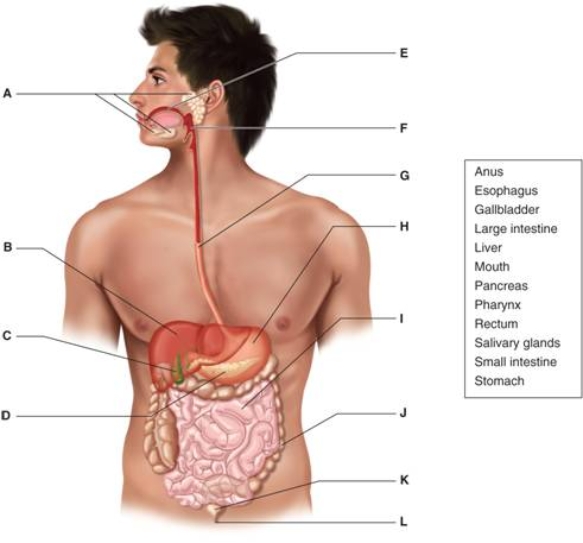 -Letter B on the figure of the digestive system shows the ________.
 (Short Answer)
5.0/5 (83)
(83) The substance produced in the liver that is used in the digestion of fats and is stored in the gallbladder is ________.
(Short Answer)
4.8/5 (75)
(75) Excess glucose is stored in the liver and skeletal muscle cells as ________.
(Short Answer)
4.7/5 (76)
(76) Letter J on the figure of the digestive system indicates the ________.
(Short Answer)
4.8/5 (84)
(84) When an organ pushes through a wall that contains it, a(n) _________ develops.
(Short Answer)
4.8/5 (88)
(88) ____ is a chronic liver disease in which normal tissue is replaced with scar tissue.
(Multiple Choice)
4.8/5 (67)
(67) The salivary glands located in the floor of the mouth just inside the surface of the mandible are the ________ glands.
(Short Answer)
5.0/5 (89)
(89) Mass movements of the large intestine trigger the ________ reflex, which allows anal sphincters to relax and feces to move through the anus in the process of elimination.
(Short Answer)
4.8/5 (81)
(81) Branches of the hepatic ________ carry blood from the digestive organs to the hepatic lobules.
(Short Answer)
4.7/5 (89)
(89) The simple sugars, monosaccharides and ________, are obtained from sweet foods and fruits.
(Short Answer)
4.9/5 (71)
(71) Which of the following enzymes, which breaks down carbohydrates, is contained in saliva?
(Multiple Choice)
4.9/5 (79)
(79) The liver is divided into a large right lobe and a small left lobe, which are divided into smaller parts called hepatic ________ that contain macrophages and hepatocytes.
(Short Answer)
4.9/5 (80)
(80) ____ is the inflammation of abnormal dilations of the intestinal wall.
(Multiple Choice)
4.8/5 (77)
(77) The transverse colon crosses the abdominal cavity and becomes the ________ colon as it runs through the left side of the abdominal cavity.
(Short Answer)
4.8/5 (81)
(81) In the nasopharynx, just above the palatine tonsils, are two masses of lymphatic tissue called the pharyngeal tonsils, or _______, that protect the area from bacteria and viruses.
(Short Answer)
4.9/5 (74)
(74) Letter L on the figure of the digestive system refers to the ________.
(Short Answer)
4.8/5 (67)
(67) The most abundant dietary lipids are ________, which are found in meats, eggs, milk, and butter.
(Short Answer)
4.9/5 (74)
(74) Which organ of the digestive system begins the chemical breakdown of foods?
(Multiple Choice)
4.9/5 (87)
(87) 
Filters
- Essay(0)
- Multiple Choice(0)
- Short Answer(0)
- True False(0)
- Matching(0)