



 Chat with AI
Exam 43: Assisting in Eye and Ear Care

Exam 1: Introduction to Medical Assisting76 Questions
Exam 2: Healthcare and the Healthcare Team80 Questions
Exam 3: Professionalism and Success75 Questions
Exam 4: Interpersonal Communication97 Questions
Exam 5: Legal and Ethical Issues85 Questions
Exam 6: Infection Control Fundamentals74 Questions
Exam 7: Safety and Patient Reception73 Questions
Exam 8: Office Equipment and Supplies155 Questions
Exam 9: Examination and Treatment Areas97 Questions
Exam 10: Written and Electronic Communication84 Questions
Exam 11: Medical Records and Documentation75 Questions
Exam 12: Electronic Health Records72 Questions
Exam 13: Managing Medical Records74 Questions
Exam 14: Telephone Techniques89 Questions
Exam 15: Patient Education75 Questions
Exam 16: Schedule Management80 Questions
Exam 17: Insurance Billing80 Questions
Exam 18: Diagnostic Coding74 Questions
Exam 19: Procedure Coding75 Questions
Exam 20: Patient Collections and Financial Management142 Questions
Exam 21: Organization of the Body145 Questions
Exam 22: The Integumentary System100 Questions
Exam 23: The Skeletal System154 Questions
Exam 24: The Muscular System100 Questions
Exam 25: The Cardiovascular System89 Questions
Exam 26: The Blood74 Questions
Exam 27: The Lymphatic and Immune Systems78 Questions
Exam 28: The Respiratory System91 Questions
Exam 29: The Nervous System130 Questions
Exam 30: The Urinary System91 Questions
Exam 31: The Reproductive Systems124 Questions
Exam 32: The Digestive System112 Questions
Exam 33: The Endocrine System80 Questions
Exam 34: Special Senses92 Questions
Exam 35: Infection Control Practices105 Questions
Exam 36: Patient Interview and History96 Questions
Exam 37: Vital Signs and Measurements93 Questions
Exam 38: Assisting With a General Physical Exam75 Questions
Exam 39: Assisting in Reproductive and Urinary Specialties74 Questions
Exam 40: Assisting in Pediatrics75 Questions
Exam 41: Assisting in Geriatrics75 Questions
Exam 42: Assisting in Other Medical Specialties75 Questions
Exam 43: Assisting in Eye and Ear Care75 Questions
Exam 44: Assisting in Minor Surgery92 Questions
Exam 45: Orientation to the Lab85 Questions
Exam 46: Microbiology and Disease117 Questions
Exam 47: Processing and Testing Urine and Stool Samples95 Questions
Exam 48: Collecting, Processing, and Testing Blood Specimens75 Questions
Exam 49: Electrocardiography and Pulmonary Function Testing94 Questions
Exam 50: Diagnostic Imaging79 Questions
Exam 51: Principles of Pharmacology104 Questions
Exam 52: Math and Dosage Calculations74 Questions
Exam 53: Medication Administration76 Questions
Exam 54: Physical Therapy and Rehabilitation78 Questions
Exam 55: Nutrition and Health90 Questions
Exam 56: Practice Management76 Questions
Exam 57: Emergency Preparedness105 Questions
Exam 58: Preparing for the World of Work76 Questions
Select questions type


The most common eye disorders treated by ophthalmologists are visual ________.
(Short Answer)
4.8/5  (93)
(93) Which of the following can be caused by a bacterial or viral infection?
(Multiple Choice)
4.8/5 (67)
(67) An external hordeolum, which is the result of an eyelash follicle infection, is commonly known as ____.
(Multiple Choice)
4.9/5 (90)
(90) A buildup of earwax in the ear canal is known as ________ impaction.
(Short Answer)
4.8/5 (82)
(82) Which ear disorder is the result of injury from a sharp object, an explosion, a sudden change in air pressure, or severe middle ear infection?
(Multiple Choice)
5.0/5 (69)
(69) A(n) ________ is a specialist who focuses on evaluating and correcting hearing problems.
(Short Answer)
5.0/5 (75)
(75) Which of the following statements about conjunctivitis is not true?
(Multiple Choice)
4.9/5 (77)
(77) A(n) ________ exam is performed to verify the need for corrective lenses.
(Short Answer)
4.8/5 (73)
(73) Fran is in the medical office because of a painful swelling at the edge of her eye. The physician examines it and tells her it is a sty. Which of the following statements might you include in your patient education for Fran?
(Multiple Choice)
4.8/5 (80)
(80) Which of the following is a disturbance in the equilibrium characterized by vertigo and tinnitus?
(Multiple Choice)
4.8/5 (78)
(78) An otology specialist who also specializes in problems affecting the nose and throat is called a(n) ________.
(Short Answer)
4.9/5 (74)
(74) If the audiometer is adjusted to increase the frequency, the sound produced by the audiometer will become ____.
(Multiple Choice)
4.9/5 (74)
(74) Which of the following is indicated by an increase in intraocular pressure caused by a buildup of aqueous humor in the anterior chamber and can result in loss of vision and possible blindness.
(Multiple Choice)
4.8/5 (76)
(76) The branch of medicine specializing in the anatomy and diseases of the eye is ________.
(Short Answer)
4.9/5 (85)
(85) Which condition, commonly called lazy eye, occurs when a child does not use one eye regularly and the eye becomes "lazy' and the brain tends to ignore what the lazy eye sees?
(Multiple Choice)
4.8/5 (71)
(71) An eye should be flushed out, or ________, to wash out foreign materials such as dust, sand, or chemicals.
(Short Answer)
4.7/5 (75)
(75) A(n) ________ is used to examine the eyelids, iris, lens, and cornea, and consists of a magnifying lens combined with a light source.
(Short Answer)
4.7/5 (81)
(81) Di was riding her bicycle when something flew into her left eye. She stopped and tried to get it out, but was unable to do so. She does not want to go to the hospital, but her eye is red and extremely irritated, and she thinks the object is still in her eye. A friend has offered to take her to the doctor. To which of the following specialists should her friend take her?
(Multiple Choice)
4.8/5 (83)
(83) 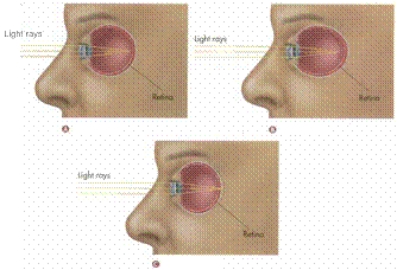 -Letter A in the figure is an example of ________ vision, in which light rays are focused directly on the retina.
 (Short Answer)
4.9/5 (84)
(84) 
Filters
- Essay(0)
- Multiple Choice(0)
- Short Answer(0)
- True False(0)
- Matching(0)