



 Chat with AI
Exam 47: Processing and Testing Urine and Stool Samples

Exam 1: Introduction to Medical Assisting76 Questions
Exam 2: Healthcare and the Healthcare Team80 Questions
Exam 3: Professionalism and Success75 Questions
Exam 4: Interpersonal Communication97 Questions
Exam 5: Legal and Ethical Issues85 Questions
Exam 6: Infection Control Fundamentals74 Questions
Exam 7: Safety and Patient Reception73 Questions
Exam 8: Office Equipment and Supplies155 Questions
Exam 9: Examination and Treatment Areas97 Questions
Exam 10: Written and Electronic Communication84 Questions
Exam 11: Medical Records and Documentation75 Questions
Exam 12: Electronic Health Records72 Questions
Exam 13: Managing Medical Records74 Questions
Exam 14: Telephone Techniques89 Questions
Exam 15: Patient Education75 Questions
Exam 16: Schedule Management80 Questions
Exam 17: Insurance Billing80 Questions
Exam 18: Diagnostic Coding74 Questions
Exam 19: Procedure Coding75 Questions
Exam 20: Patient Collections and Financial Management142 Questions
Exam 21: Organization of the Body145 Questions
Exam 22: The Integumentary System100 Questions
Exam 23: The Skeletal System154 Questions
Exam 24: The Muscular System100 Questions
Exam 25: The Cardiovascular System89 Questions
Exam 26: The Blood74 Questions
Exam 27: The Lymphatic and Immune Systems78 Questions
Exam 28: The Respiratory System91 Questions
Exam 29: The Nervous System130 Questions
Exam 30: The Urinary System91 Questions
Exam 31: The Reproductive Systems124 Questions
Exam 32: The Digestive System112 Questions
Exam 33: The Endocrine System80 Questions
Exam 34: Special Senses92 Questions
Exam 35: Infection Control Practices105 Questions
Exam 36: Patient Interview and History96 Questions
Exam 37: Vital Signs and Measurements93 Questions
Exam 38: Assisting With a General Physical Exam75 Questions
Exam 39: Assisting in Reproductive and Urinary Specialties74 Questions
Exam 40: Assisting in Pediatrics75 Questions
Exam 41: Assisting in Geriatrics75 Questions
Exam 42: Assisting in Other Medical Specialties75 Questions
Exam 43: Assisting in Eye and Ear Care75 Questions
Exam 44: Assisting in Minor Surgery92 Questions
Exam 45: Orientation to the Lab85 Questions
Exam 46: Microbiology and Disease117 Questions
Exam 47: Processing and Testing Urine and Stool Samples95 Questions
Exam 48: Collecting, Processing, and Testing Blood Specimens75 Questions
Exam 49: Electrocardiography and Pulmonary Function Testing94 Questions
Exam 50: Diagnostic Imaging79 Questions
Exam 51: Principles of Pharmacology104 Questions
Exam 52: Math and Dosage Calculations74 Questions
Exam 53: Medication Administration76 Questions
Exam 54: Physical Therapy and Rehabilitation78 Questions
Exam 55: Nutrition and Health90 Questions
Exam 56: Practice Management76 Questions
Exam 57: Emergency Preparedness105 Questions
Exam 58: Preparing for the World of Work76 Questions
Select questions type


The evaluation of urine to obtain information about body health and disease is called a(n) ________.
(Short Answer)
4.7/5  (79)
(79) Renal or urethral obstruction and renal failure can cause ____.
(Multiple Choice)
4.9/5 (64)
(64) A(n) ________ urine specimen contains greater concentrations of substances that collect overnight than do specimens taken during the day.
(Short Answer)
4.8/5 (87)
(87) Which type of catheter is used to collect specimens or to instill medications?
(Multiple Choice)
4.7/5 (74)
(74) Which of the following statements is true about patient collection of a stool sample?
(Multiple Choice)
4.9/5 (78)
(78) Which of the following is a general urine collection guideline?
(Multiple Choice)
4.9/5 (87)
(87) Which of the following is one of the first signs of liver disease?
(Multiple Choice)
4.8/5 (89)
(89) The presence of which of the following in the urine suggests a bacterial infection in the urinary tract?
(Multiple Choice)
4.9/5 (71)
(71) The presence of free hemoglobin in the urine is known as ________, a rare condition caused by transfusion reactions, malaria, drug reactions, snakebites, or severe burns.
(Short Answer)
4.9/5 (88)
(88) The microscopic cast found in urine and pictured here is a(n) ________ cast. 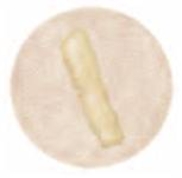
(Short Answer)
4.7/5 (69)
(69) Which of the following is important when obtaining a urine specimen from a patient for drug and alcohol testing?
(Multiple Choice)
4.7/5 (95)
(95) Tyrone has provided a random urine sample, and you are performing a routine urinalysis. The specific gravity of the urine is 1.043. Which of the following conditions might the physician suspect based on this result?
(Multiple Choice)
4.9/5 (89)
(89) In which condition would the odor of urine be characterized as "fruity"?
(Multiple Choice)
4.8/5 (93)
(93) Which type of catheter is inserted after plastic repair of the ureter and must remain in place for at least a week after surgery?
(Multiple Choice)
5.0/5 (99)
(99) In your office, patients collect samples using the patient restroom and leave the samples on the back of the toilet. You send April into the restroom after giving her the collection kit, including three towelettes, and instructing her on how to perform a clean-catch midstream urine specimen. After she returns to the exam room and you go into the restroom to collect the specimen, you notice the three towelette packages, unopened, in the trashcan. What should you do?
(Multiple Choice)
4.9/5 (69)
(69) If the practitioner suspects that a patient has a protozoal or parasitic infection, what type of specimen may be ordered?
(Multiple Choice)
4.7/5 (76)
(76) Which method of collecting a urine specimen is required when performing a urine culture to identify the number and the types of pathogens present?
(Multiple Choice)
4.8/5 (82)
(82) Catheters used to withdraw fluids, including Foley, retention, ureteral, and straight versions, are collectively known as ________ catheters.
(Short Answer)
4.8/5 (79)
(79) 
Filters
- Essay(0)
- Multiple Choice(0)
- Short Answer(0)
- True False(0)
- Matching(0)