



 Chat with AI
Exam 54: Physical Therapy and Rehabilitation

Exam 1: Introduction to Medical Assisting76 Questions
Exam 2: Healthcare and the Healthcare Team80 Questions
Exam 3: Professionalism and Success75 Questions
Exam 4: Interpersonal Communication97 Questions
Exam 5: Legal and Ethical Issues85 Questions
Exam 6: Infection Control Fundamentals74 Questions
Exam 7: Safety and Patient Reception73 Questions
Exam 8: Office Equipment and Supplies155 Questions
Exam 9: Examination and Treatment Areas97 Questions
Exam 10: Written and Electronic Communication84 Questions
Exam 11: Medical Records and Documentation75 Questions
Exam 12: Electronic Health Records72 Questions
Exam 13: Managing Medical Records74 Questions
Exam 14: Telephone Techniques89 Questions
Exam 15: Patient Education75 Questions
Exam 16: Schedule Management80 Questions
Exam 17: Insurance Billing80 Questions
Exam 18: Diagnostic Coding74 Questions
Exam 19: Procedure Coding75 Questions
Exam 20: Patient Collections and Financial Management142 Questions
Exam 21: Organization of the Body145 Questions
Exam 22: The Integumentary System100 Questions
Exam 23: The Skeletal System154 Questions
Exam 24: The Muscular System100 Questions
Exam 25: The Cardiovascular System89 Questions
Exam 26: The Blood74 Questions
Exam 27: The Lymphatic and Immune Systems78 Questions
Exam 28: The Respiratory System91 Questions
Exam 29: The Nervous System130 Questions
Exam 30: The Urinary System91 Questions
Exam 31: The Reproductive Systems124 Questions
Exam 32: The Digestive System112 Questions
Exam 33: The Endocrine System80 Questions
Exam 34: Special Senses92 Questions
Exam 35: Infection Control Practices105 Questions
Exam 36: Patient Interview and History96 Questions
Exam 37: Vital Signs and Measurements93 Questions
Exam 38: Assisting With a General Physical Exam75 Questions
Exam 39: Assisting in Reproductive and Urinary Specialties74 Questions
Exam 40: Assisting in Pediatrics75 Questions
Exam 41: Assisting in Geriatrics75 Questions
Exam 42: Assisting in Other Medical Specialties75 Questions
Exam 43: Assisting in Eye and Ear Care75 Questions
Exam 44: Assisting in Minor Surgery92 Questions
Exam 45: Orientation to the Lab85 Questions
Exam 46: Microbiology and Disease117 Questions
Exam 47: Processing and Testing Urine and Stool Samples95 Questions
Exam 48: Collecting, Processing, and Testing Blood Specimens75 Questions
Exam 49: Electrocardiography and Pulmonary Function Testing94 Questions
Exam 50: Diagnostic Imaging79 Questions
Exam 51: Principles of Pharmacology104 Questions
Exam 52: Math and Dosage Calculations74 Questions
Exam 53: Medication Administration76 Questions
Exam 54: Physical Therapy and Rehabilitation78 Questions
Exam 55: Nutrition and Health90 Questions
Exam 56: Practice Management76 Questions
Exam 57: Emergency Preparedness105 Questions
Exam 58: Preparing for the World of Work76 Questions
Select questions type


 -The type of movement shown by letter B in the picture is ____.
 (Multiple Choice)
4.9/5  (89)
(89) The pulling or stretching of the musculoskeletal system to treat fractured bones and dislocated, arthritic, or other diseased joints is ________.
(Short Answer)
4.8/5 (78)
(78) Which of the following therapies can help prevent atrophy in muscles that cannot move voluntarily by causing the muscles to contract involuntarily and relax?
(Multiple Choice)
4.8/5 (67)
(67) In the dry heat therapy called ________, the patient places the affected body part into a container of glass beads that are heated and agitated with hot air.
(Short Answer)
4.8/5 (88)
(88) Exercises in which the patient relaxes and then contracts the muscles of a body part are ________ exercises.
(Short Answer)
4.7/5 (78)
(78)
-The type of movement shown by letter C in the picture is ____.
-The type of movement shown by letter C in the picture is ____. (Multiple Choice)
4.9/5 (69)
(69) Eleanor is a 44-year-old patient who was brought to the emergency room where you work for treatment of minor injuries from an automobile accident. The physician has ordered an ice pack to be applied to Eleanor's right arm to help reduce swelling and pain. Five minutes after you place the ice on her arm, Eleanor asks you to remove it. She says it is "burning" her arm. You look, but do not see any unusual redness or paleness of the skin. What should you do?
(Multiple Choice)
4.8/5 (72)
(72) Which type of therapy is most likely to be used to help a patient regain muscle strength in a badly injured leg?
(Multiple Choice)
4.8/5 (69)
(69) During thermotherapy, treated skin becomes warm and develops redness, or ________, as the capillaries in the skin's deep layers fill with blood.
(Short Answer)
4.8/5 (84)
(84) Exercises in which the patient works against a counter-pressure to increase muscle strength are ________ exercises.
(Short Answer)
5.0/5 (83)
(83) To stimulate improved circulation, the physician may order ________ baths, in which the patient alternately moves the affected body part from a bath filled with hot water to a bath filled with cold water.
(Short Answer)
4.8/5 (76)
(76) To which of the following professionals is a physician likely to refer a patient to help the patient recover from a stroke?
(Multiple Choice)
4.8/5 (76)
(76) A protractor device called a(n) ________ is used to measure range of motion.
(Short Answer)
5.0/5 (76)
(76) A receptacle for heated wax and mineral oil that is used to reduce pain, muscle spasms, and stiffness in patients with arthritis is a(n) ________ bath.
(Short Answer)
4.8/5 (82)
(82) Applying heat to a patient's body for therapeutic reasons is called ________.
(Short Answer)
4.9/5 (81)
(81) 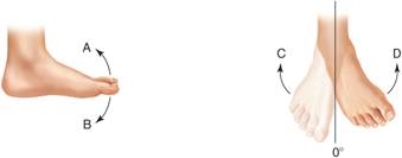 -The type of movement shown by the letter C is ____.
Mrs. Peterson is an 87-year-old patient whose arthritis has been very painful lately. When the practitioner asks if she has been performing the prescribed exercises for the affected joints, she says, "No, because it hurts too much." The practitioner explains that performing the exercises is important to help keep her mobility. Which of the following therapies might help Mrs. Peterson?
(Multiple Choice)
4.9/5 (69)
(69) 
Filters
- Essay(0)
- Multiple Choice(0)
- Short Answer(0)
- True False(0)
- Matching(0)