



 Chat with AI
Exam 7: Capturing Solar Energy: Photosynthesis

Exam 1: An Introduction to Life on Earth91 Questions
Exam 2: Atoms, Molecules, and Life90 Questions
Exam 3: Biological Molecules98 Questions
Exam 4: Cell Structure and Function90 Questions
Exam 5: Cell Membrane Structure and Function96 Questions
Exam 6: Energy Flow in the Life of a Cell90 Questions
Exam 7: Capturing Solar Energy: Photosynthesis101 Questions
Exam 8: Harvesting Energy: Glycolysis and Cellular Respiration91 Questions
Exam 9: The Continuity of Life: Cellular Reproduction90 Questions
Exam 10: Patterns of Inheritance93 Questions
Exam 11: Dna: the Molecule of Heredity90 Questions
Exam 12: Gene Expression and Regulation90 Questions
Exam 13: Biotechnology90 Questions
Exam 14: Principles of Evolution98 Questions
Exam 15: How Populations Evolve110 Questions
Exam 16: The Origin of Species92 Questions
Exam 17: The History of Life119 Questions
Exam 18: Systematics: Seeking Order Amidst Diversity91 Questions
Exam 19: The Diversity of Prokaryotes and Viruses97 Questions
Exam 20: The Diversity of Protists102 Questions
Exam 21: The Diversity of Plants103 Questions
Exam 22: The Diversity of Fungi105 Questions
Exam 23: Animal Diversity I: Invertebrates101 Questions
Exam 24: Animal Diversity Ii: Vertebrates118 Questions
Exam 25: Animal Behavior119 Questions
Exam 26: Population Growth and Regulation116 Questions
Exam 27: Community Interactions124 Questions
Exam 28: How Do Ecosystems Work124 Questions
Exam 29: Earths Diverse Ecosystems126 Questions
Exam 30: Conserving Earths Biodiversity110 Questions
Exam 31: Homeostasis and the Organization of the Animal Body95 Questions
Exam 32: Circulation89 Questions
Exam 33: Respiration92 Questions
Exam 34: Nutrition and Digestion91 Questions
Exam 35: The Urinary System90 Questions
Exam 36: Defenses Against Disease89 Questions
Exam 37: Chemical Control of the Animal Body: the Endocrine System129 Questions
Exam 38: The Nervous System111 Questions
Exam 39: The Senses90 Questions
Exam 40: Action and Support: the Muscles and Skeleton90 Questions
Exam 41: Animal Reproduction117 Questions
Exam 42: Animal Development123 Questions
Exam 43: Plant Anatomy and Nutrient Transport95 Questions
Exam 44: Plant Reproduction and Development90 Questions
Exam 45: Plant Responses to the Environment87 Questions
Select questions type


Hydrogen ions cross the thylakoid membranes from the stroma by:
(Multiple Choice)
4.7/5  (83)
(83) Some plants, called the ________ plants, have evolved a way to reduce photorespiration.
(Essay)
4.9/5 (77)
(77) Imagine that, similar to events that occurred 65 million years ago, a huge meteorite were to hit Earth tomorrow, spewing cloudy debris into the atmosphere and blocking a large proportion of sunlight. Because plants rely on sunlight, global rates of photosynthesis would be greatly reduced, and many of the animals that depend on photosynthetic plants (such as herbivores and the predators that fed on those herbivores)would starve or go extinct.
In this scenario, why can't the plants continue to produce sugars and survive if the sugar-producing reactions in photosynthesis are considered "light independent"?
(Essay)
4.8/5 (76)
(76) The energy of the movement of electrons down a concentration gradient via electron transport within chloroplasts and mitochondria is used to generate molecules of:
(Multiple Choice)
4.9/5 (79)
(79) Which of the following occurs during the Calvin cycle of photosynthesis?
(Multiple Choice)
4.9/5 (99)
(99) The primary function of the light reactions of photosynthesis is to:
(Multiple Choice)
4.7/5 (84)
(84) You are carrying out an experiment on several aquatic plants in your fish tank. You decide to expose two of the plants to green light and two to blue light. You want to determine which type of light is best for the light reactions, so you decide to record the amount of oxygen bubbles produced to reach your conclusions. Which of the following results would be expected?
(Multiple Choice)
4.8/5 (76)
(76) Specifically, molecules of chlorophyll are located in the membranes of sacs called:
(Multiple Choice)
4.9/5 (82)
(82) The stacked thylakoids are disk-shaped, interconnected membranous sacs embedded in the stroma. True or False?
(True/False)
4.8/5 (78)
(78) What is produced in the electron transport system associated with photosystem II?
(Multiple Choice)
4.8/5 (75)
(75) Based on the information provided in this figure, what event contributes directly to the creation of a proton gradient across the thylakoid membrane? 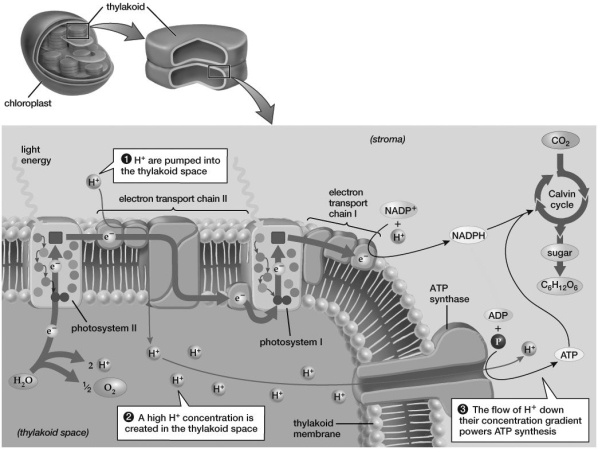
(Multiple Choice)
4.8/5 (85)
(85) Imagine that a plant in your garden doesn't receive an adequate amount of water. Which of the following would be most affected by this?
(Multiple Choice)
4.8/5 (73)
(73) Imagine that a scientist discovers a mutant plant seedling that appears to lack stomata. What would be the effect of this?
(Multiple Choice)
4.7/5 (73)
(73) Give the simplest chemical equation for photosynthesis. For each reactant, indicate where the plant acquires it. For each product, note during what part of photosynthesis it is produced.
(Essay)
4.7/5 (82)
(82) What is photorespiration? Describe how C4 plants have evolved the ability to reduce photorespiration.
(Essay)
4.9/5 (85)
(85) In green plants, the primary function of the Calvin cycle is to:
(Multiple Choice)
4.9/5 (80)
(80) The pigment(s)that absorb light energy to drive photosynthesis is/are:
(Multiple Choice)
4.7/5 (82)
(82) 
Filters
- Essay(0)
- Multiple Choice(0)
- Short Answer(0)
- True False(0)
- Matching(0)