



 Chat with AI
Exam 18: Systematics: Seeking Order Amidst Diversity

Exam 1: An Introduction to Life on Earth91 Questions
Exam 2: Atoms, Molecules, and Life90 Questions
Exam 3: Biological Molecules98 Questions
Exam 4: Cell Structure and Function90 Questions
Exam 5: Cell Membrane Structure and Function96 Questions
Exam 6: Energy Flow in the Life of a Cell90 Questions
Exam 7: Capturing Solar Energy: Photosynthesis101 Questions
Exam 8: Harvesting Energy: Glycolysis and Cellular Respiration91 Questions
Exam 9: The Continuity of Life: Cellular Reproduction90 Questions
Exam 10: Patterns of Inheritance93 Questions
Exam 11: Dna: the Molecule of Heredity90 Questions
Exam 12: Gene Expression and Regulation90 Questions
Exam 13: Biotechnology90 Questions
Exam 14: Principles of Evolution98 Questions
Exam 15: How Populations Evolve110 Questions
Exam 16: The Origin of Species92 Questions
Exam 17: The History of Life119 Questions
Exam 18: Systematics: Seeking Order Amidst Diversity91 Questions
Exam 19: The Diversity of Prokaryotes and Viruses97 Questions
Exam 20: The Diversity of Protists102 Questions
Exam 21: The Diversity of Plants103 Questions
Exam 22: The Diversity of Fungi105 Questions
Exam 23: Animal Diversity I: Invertebrates101 Questions
Exam 24: Animal Diversity Ii: Vertebrates118 Questions
Exam 25: Animal Behavior119 Questions
Exam 26: Population Growth and Regulation116 Questions
Exam 27: Community Interactions124 Questions
Exam 28: How Do Ecosystems Work124 Questions
Exam 29: Earths Diverse Ecosystems126 Questions
Exam 30: Conserving Earths Biodiversity110 Questions
Exam 31: Homeostasis and the Organization of the Animal Body95 Questions
Exam 32: Circulation89 Questions
Exam 33: Respiration92 Questions
Exam 34: Nutrition and Digestion91 Questions
Exam 35: The Urinary System90 Questions
Exam 36: Defenses Against Disease89 Questions
Exam 37: Chemical Control of the Animal Body: the Endocrine System129 Questions
Exam 38: The Nervous System111 Questions
Exam 39: The Senses90 Questions
Exam 40: Action and Support: the Muscles and Skeleton90 Questions
Exam 41: Animal Reproduction117 Questions
Exam 42: Animal Development123 Questions
Exam 43: Plant Anatomy and Nutrient Transport95 Questions
Exam 44: Plant Reproduction and Development90 Questions
Exam 45: Plant Responses to the Environment87 Questions
Select questions type


Canis latrans, Canis lupus, and Canis familiaris are all members of the same:
(Multiple Choice)
4.7/5  (61)
(61) Which biologist first proposed that all organisms share a common ancestry?
(Multiple Choice)
4.8/5 (79)
(79) If genetic studies reveal that a population has genetic sequences in common with two closely related species but has no unique sequences of its own, then:
(Multiple Choice)
5.0/5 (75)
(75) The virus most closely related to HIV preys on monkeys. True or False?
(True/False)
4.8/5 (63)
(63) The diversity of a population of bacteria can be determined best by examining:
(Multiple Choice)
4.8/5 (65)
(65) What is the main reason scientists use Latin scientific names?
(Multiple Choice)
4.9/5 (92)
(92) 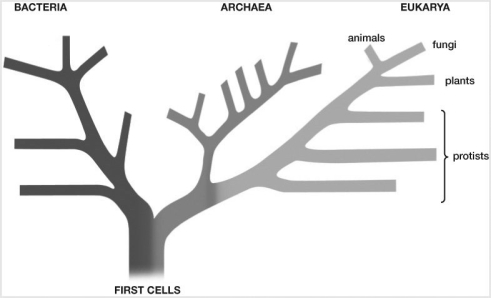 -Based on the tree of life, which two groups have the closest ancestor in common?
 (Multiple Choice)
4.9/5 (69)
(69) Suppose a population of a new plant is found on an island. DNA sequencing determines that this plant shares a limited number of genes with plants on the mainland. Within the species, there is a huge genetic variability. This would suggest that:
(Multiple Choice)
4.7/5 (81)
(81) Which of the following is the smallest or least inclusive group?
(Multiple Choice)
4.7/5 (77)
(77) 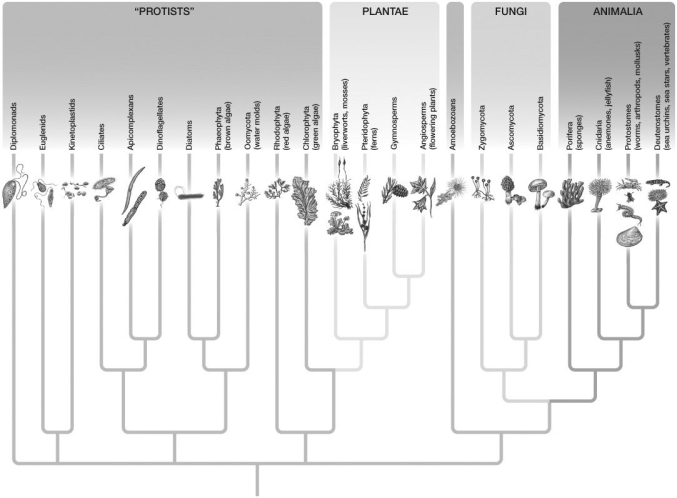 -Based on the eukaryotic tree, Deuterostomes are most closely related to:
 (Multiple Choice)
4.8/5 (83)
(83)
-According to chemical and molecular evidence, members of the kingdom Fungi are most closely related to which of these groups in the tree of life?
-According to chemical and molecular evidence, members of the kingdom Fungi are most closely related to which of these groups in the tree of life? (Multiple Choice)
4.9/5 (79)
(79) Historically, most classification has been based on ________ similarity.
(Essay)
4.8/5 (84)
(84) 
Filters
- Essay(0)
- Multiple Choice(0)
- Short Answer(0)
- True False(0)
- Matching(0)